

Affordable Bulking Diet Plan South Africa: Build Muscle on a Budget in 2026
Your bulking diet doesn’t have to rely on pricey cuts of meat or a cupboard full of supplements. An affordable bulking diet plan south africa can start with familiar staples, planned portions and a small number of carefully chosen products.
When food costs are tight, getting enough energy and protein each day can feel like a trade-off. It’s reasonable to question whether expensive supplements deliver better value and whether budget meals can support your training goals. Focus on the cost of each useful serving, not flashy packaging.
This guide shows you how to build a practical shopping list around South African staples such as oats, rice, eggs, beans and lentils, then organise them into a workable day of meals. You’ll also learn how to compare whey protein by the cost per gram of protein and why creatine can be a cost-effective performance supplement. Bulk, lab-tested ingredients can complement your meals without taking over your budget.
Use the plan as a starting point, adjust portions to suit your appetite and training needs, and make consistency the priority.
Key Takeaways
- Build a controlled calorie surplus and prioritise consistency over costly ingredients or complicated meal rules.
- Organise an affordable bulking diet plan south africa around versatile staples, planned portions and bulk buying where it makes sense.
- Compare supplements by protein or active ingredient per serving, along with ingredient quality. Bulk, lab-tested options can help fill gaps when meal preparation is difficult.
- Adapt the sample 3,000-calorie meal structure to your workday, appetite and training needs rather than treating it as a fixed prescription.
- Keep costs and progress on track with balanced food choices, adequate sleep and recovery.
The Fundamentals of an Affordable Bulking Strategy
Bulking is a planned phase of eating slightly more energy than your body uses, while following resistance training to support muscle growth. The aim isn’t to eat as much as possible. It’s to provide enough energy and nutrients to train, recover and gradually build muscle. Training remains the key stimulus, so pair your eating plan with consistent sessions and sound technique. For a useful overview, read The fundamentals of strength training.
For an affordable bulking diet plan south africa, compare foods by their value per rand: the energy and protein you get for the amount you spend. Premium ingredients aren’t essential. Affordable staples can form the dependable base of your meals, while protein-rich foods help you work towards your daily target. A plan you can follow week after week is more useful than an expensive menu you can’t sustain.
Calculating Your Caloric Surplus on a Budget
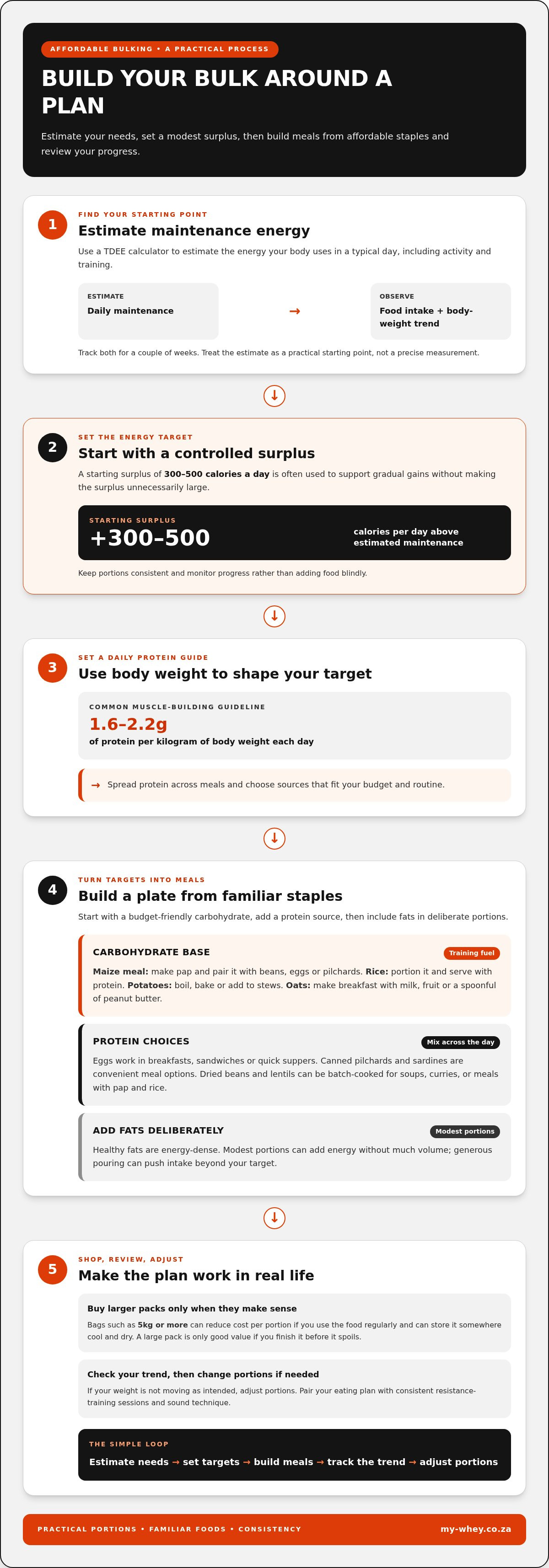
Your Total Daily Energy Expenditure (TDEE) is the energy your body uses in a typical day, including activity and training. Estimate your maintenance needs with a TDEE calculator, then track your food intake and body-weight trend for a couple of weeks. This helps you see whether the estimate fits your routine. Treat it as a practical starting point, not a precise measurement.
A caloric surplus for muscle growth means eating more energy than your body uses each day, giving it additional fuel to support training and muscle gain. A starting surplus of 300–500 calories a day is often used to support gradual gains without making the surplus unnecessarily large. Keep portions consistent and monitor your progress. If your weight isn’t moving as intended, adjust your portions rather than adding food blindly.
The Macro-nutrient Split: Protein, Carbs, and Fats
Use your body weight to set a protein target: a common muscle-building guideline is 1.6–2.2g of protein per kilogram of body weight each day. Spread protein across meals and use sources that fit your budget and routine. Protein quality matters, but consistently getting a realistic daily amount matters too.
Carbohydrates are often the budget-friendly workhorse of a bulking diet. They provide training fuel and make it easier to raise your calorie intake with familiar foods. Build meals around affordable carbohydrate staples, then add a protein source. You don’t need every meal to be elaborate.
Include healthy fats as well. They contribute to normal hormone production and are energy-dense, so modest portions can help increase meal calories without adding much volume. Use them deliberately: too little can make meals less satisfying, while generous pouring can push your intake beyond your target. Aim for a workable balance of protein, carbohydrates and fats, not a perfect-looking plate.
Sourcing Cheap Calories: The South African Grocery List
A budget-friendly shop starts with foods that are easy to find, versatile and simple to prepare in batches. Maize meal, rice, potatoes, oats, eggs, dried beans and lentils can form the backbone of an affordable bulking diet plan south africa. Add other ingredients for variety and nutritional balance. South Africa’s food-based dietary guidelines also recognise locally available foods such as beans and lentils as part of a balanced diet.
Buying larger bags, such as 5kg or more, can reduce the cost per portion if you use the food regularly and have somewhere cool and dry to store it. A bigger pack is only good value if you’ll finish it before it spoils. Plan meals first, compare pack sizes and keep a simple record of what you actually use.
Complex Carbohydrates: The Engine of Your Bulk
Maize meal makes familiar, filling pap and is an accessible way to add energy to meals. Pair it with beans, eggs or pilchards rather than relying on pap alone. Bulk white rice is easy to portion and works with a range of proteins. Potatoes offer another flexible option, whether boiled, baked or added to stews. Oats bring fibre to breakfast and can be prepared with milk or mixed with fruit or a spoonful of peanut butter for a more substantial meal.
These foods contribute energy alongside nutrients, making them useful staples for a bulk. Adjust portions to your appetite and training needs, and include vegetables or fruit where your budget allows. Aim for a calorie surplus based on nourishing foods, not a plate dominated by low-nutrient snacks.
Budget-Friendly Protein Sources
Eggs are practical, versatile and provide protein. A tray of 30 can make meal planning easier if you eat them regularly. Use them in breakfasts, sandwiches or quick suppers, and store them safely. Canned pilchards and sardines provide protein as well as omega-3 fatty acids, making them convenient for meals when there’s little time to cook.
Dried beans and lentils are useful pantry staples. They supply protein and fibre, can be cooked in batches, and work in soups, curries or alongside pap and rice. Combine different sources across the day to keep meals varied. Choose nutrient-dense staples most of the time; relying heavily on sugary drinks and snack foods can add calories without the same nutritional contribution.
Build your shopping list around foods you’ll genuinely eat, then fill any remaining protein gaps with a convenient option such as bulk whey protein.
Supplementing for Efficiency: Why Bulk Purity Matters
Supplements can be a practical backup when meal preparation gets difficult or food alone doesn’t comfortably meet your protein needs. They’re not a replacement for a balanced diet, and they don’t need to make an affordable bulking diet plan south africa expensive. Compare the amount of useful protein or active ingredient you get for the price, rather than judging a product by its tub, branding or list of added ingredients.
Retail supplements often come in branded packaging and may include flavourings, sweeteners or blends. Bulk ingredients focus on the ingredient itself, which can help keep the cost per serving down. That doesn’t make every retail product poor value or every bulk ingredient suitable. Read the label, check the stated composition, and prioritise purity and lab testing over elaborate claims. My Whey’s bulk approach centres on lab-tested ingredients and less packaging.
For a closer look at whey protein and how to assess it, read this guide to whey protein science, benefits and selection.
The Cost-Effectiveness of Whey Protein Concentrate 80%
Compare protein by the gram, not just the tub price. Whey Protein Concentrate 80% can cost less per gram of protein than many meats, especially when bought in bulk. When comparing it with a mass gainer, check the protein and calorie content per serving. A gainer may include substantial carbohydrate, which can be useful if you need extra energy, but it isn’t automatically the most efficient choice for meeting a protein target.
Unneeded fillers or sweeteners can add cost without helping you meet your nutrition goal. Keep flavour simple: blend whey with milk, oats, banana or cocoa, using ingredients you already buy.
Creatine Monohydrate: A Practical Performance Choice
Creatine monohydrate is one of the most extensively studied sports supplements and a cost-effective option for supporting performance during repeated high-intensity efforts. Better training capacity can help you work towards strength and muscle-building goals, but creatine isn’t a substitute for consistent training, food and recovery. It’s often regarded as one of the most affordable performance-enhancing supplements.
Choose creatine monohydrate for a straightforward ingredient profile. Buying a larger quantity may improve value if you’ll use it consistently and store it properly. Micronised forms are designed to mix more readily, but don’t assume micronised creatine is necessary for results or that every bulk product has this specification. Check the label and prioritise purity and testing over extras. For a budget-conscious plan, simple and well-chosen is enough.
A Sample 3,000-Calorie Daily Plan for Mass
This example gives you a practical workday structure without requiring six small meals or hard-to-find ingredients. The calorie figures are estimates, not exact prescriptions: brands, cooking methods and portion sizes change the total. Use food labels and your usual portions to bring the day close to 3,000 calories, then adjust to your appetite, activity and weight trend. An affordable bulking diet plan south africa should fit your routine, not make meal preparation a second job.
Breakfast and Pre-Workout Fuelling
Breakfast, approximately 700 calories: Prepare a large bowl of oats with milk, a serving of Whey Protein Concentrate 80%, a banana and a spoonful of peanut butter. This combines carbohydrates, protein and energy in a convenient breakfast. If you train later, have the banana or another carbohydrate-rich snack before your session. The timing and portion should suit your comfort during exercise.
High-Volume Lunches and Dinners
- Lunch, approximately 800 calories: Pack cooked rice, chicken or beans, vegetables and a measured drizzle of oil. Use the plate as a simple guide: roughly half carbohydrates, a quarter protein and a quarter vegetables.
- Workday snack, approximately 500 calories: Make a peanut butter sandwich and add fruit, or have a whey shake alongside a familiar carbohydrate snack if you need a portable option.
- Dinner, approximately 1,000 calories: Serve pap or potatoes with pilchards, eggs, chicken or beans, plus vegetables. Adjust the portions to reach your daily target rather than forcing down an uncomfortably large meal.
These meal estimates total about 3,000 calories, but treat them as a starting framework. Peanut butter and cooking oil can raise energy intake without adding much food volume, so measure them rather than pouring freely. If you’re short on calories, increase a staple portion modestly.
Save time and avoid last-minute convenience food by preparing rice or pap, a protein source and vegetables for three days at a time. Store portions safely, keep the menu flexible, and prepare oats or a shake quickly on mornings when cooking isn’t practical.
Drink regularly throughout the day, especially around training and in hot conditions. Adequate hydration supports normal performance, while muscle glycogen is stored with water and can affect how full muscles look. Water isn’t a substitute for calories or protein, so keep meals consistent too.
Make Whey Protein Concentrate 80% part of your routine with bulk whey protein options.
Optimising Gains and Avoiding Hidden Costs
A useful bulk is measured by steady progress, not by how quickly you increase your calorie intake. A “clean bulk” uses mostly nutrient-dense foods and a controlled surplus; a “dirty bulk” relies heavily on foods with little nutritional value and can make it easier to overshoot your energy needs. Rapid weight gain may mean more fat gain alongside muscle, potentially leaving you with a longer, less comfortable cutting phase. Keep your plan practical and balanced instead.
Recovery matters, too. Sleep gives your body time to recover from training, while rest days help you manage fatigue and maintain consistent sessions. These habits don’t add to your grocery bill, but they support the work you’re already putting into your training and meals. More training isn’t automatically better if you can’t recover from it.
Managing Digestion and Nutrient Absorption
Increasing food intake can leave you feeling overly full or uncomfortable, especially if you suddenly make meals much larger. Raise portions gradually and spread food across meals that fit your day. Fibre from oats, beans and vegetables supports healthy digestion, but increase high-fibre foods progressively and drink enough fluids. This can make a higher-calorie routine more comfortable and sustainable.
Gut health is part of the bigger picture: digestive discomfort can affect appetite, energy and your ability to stick to regular meals, which may disrupt training and recovery. It doesn’t mean you need a supplement to absorb your food. Start with varied meals, adequate fluids and a routine you tolerate. For more on this topic, explore gut health supplements South Africa.
Long-Term Sustainability: Tracking and Adjusting
You don’t need body-fat scans to judge whether your approach is working. Use a bathroom scale to track body weight under similar conditions, note your gym performance, and check how clothes fit or take occasional progress photos. Look at trends over several weeks rather than reacting to daily fluctuations.
If your weight and training performance remain unchanged over several weeks, add a modest portion to your daily meals and keep monitoring. If weight is rising faster than you want, or your waist is increasing quickly, hold your intake steady or make a small reduction. Keep adjustments measured; large swings make it harder to learn what works.
Patience is the most affordable part of a bulk: gradual progress helps you make better use of your food, training and recovery without spending to chase quick changes.
Build Your Bulk with a Plan You Can Sustain
Building muscle on a budget doesn’t require premium groceries or a complicated supplement routine. A steady calorie surplus built around affordable South African staples, sensible portions and consistent training gives you a practical foundation. Plan meals ahead, track your progress over time and adjust gradually rather than spending more in pursuit of quick results.
Use supplements to fill genuine gaps in your routine. Bulk Whey Protein Concentrate 80% can help you meet protein needs conveniently, while creatine monohydrate offers a straightforward addition to a considered training plan. Choose products for ingredient quality and value, not packaging alone. My Whey focuses on lab-tested purity, raw ingredients and no-nonsense bulk pricing.
Ready to make your affordable bulking diet plan south africa easier to follow? Shop purity-tested bulk supplements at My Whey and choose ingredients that fit your goals. Stay patient, keep your meals and training consistent, and build progress one manageable day at a time.
Frequently Asked Questions
Is it possible to bulk on a budget in South Africa with current food prices?
Yes, you can build a budget-conscious bulk by planning meals around affordable staples and adjusting portions to your needs. Base your shopping on versatile foods such as maize meal, oats, rice, potatoes, eggs, beans and lentils, then compare pack sizes and buy larger quantities of items you use regularly. Prepare meals ahead to reduce reliance on convenience food. Track your intake and progress, and adapt your shopping list as prices and priorities change.
What are the cheapest protein sources for muscle gain in South Africa?
Dried beans, lentils and eggs are practical lower-cost protein staples, while canned pilchards can add variety and protein to meals. Compare foods by protein per portion and cost, rather than assuming meat is always the best value. Use several sources across the day, such as beans with pap or eggs with oats. Bulk whey protein can also be a convenient option; compare its protein value with the foods you usually buy.
Are bulk supplements better than retail brands for building muscle?
Not automatically. A bulk supplement may offer better value if it provides the ingredient you need without elaborate packaging or extras, but judge the product by its label, purity and testing rather than format alone. Compare cost per serving and the amount of relevant ingredient. My Whey focuses on lab-tested supplements and bulk pricing. Supplements can support a consistent diet, but they don’t replace suitable meals and training.
How much weight should I aim to gain per week whilst bulking?
Aim for gradual, consistent weight gain rather than a rapid jump, which can mean gaining more fat alongside muscle. There isn’t one weekly target that suits everyone, since starting weight, training experience and energy needs differ. Weigh yourself under similar conditions and look at the trend over several weeks, not one reading. If weight stays flat, make a small increase to food portions; if it rises faster than you want, hold steady or reduce slightly.
Can I use maize meal (pap) as my primary carbohydrate for bulking?
Yes, pap can be a main carbohydrate in a bulking diet, providing an accessible, versatile base for meals. For balance, pair it with a protein source such as eggs, beans, lentils, chicken or pilchards, and add vegetables where practical. You don’t need to rely on pap alone: oats, rice and potatoes can add variety and suit different meals. Choose portions that help meet your energy needs without crowding out other nourishing foods.
Is creatine monohydrate safe for beginners on a budget?
Creatine monohydrate is a widely studied supplement and a straightforward option for people considering sports nutrition, but suitability depends on personal health and circumstances. Beginners don’t need an expensive stack to start training; prioritise food, a sensible training routine and recovery first. Choose a clearly labelled product and follow its directions. If you have a medical condition, take medication, or are unsure whether creatine is appropriate for you, speak with a healthcare professional.
How do I avoid gaining too much fat during a bulking phase?
Use a modest calorie surplus, choose mostly nutrient-dense foods and monitor your weight trend, waist measurement and training performance over time. Don’t respond to a single weigh-in by sharply changing your intake. If your weight or waist is rising faster than you’re comfortable with, hold calories steady or reduce portions slightly. Keep resistance training consistent and allow enough time for recovery. A controlled approach is easier to adjust than a large, unmonitored surplus.
Do I really need whey protein if I eat enough eggs and chicken?
No. If meals already provide enough protein for your needs, whey protein isn’t essential. Eggs, chicken, beans, lentils and other foods can all contribute to your daily total. Whey Protein Concentrate 80% is a convenient option when meal preparation is difficult or food intake falls short, and bulk whey can be worth comparing by protein per gram. Treat it as a practical supplement, not a requirement for building muscle.