

Agmatine Sulfate Dosage for Workout: What the Evidence Says
A workout dose can sound precise without being supported by strong evidence. If you’re comparing conflicting recommendations for agmatine sulfate dosage for workout, the key point is that published guidance doesn’t establish one proven amount for everyone.
It’s understandable to want a clear answer, especially when supplement labels and fitness articles give different directions on dose and timing. Human research on agmatine for exercise performance remains limited, so commonly repeated workout recommendations shouldn’t be mistaken for a clinically established protocol.
This guide separates commercial dosing claims from what human evidence can support. You’ll learn what’s known about pre-workout timing, taking agmatine with or without food, and whether there’s evidence to use it on rest days. We’ll also cover potential side effects and why medication use can make professional advice important. The aim is a practical, cautious decision based on evidence rather than hype. As with any supplement, clear ingredient information and careful attention to product quality matter.
Key Takeaways
- Learn why a supplement’s suggested serving isn’t automatically a clinically established workout dose.
- See how agmatine sulfate dosage for workout claims compare with the limited human research available.
- Assess pre-workout timing and empty-stomach advice without assuming either guarantees better results.
- Use a label checklist to review serving size, active ingredients and manufacturer directions before making a decision.
- Weigh potential safety considerations and prioritise training, sleep, hydration and an appropriate diet before optional performance ingredients.
Agmatine sulfate dosage for workout: what the question means
“How much should I take?” sounds straightforward, but a workout dose involves more than a number on a label. It could mean the amount per serving, when to take it, whether to use it only on training days and what outcome it’s meant to support. Those details matter because a commercial recommendation isn’t automatically a dose established through clinical research.
Research has not established a universal agmatine sulfate dose for workouts. Human research is limited, and studies investigating other possible uses don’t establish an effective exercise dose. An overview of Agmatine describes its biological pathways and areas of investigation, but that background isn’t proof of improved training performance.
What is agmatine sulfate?
Agmatine is a compound the body can form from L-arginine, an amino acid. “Agmatine sulfate” refers to agmatine supplied in a sulfate form in a supplement. It isn’t a protein or a branched-chain amino acid, and it shouldn’t be presented as a proven muscle-building ingredient. For a clearer distinction between supplement categories, see this guide to branched-chain amino acids.
Why do workout articles recommend it?
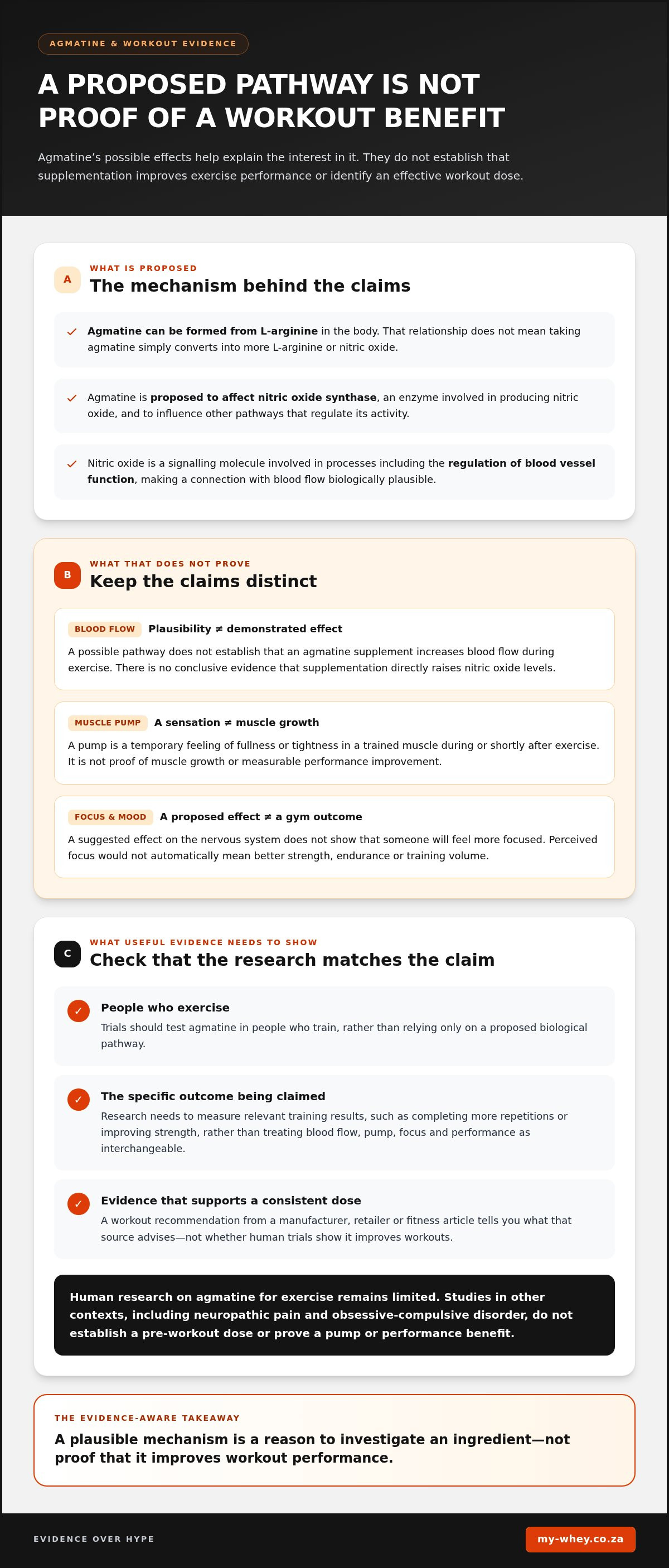
Workout discussions often focus on a possible muscle “pump”, focus or nitric oxide-related effects. These are proposed benefits, not guaranteed outcomes. Agmatine is suggested to influence nitric oxide pathways, but a possible mechanism doesn’t show that taking it will improve gym performance. Changes in nitric oxide signalling, blood flow, a perceived pump and measurable improvements in strength or endurance are not interchangeable outcomes.
That distinction helps make sense of the dose question. A recommendation might come from a manufacturer’s suggested serving, a retailer’s guidance or a fitness article repeating a commonly used protocol. It tells you what that source advises, but not whether the amount has been shown to improve workouts in human trials. To establish that, research would need to test agmatine in people exercising, measure relevant training outcomes and provide enough evidence to support a consistent dose. The available human evidence doesn’t provide that foundation for a universal workout protocol.
Agmatine has also been investigated in human research for contexts such as neuropathic pain and obsessive-compulsive disorder. Those studies address different questions and populations. Their doses and findings can’t simply be transferred to pre-workout use or treated as proof of a pump or performance benefit. Keep the categories separate: proposed mechanisms may help explain why an ingredient attracts interest, while workout-specific evidence determines what can responsibly be claimed about exercise.
How agmatine is proposed to work, and what that proves
Agmatine’s proposed effects are often explained through nitric oxide, blood flow and the nervous system. These ideas help explain why it attracts interest as a workout supplement. They don’t, on their own, show that taking agmatine improves exercise performance or establish an effective dose.
Agmatine, L-arginine and nitric oxide
The body can form agmatine from L-arginine, but that relationship doesn’t mean taking agmatine simply converts into more L-arginine or nitric oxide. Agmatine is proposed to affect nitric oxide synthase, an enzyme involved in producing nitric oxide, and to influence other pathways that regulate its activity. The effects in the body are complex, and there’s no conclusive evidence that supplementation directly raises nitric oxide levels.
Nitric oxide is a signalling molecule involved in processes including the regulation of blood vessel function. That makes a link with blood flow biologically plausible, but it doesn’t establish that an agmatine supplement increases blood flow during exercise. Even a demonstrated change in a pathway would still need to be connected to a meaningful outcome, such as completing more repetitions or improving strength. A proposed pathway also can’t tell us what amount, if any, would produce that outcome.
Pump, focus and performance are different claims
A muscle pump is the temporary feeling of fullness or tightness in a trained muscle during or shortly after exercise. It can be part of the workout experience, but it isn’t proof of muscle growth or measurable improvement in performance. Blood flow, the sensation of a pump and lasting changes in training results are related ideas, not interchangeable evidence.
Focus and mood claims need separate consideration, too. A proposed effect on the nervous system doesn’t show that a person will feel more focused in the gym, and a change in perceived focus wouldn’t automatically mean better strength, endurance or training volume. Each claim needs appropriate human research measuring that specific outcome.
A plausible biological mechanism is a reason to investigate an ingredient, not proof that it improves workout performance. To support an exercise claim, human trials would need to test agmatine in people who train and report relevant outcomes, rather than relying on a pathway explanation or results from a different context. Without that evidence, treat pump, focus and performance statements as claims with important gaps, not established benefits.
Use the same standard when evaluating any pre-workout ingredient: look for clear labels and evidence that matches the promised outcome. If you’re comparing options, you can also explore My Whey’s broader supplement range as part of a considered approach to nutrition.
Agmatine sulfate dose claims compared with human evidence
Workout advice and human research can both mention a dose, but that doesn’t mean they provide evidence for the same use. One may describe a pre-training routine; the other may report an amount used while investigating a health condition. For agmatine sulfate dosage for workout, this distinction is central: neither a commercial protocol nor a dose studied for another purpose establishes an effective exercise dose.
What pre-workout dosing advice says
Gaspari Nutrition’s article recommends 500-1,000 mg, taken 20-30 minutes before training on an empty stomach. That’s the recommendation from that source, not a universal standard. Specific timing and fasting instructions may sound precise, but precision alone doesn’t show that a protocol has been validated in human exercise trials or improves workout results.
Recommendations can differ between articles and product labels. Treat each as source-specific guidance, not evidence that manufacturers or researchers agree. The comparison below shows why the context behind a dose matters.
| Source or context | Reported guidance or dose | What it tells you |
|---|---|---|
| Gaspari Nutrition workout article | 500-1,000 mg, 20-30 minutes before training, on an empty stomach | A commercial pre-workout recommendation, not proof of an effective or clinically established workout protocol. |
| Human research summarised by Examine | 1,300-2,670 mg daily in research concerning neuropathic pain | A reported range in a different research context, not workout-dose guidance. |
| Human exercise evidence | No universal workout dose established | The available information doesn’t provide a reliable basis for choosing a performance dose. |
Why other human-study doses don’t answer the workout question
Examine reports a range of 1,300-2,670 mg daily in research on neuropathic pain. A dose studied for neuropathic pain does not establish a workout dose. The research question, participant population, length of use and outcomes all affect whether findings can apply elsewhere. A dose investigated in people receiving treatment for pain can’t simply be transferred to healthy people exercising or interpreted as support for a pump, strength or endurance benefit.
Before relying on precise study figures, verify them against the original research. A summary is useful for orientation, but the study itself is needed to confirm the dose, duration, participants and measured outcomes. Those details can change how a number should be understood.
Don’t combine, average or select between these figures to create a personal routine. The Gaspari recommendation and the neuropathic-pain research range answer different questions. At present, the evidence gap is workout-specific: without suitable human exercise trials, these figures don’t establish a proven agmatine sulfate dose for training.
How to assess timing, labels and safety before use
A label can tell you how a manufacturer intends a supplement to be used. It can’t, by itself, show that its suggested timing or serving has been proven to improve workouts. Before considering agmatine sulfate dosage for workout, use the label to understand what’s in the product, then weigh that information against your health circumstances.
A practical label-reading checklist
Read the full label, not just the front-panel claim. Work through these checks before deciding whether the directions make sense for you:
- Find the serving size. Check how many capsules, scoops or other units make up one serving. Don’t mistake the amount in a serving for the amount in a single capsule or scoop.
- Separate serving amount from container amount. The total quantity for the whole container doesn’t tell you how much you’d take at once. Look for the amount per serving and the number of servings in the container.
- Check the ingredient name and amount. See whether the label identifies agmatine sulfate and states its amount clearly. If it uses a blend without disclosing individual ingredient quantities, you can’t readily determine how much agmatine a serving provides.
- Review all active ingredients. Note other ingredients in the formula, especially if you already use supplements or medicines. Don’t assume a combination is suitable simply because it’s sold as a pre-workout.
- Read the manufacturer’s directions in full. Note any instructions about timing, food, serving frequency or use on training and rest days. Treat them as directions for that product, not proof of a clinically established protocol.
- Put claims in context. Words such as “pump” or “focus” describe intended benefits, not evidence that the product will deliver them. A clear label helps you assess a product; it doesn’t establish an effective dose.
When to pause and seek qualified advice
Speak with a qualified health professional before using agmatine if you’re pregnant, managing a health condition or taking medication. This is particularly important if you’re unsure how a supplement could fit alongside your treatment or other products. Don’t stop or change prescribed medication to accommodate a supplement.
If you experience an unexpected reaction after taking any supplement, stop using it and seek appropriate health advice. This article offers general information, not a diagnosis, a personal safety assessment or individual dosing advice. A health professional can consider your circumstances in a way a general workout recommendation cannot.
For a broader look at nutrition products and ingredients, explore My Whey's supplement range. Review each product’s ingredient information and directions, and keep the evidence for its intended use in perspective.
Where agmatine fits in a considered pre-workout routine
A pre-workout routine doesn’t need another ingredient by default. Start with the factors that support consistent training: a suitable programme, enough sleep, adequate hydration and an overall diet that meets your needs. Optional supplements come after those foundations, not in place of them. For broader context on planning nutrition around exercise, this whey protein guide explores one familiar part of workout nutrition.
A simple decision framework for gym-goers
Before considering agmatine, work through three questions. First, is the benefit you want supported by human research on exercise, or mainly by a proposed mechanism or commercial claim? Second, does the label clearly state the ingredients and their amounts? Third, is the product appropriate for your health circumstances and any medicines you take? If any answer is unclear, pause rather than treating a suggested serving as a personal prescription.
Then weigh the possible value against the uncertainty. If your goal is better strength, endurance or training consistency, look for evidence that measures that outcome, rather than relying on a claim about pumps or focus. Consider speaking with a qualified health professional if you have a health condition, take medication or are unsure about suitability. Choosing not to add an optional ingredient is reasonable, particularly when the evidence doesn’t answer your workout-specific question.
Choose supplements with quality and transparency in mind
Clear ingredient information helps you understand what a supplement contains and compare its directions with the evidence. Look for a readable serving size, named ingredients and disclosed amounts; be cautious about claims that aren’t supported by relevant research. Quality controls matter, too, but they don’t prove that an ingredient will deliver a particular performance result.
My Whey offers lab-tested wellness products across a range of supplement categories. Product quality and evidence for effectiveness are separate considerations: both matter, and one doesn’t establish the other.
Use this decision rule: prioritise training, recovery and day-to-day nutrition; assess the evidence and label; then consider personal suitability. If the available information still leaves you uncertain about the agmatine sulfate dosage for workout, don’t feel pressured to choose a dose. A cautious decision can include leaving it out.
For a considered next step, explore My Whey’s broader supplement range and review ingredient information as part of your overall nutrition plan.
Make your next training decision with confidence
The most useful next step isn’t finding a number that sounds exact. Decide what you want to improve, then look for evidence that measures that outcome and information that helps you judge whether an ingredient is suitable for you. If support for a claimed benefit remains uncertain, it’s reasonable to leave that ingredient out and focus on the parts of your routine you can assess consistently.
Use the same standard whenever you encounter a new supplement claim: separate a plausible explanation from a demonstrated result, and marketing advice from evidence. That approach keeps the agmatine sulfate dosage for workout question in perspective without turning uncertainty into pressure to buy or take something.
If you’re reviewing your wider nutrition options, explore My Whey’s supplement range and choose products that fit your needs and routine. Progress is built through informed, sustainable choices. Keep asking clear questions, and let the evidence guide your next step.
Frequently Asked Questions
How much agmatine sulfate should I take before a workout?
There’s no established universal amount of agmatine sulfate for workouts. The phrase agmatine sulfate dosage for workout often leads to commercial recommendations, but those shouldn’t be treated as a personalised or clinically proven dose. Don’t combine figures from different articles or use doses studied for unrelated health conditions to set your own serving. If you’re considering it, check the product directions and discuss suitability with a qualified health professional.
When should I take agmatine sulfate before exercise?
No timing has been established as best for exercise performance. A product or article may suggest taking it before training, but that timing is guidance from that source, not proof that it improves a workout. When comparing advice, note who makes the recommendation and whether it’s backed by human exercise research. Avoid taking an extra serving because you don’t notice an immediate effect.
Should I take agmatine sulfate every day or only on training days?
There isn’t enough workout-specific evidence to establish whether daily use or training-day-only use is more appropriate. The choice may depend on the product’s directions and your circumstances, but a label schedule doesn’t establish that either pattern benefits training. Don’t infer a need for rest-day use from research conducted for another purpose. If you take medication or manage a health condition, seek professional advice before use.
Does agmatine sulfate work better on an empty stomach?
There’s no conclusive workout evidence showing that taking agmatine sulfate on an empty stomach produces better results. Some advice suggests separating it from food or protein, but that instruction isn’t proof of improved absorption or gym performance. If the product label gives directions, read them carefully rather than assuming they apply to every formulation. Don’t skip a meal or disrupt your usual nutrition routine to follow an unverified timing claim.
Is agmatine sulfate safe to take before a workout?
Available information doesn’t establish that agmatine sulfate is safe for everyone or with every pre-workout routine. Safety can depend on individual health, medicines and the other ingredients used alongside it. Speak with a qualified health professional before use if you’re pregnant, managing a condition or taking medication, including blood-pressure or psychiatric medicines. If you experience an unexpected reaction, stop using it and seek appropriate health advice.
Can I stack agmatine sulfate with other pre-workout supplements?
Combining supplements isn’t automatically safe or more effective. Before stacking, list the active ingredients and serving directions for each product so you can spot overlap and avoid accidentally taking more than intended. Evidence for one ingredient doesn’t prove that a combination works. If you take medicines, have a health condition or are unsure about the combined ingredients, ask a qualified health professional before using the products together.