

Are Bulk Supplements Lower Quality? The Truth About Purity and Price
The extra R500 you're paying for that flashy tub of pre-workout isn't buying you more muscle; it's paying for a graphic designer's salary and a retail lease. It's a common frustration for anyone trying to maintain a serious fitness regime in South Africa. You want high-purity ingredients, yet the price of branded stacks continues to climb. You might find yourself wondering why are bulk supplements cheaper and if that lower price tag signals a compromise in safety or effectiveness. It's natural to feel sceptical when the price gap is so significant, especially when your health and performance are on the line.
We're here to pull back the curtain on the supplement industry's pricing structures. You'll discover that choosing bulk isn't about cutting corners; it's about "unbundling" your nutrition to remove the marketing tax. This article explains the economics of sourcing and why laboratory-tested purity is often higher in raw ingredients than in complex, proprietary blends. We'll show you how to identify transparent suppliers and, most importantly, how to read a Certificate of Analysis (COA) to ensure you're getting exactly what you pay for. By the end, you'll have the tools to save money without sacrificing a single gram of progress.
Key Takeaways
- Understand that bulk supplements represent unbundled nutrition, offering the same high-quality ingredients as premium brands without the retail overheads.
- Learn exactly why are bulk supplements cheaper by breaking down the hidden costs of marketing taxes and retail profit margins that inflate standard store prices.
- Discover how to verify product safety by requesting a Certificate of Analysis (COA) and checking for third-party lab testing on heavy metals.
- Identify common fillers like maltodextrin and avoid the lack of transparency found in proprietary blends to ensure you're only paying for active ingredients.
- Master the art of customising your own supplement stack using pure ingredients to save money whilst maintaining professional-grade standards.
Dispelling the Myth: Is Bulk "Cheap" or Just Better Value?
Bulk supplements aren't merely large bags of product found in the corner of a warehouse. They represent a fundamental shift in how you source your nutrition. By definition, bulk refers to raw, unflavoured, or minimally packaged ingredients. When you strip away the neon labels and oversized plastic tubs, you're left with the core nutritional profile. Many athletes struggle with a psychological bias that equates a low price point with inferior results. This is a common misconception in the fitness industry. In reality, the raw whey protein found in a 5kg bag is often identical to the powder inside a premium 900g retail tub. The difference lies in "unbundling" the product. You're no longer paying for a pre-mixed solution or a brand's expensive sponsorship deals. You're buying the building blocks of performance.
The Difference Between Bulk Category and Specific Brands
It's vital to distinguish between "bulk" as a category and specific international brand names. Buying in bulk is a strategic choice to avoid the marketing tax that inflates retail prices. For the South African consumer, this means prioritising local quality control over international brand recognition. Whilst the Dietary Supplement Health and Education Act of 1994 (DSHEA) helped define the industry's growth and safety parameters globally, local standards remain the ultimate safeguard for your health. Focus on the purity of the raw material rather than the logo on the bag. This approach allows you to build a customised stack that is both effective and affordable, using whey protein as your nutritional foundation.
Why Price Scepticism is a Healthy Starting Point
Asking why are bulk supplements cheaper is the mark of an informed consumer. You should be sceptical. Scepticism leads to better questions about where the actual savings occur. Are you saving money because the supplier cut corners on heavy metal testing, or because they removed the cost of a retail storefront? True value comes from efficiency-gaining. This is achieved through a direct-to-consumer model that eliminates middleman markups and distributor fees. Transparency in the sourcing of Creatine Monohydrate and Amino Acids is non-negotiable. If a supplier can't show you the source or provide a lab report, the low price isn't a bargain; it's a risk. Look for suppliers who prioritise substance over style and provide clear evidence of their quality standards.
The Economics of Bulk: Where Your Money Actually Goes
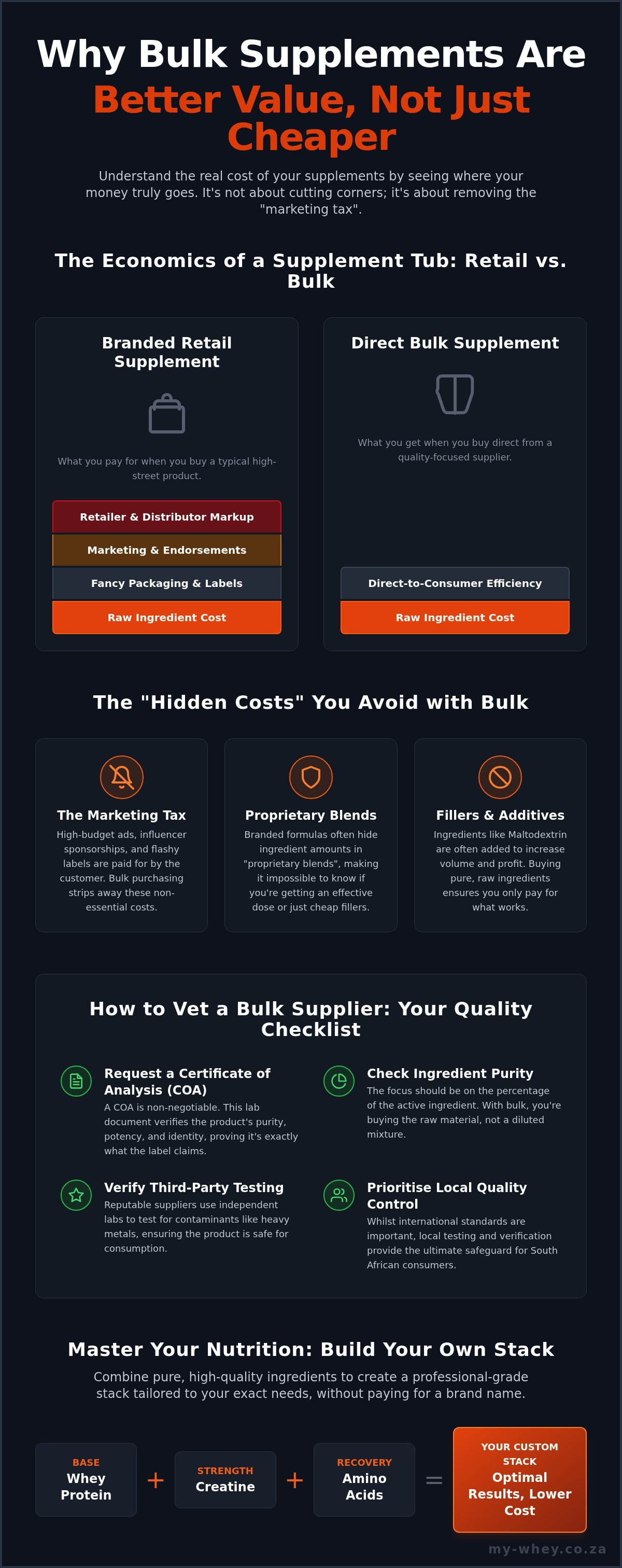
When you walk into a South African health shop, the price on the tag is the result of a complex financial stack. Each layer adds cost without adding a single gram of nutritional value. Understanding why are bulk supplements cheaper requires looking at the "Retail Markup." Traditional brands sell to a distributor; that distributor then sells to a retailer. By the time a tub reaches the shelf, it has been marked up multiple times to cover logistics, storage, and retail profit margins. When you buy bulk, you're essentially removing the middleman and paying closer to the actual cost of the ingredient.
Eliminating the "Marketing Tax" and Fancy Tubs
Branding is an expensive endeavour. High-budget video ads, social media influencers, and celebrity endorsements create a "Marketing Tax" that the consumer ultimately pays for at the till. Whilst these campaigns create a sense of excitement, colourful labels and "explosive" product names don't improve muscle protein synthesis or recovery times. Purity remains constant whilst branding costs fluctuate wildly based on a company's advertising spend. Beyond the ads, the physical container contributes to the price gap. A custom-moulded plastic tub with foil-embossed labels costs significantly more to produce and transport than a simple, durable foil pouch. These rigid tubs are air-filled and inefficient to store. Understanding how the FDA regulates supplements helps you realise that safety standards apply to the contents, not the aesthetics of the jar. Choosing a pouch over a tub is a simple way to reduce both environmental waste and your monthly supplement bill.
Supply Chain Efficiency and Direct-to-Consumer Benefits
Bulk suppliers operate on a model of high volume and low overhead. By purchasing ingredients in tonnes rather than kilograms, they secure massive discounts from raw material producers. These savings are passed directly to the end user. A direct-to-consumer model bypasses the typical layers of profit-taking found in traditional commerce. Logistics are also more efficient. Pouches are lightweight and flat; they allow for more units per delivery vehicle across South Africa compared to bulky, air-filled tubs. This streamlined chain means fewer people handle the product before it reaches your door. Consequently, you often receive a fresher batch because the inventory turns over faster than it would in a stagnant retail setting. If you're ready to stop paying for logos and start paying for performance, you can browse our pure supplement range to see the price difference for yourself.
Quality Control: How to Vet a Bulk Supplier in 2026
When you ask why are bulk supplements cheaper, the fear is often that quality control has been sacrificed to lower the price. This is a valid concern. In a market where results are everything, you cannot afford to consume tainted or under-dosed powders. Trust is earned through data, not through the loudest marketing campaign. High-quality bulk suppliers prove their value by providing rigorous, accessible evidence of purity. This transparency ensures that the lower price tag is a result of supply chain efficiency rather than a compromise on your safety. Vetting a supplier in South Africa requires looking past the website design and into their actual laboratory protocols.
The Importance of Third-Party Testing and COAs
A Certificate of Analysis (COA) is the gold standard of supplement transparency. It is a document issued by a laboratory that confirms a specific batch of product meets its advertised specifications. You should be able to request a COA for any product you buy. A legitimate report must include the batch number, the date of testing, and a detailed breakdown of purity percentages. Crucially, it should also feature a contaminant screen for heavy metals like Lead, Mercury, and Arsenic.
- Verify the Date: Ensure the lab report is current and corresponds to the batch you've purchased. An outdated "placeholder" report from three years ago is a major red flag.
- Third-Party Objectivity: In-house testing is a starting point, but it's never enough. Third-party testing by an independent lab provides an unbiased layer of verification.
- Contaminant Limits: Look for results that fall well below the safety thresholds for heavy metals and microbial activity.
Understanding Manufacturing Standards
Professional bulk suppliers organise their facilities according to international safety frameworks. Look for Good Manufacturing Practice (GMP) and Hazard Analysis and Critical Control Point (HACCP) certifications. These standards dictate how a facility manages hygiene, equipment maintenance, and cross-contamination prevention. This is particularly vital when handling allergens or different types of protein. There is also a distinction between "food-grade" and "pharmaceutical-grade" ingredients. Whilst food-grade is safe for consumption, pharmaceutical-grade implies a higher level of purity often exceeding 99%.
A supplier's physical presence in South Africa is another critical factor. A local, verifiable address means the company is accountable to South African consumer laws and health regulations. This local accountability is a significant part of why are bulk supplements cheaper yet safer when sourced correctly; you're dealing with a lean, local operation that prioritises substance over style. Always check for a physical location and a clear way to contact the team if you have questions about a specific batch's origin.
Beyond the Bag: Comparing Purity and Ingredient Profiles
The price difference between retail tubs and bulk pouches isn't just about the logistics we've discussed. It's often found in the fine print of the ingredient list. When you ask why are bulk supplements cheaper, the answer frequently lies in what is missing from the bag. Retail products are often "formulated" for the mass market, which means they include various additives to improve shelf-life, texture, and taste. Bulk powders, by contrast, focus on the active compound. This "unflavoured" approach provides better bioavailability and significantly reduces the risk of digestive discomfort caused by artificial thickeners or excessive sweeteners. You're paying for the nutrition, not the chemistry required to make a powder taste like a milkshake.
The Problem with Retail Fillers and Proprietary Blends
Many retail brands use "Proprietary Blends" to obscure the actual dosage of their ingredients. This practice allows for "fairy dusting," where expensive components are listed on the label but included in tiny, ineffective amounts. When you buy bulk, you gain total transparency. You know the exact milligramme count of every ingredient in your shake. This clarity is essential for products like omega 3, where quality depends entirely on the specific concentration of EPA and DHA rather than the total weight of the softgel. By avoiding retail fillers, you also avoid common additives such as:
- Maltodextrin: A cheap carbohydrate often used as a thickener or to add "bulk" to a serving size.
- Silicon Dioxide: An anti-caking agent that is frequently overused in retail formulations.
- Unnecessary Thickeners: Gums and fibres added solely to improve the "mouthfeel" of a drink.
Raw Ingredients vs Formulated Products
Choosing raw ingredients gives you the power to customise your nutrition based on your specific body weight and goals. You can precisely dose your branched chain amino acids without being forced to consume the caffeine or beta-alanine often found in "all-in-one" pre-workouts. This flexibility extends to flavouring. You can add your own specialised flavour systems or sweeteners as you see fit, rather than being stuck with a flavour that becomes cloying after a week. You can even combine bulk carbohydrates and fibres with your protein to create a custom meal replacement that fits your exact macros. This methodical approach ensures you're only consuming what your body actually needs for recovery and growth.
If you're tired of paying for fillers and hidden blends, it's time to take control of your nutrition. You can start building your custom supplement stack today and experience the difference that pure, transparent ingredients make to your performance.
Sourcing Smart: Why My Whey Prioritises Purity Over Packaging
My Whey is built on a foundation of transparency and efficiency. We understand the South African fitness market and the rising costs associated with maintaining a healthy lifestyle. Our strategy is simple: we provide the highest quality ingredients without the unnecessary retail "fluff." When you consider why are bulk supplements cheaper at My Whey, you're seeing the result of a direct-to-consumer model that values your results over our brand's ego. We focus on what's inside the bag because that's what drives your progress. Our expert team handles the complexities of sourcing and quality control, allowing you to focus entirely on your training and recovery.
Our Commitment to Lab-Tested Wellness
Every raw ingredient we stock undergoes a rigorous vetting process. We don't just take a manufacturer's word for it; we verify purity to ensure our high standards are met. This is why we offer everything from Whey Protein Concentrate 80% to specialised gut health supplements. We deliberately choose transparent, durable pouches over expensive, wasteful plastic tubs. This choice reduces our environmental footprint and significantly lowers the shipping costs we'd otherwise have to pass on to you. Being a local supplier means we can offer fast, reliable national delivery across South Africa. You get fresh batches delivered to your door without the international shipping delays or customs markups that often inflate the price of imported brands.
Building a Transparent Supplement Stack
Starting your wellness journey doesn't require a dozen different pills or complex formulas. We recommend focusing on the core pillars of performance: Protein, Creatine Monohydrate, and Omega 3 Softgels. These are the foundational elements that yield the most significant results for the majority of athletes. By purchasing these in bulk, you're effectively answering why are bulk supplements cheaper through your own monthly savings. You can keep your routine interesting by using our separate flavour systems. This allows you to change the taste of your shake daily without having to buy multiple large tubs of pre-flavoured protein. It’s a logical, cost-effective way to manage your nutrition whilst maintaining total control over your intake.
We've done the heavy lifting of vetting and curation so that you don't have to. Our goal is to be your steady partner in performance, providing the tools you need to reach your goals without the marketing hype. Stop paying the retail tax and start investing in your gains. View our full range of bulk supplements and start saving today.
Take Control of Your Nutritional Investment
Choosing bulk is a strategic decision to prioritise substance over style. You now understand that the high cost of retail brands often stems from distributor markups and excessive packaging rather than superior ingredient quality. By unbundling your nutrition, you avoid hidden fillers and proprietary blends whilst gaining total transparency over your daily intake. Understanding why are bulk supplements cheaper allows you to reinvest those savings into your performance rather than a brand's advertising budget. Purity is a matter of lab testing and rigorous standards, not flashy labels.
We're committed to being your reliable partner in this journey. Our products are lab-tested for purity and backed by a no-nonsense bulk pricing model that puts your results first. Whether you're building a foundation with Whey Protein or optimising recovery with Creatine, you can expect clean, effective ingredients delivered directly to your door with our national South African delivery service.
Shop Premium Bulk Supplements at My Whey and start building a stack that works as hard as you do. You've done the research; now it's time to fuel your progress with confidence.
Frequently Asked Questions
Are bulk supplements as safe as retail brands?
Bulk supplements are just as safe as retail brands when they are sourced from facilities that follow Good Manufacturing Practice (GMP) standards. Safety is determined by the purity of the raw ingredient rather than the brand's marketing budget or packaging. Many retail products use the same raw material suppliers as bulk providers. The primary difference is the lack of unnecessary fillers and additives in bulk options, which often makes them a cleaner choice.
How can I tell if a bulk supplement is pure?
You can verify purity by requesting a batch-specific Certificate of Analysis (COA) from your supplier. A legitimate COA shows the results of independent laboratory testing, confirming the ingredient concentration and the absence of contaminants like heavy metals. You should also look for a neutral, unflavoured profile; pure powders like Creatine Monohydrate should be nearly tasteless. If a powder has a gritty texture or unusual chemical smell, it may contain unwanted processing residues.
Why does my bulk protein taste different to a retail brand?
Bulk protein tastes different because it is usually unflavoured and free from the heavy dose of artificial sweeteners and creamers used in retail tubs. Retail brands prioritise "mouthfeel" and dessert-like flavours to appeal to a mass market. In contrast, bulk whey has a mild, slightly milky taste that reflects its natural state. This allows you to control your own flavouring using natural fruit, cocoa, or specialised flavour systems without consuming hidden calories.
Do bulk supplements contain more heavy metals?
Bulk supplements do not contain higher levels of heavy metals; they are often tested more rigorously because they are sold as raw materials. Heavy metal content depends on the sourcing of the ingredient, such as the quality of the soil or water at the point of origin. Reputable suppliers conduct third-party screens for Lead, Arsenic, and Mercury to ensure every batch falls within international safety limits. Always check that your supplier provides current lab reports.
How should I store bulk supplements to keep them fresh?
Maintaining freshness requires protecting the powder from moisture, heat, and direct sunlight. Keep your supplements in their original resealable foil pouches or transfer them to airtight glass or plastic containers. Ensure the seal is completely closed after every use to prevent clumping, especially in humid South African coastal climates. Storing your bags in a cool kitchen cupboard away from the stove or oven will prevent heat degradation and extend the product's shelf life.
What is a Certificate of Analysis (COA) and do I need one?
A Certificate of Analysis is a laboratory report that confirms a product meets its chemical specifications. You need access to this document to ensure you aren't consuming heavy metals or low-purity fillers. It acts as a safety guarantee in an industry where labels can sometimes be misleading. A transparent supplier will provide a COA upon request, giving you the confidence that your Creatine or Whey is exactly what the label claims it to be.
Why are bulk supplements so much cheaper in South Africa?
Understanding why are bulk supplements cheaper in the local market involves looking at supply chain efficiency. By sourcing directly and using a lean online model, local suppliers avoid the heavy costs of physical retail space and distributor commissions. You also avoid the significant price hikes associated with importing branded tubs from overseas, which include high shipping fees and customs duties. These savings allow South African athletes to access professional-grade nutrition at a reduced cost.
Can I mix different bulk powders together safely?
Mixing bulk powders is a safe and effective way to create a customised supplement stack tailored to your specific goals. For example, combining Whey Protein Concentrate with Creatine Monohydrate and Amino Acids is a standard practice for post-workout recovery. Because these ingredients are pure and unflavoured, they don't have conflicting chemical interactions or clashing tastes. This flexibility is one reason why are bulk supplements cheaper and more versatile for trainers who want precise control over their dosages.