

Are Expensive Supplements Worth the Money? A Practical Buying Guide
The pricier tub may be the poorer-value choice. If you’ve compared supplement labels in South Africa, you’ll know the shelf price rarely tells the whole story. Serving sizes, ingredient amounts, blends and quality information can all vary. So, are expensive supplements worth the money? Sometimes, but a premium only makes sense when it pays for something relevant and verifiable, not just polished packaging or a longer list of claims.
It’s reasonable to want confidence that what you pay for matches what’s in the product, while keeping your wellness budget under control. This guide offers a consistent way to judge value by your needs, the evidence behind the ingredients, serving details and available quality information. The aim isn’t to choose the cheapest option automatically or assume that higher-priced products are better.
You’ll learn how to compare cost per serving, read labels beyond headline amounts, assess testing claims and decide whether extras such as added flavours or complex blends suit your goals. Use the checklist to compare options, including bulk formats, without paying for features you don’t need.
Key Takeaways
- Are expensive supplements worth the money? Judge each product by its fit, evidence and disclosed contents, not its price tag alone.
- Compare products by cost per comparable serving, rather than container size or headline serving count.
- Look for clear ingredient information and testing details, including what was tested and whether supporting documentation is available.
- Match premium features to a specific, realistic goal. Consider whether the product suits your diet and routine, and seek professional advice when needed.
- Bulk pricing may reduce unnecessary retail packaging, but it isn’t proof of better quality or effectiveness.
Are expensive supplements worth the money? Start with what you’re paying for
Are expensive supplements worth the money? Sometimes, but a higher price can reflect ingredient sourcing, processing, quality controls or formulation. It can also reflect branding, flavour options, convenience and retail presentation. Price alone can’t tell you which applies or prove that a product has better ingredients or stronger evidence. Value depends on whether the supplement suits your needs, whether its contents and serving information are clear, whether evidence supports its intended use, and what it costs to use as directed.
Supplements are optional additions, not substitutes for food, training or appropriate medical care. As the broad overview of Dietary supplement explains, the category includes different kinds of products, so no single rule about effectiveness applies to all of them. Evidence and suitability depend on the ingredient, intended use and individual circumstances. A persuasive claim alone is not a reason to buy. Check that the product and its intended use make sense for you.
What can make a supplement more expensive?
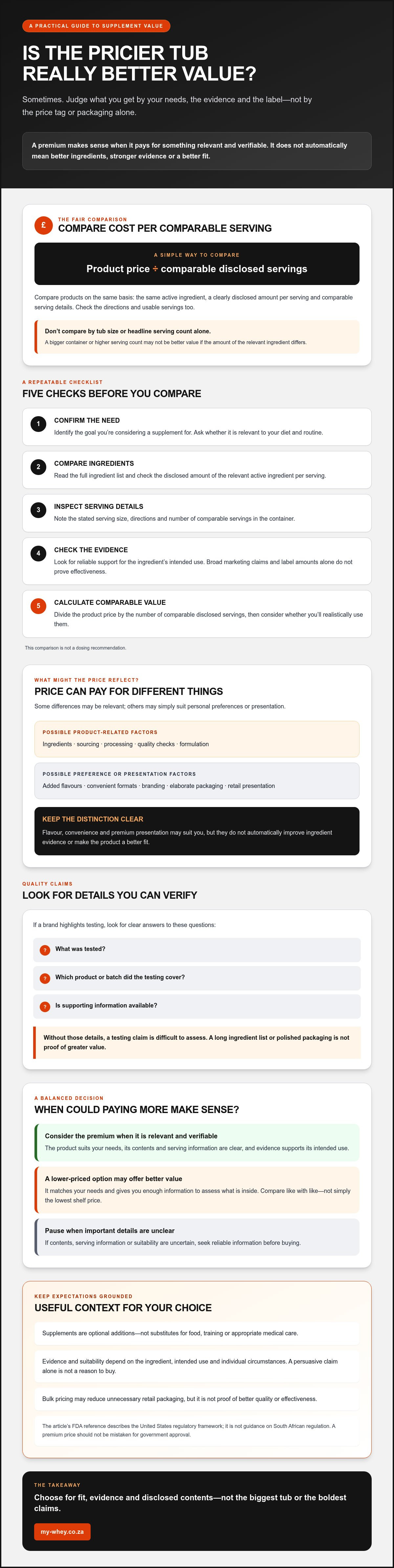
Some price differences may come from the ingredients, how they’re sourced or processed, and the quality checks applied during production. But a higher price might also pay for added flavours, convenient formats, prominent branding or elaborate packaging. These features can suit your preferences or make a product easier to use, but they don’t automatically improve the ingredient’s evidence or make the product a better fit.
Look for substantiation, not implication. If a brand highlights testing, check what was tested, which product or batch it covered, and whether supporting information is available. Without those details, it’s difficult to assess the claim. A long ingredient list or premium presentation is not, by itself, proof of greater value.
When might a lower-priced supplement offer better value?
A lower-priced option can be sensible when it matches your needs and provides enough information to assess what’s inside. Compare like with like: the same active ingredient, a clearly disclosed amount per serving and a comparable serving basis. Check the directions and number of usable servings, too. A larger container or higher serving count may not represent better value if the amount of the relevant ingredient differs.
Choose an option that gives you enough clarity to make an informed decision, not simply the lowest-priced one. If key contents, serving details or suitability are unclear, pause and seek reliable information before buying. The aim is to find a product you can use appropriately and understand, without paying extra for features that don’t matter to your goals.
How to compare supplement value beyond the price on the label
A useful comparison applies the same checks to every product. Don’t start with the biggest tub or the lowest shelf price. Start with what you need and what each label actually tells you.
- Confirm the need. Identify the goal you’re considering a supplement for, and whether it’s relevant to your diet and routine.
- Compare ingredients. Check the full ingredient list and the amount of the relevant active ingredient disclosed per serving.
- Inspect serving details. Note the stated serving size, directions and number of comparable servings in the container.
- Check the evidence. Look for reliable support for the ingredient’s intended use, rather than relying on broad marketing claims. Ingredient amounts are label information, not proof of effectiveness. This comparison is not a dosing recommendation.
- Calculate comparable value. Divide the product price by the number of comparable disclosed servings, then consider whether you’ll realistically use them.
The FDA’s overview of FDA’s role in regulating supplements explains the US regulatory framework, including that supplements aren’t approved by the FDA for safety and effectiveness before sale. This is a US source, not guidance on South African regulation. It does, however, reinforce why a premium price shouldn’t be mistaken for government approval.
Compare the ingredient and amount first
Read the full label, not just the front-panel claims. For whey protein, compare the disclosed protein amount on the same serving basis. For more context, see the definitive guide to whey protein. For omega-3 products, check which relevant ingredients the label specifies instead of comparing softgel counts alone; see the guide to omega-3 benefits and selection.
Calculate comparable value without being misled
Cost per serving is the product price divided by its number of comparable disclosed servings. This calculation is useful only when the servings contain comparable amounts of the ingredient you’re assessing. Two containers can list different serving counts because their serving sizes or ingredient quantities differ. Compare like with like, then check that the product suits your intended use.
For a side-by-side comparison, note each option’s ingredient, disclosed amount, serving size, comparable serving count and cost per serving. My Whey’s range includes whey protein and omega-3 softgels. Review the supplement product information to compare current label details before choosing.
Do premium supplements offer better evidence, purity or testing?
A higher price doesn’t guarantee stronger evidence, cleaner ingredients or better testing. Compare the information a seller makes available, and distinguish evidence about an ingredient from proof about a particular finished product. Research on an ingredient may not apply to every formulation, serving or intended use.
| Factor | What to check | Use caution if |
|---|---|---|
| Evidence | Does the evidence relate to the named ingredient and intended use? | A broad benefit claim has no clear supporting context. |
| Ingredient disclosure | Are ingredients and relevant amounts clearly identified? | A blend or vague label makes amounts hard to assess. |
| Testing transparency | Is the testing method, product or batch, and tester identified? | “Tested” appears without details or documentation. |
| Serving value | Can you compare the disclosed contents of a usable serving? | Serving counts are presented without comparable amounts. |
| Marketing claims | Are claims specific and consistent with the information provided? | Words such as “premium” or “pure” stand in for evidence. |
What should you look for in a quality claim?
Ask what was tested, by whom, and whether the result applies to the product or batch you’re considering. Independent testing can offer useful information, but only when its scope and documentation are clear. A quality claim matters only when the method and scope are disclosed. Harvard Health Publishing’s advice on vetting your supplements discusses third-party certification seals. Don’t assume a particular product holds one unless its documentation confirms it.
My Whey describes its wellness products as lab-tested. Before treating that as a reason to pay more, check which products are covered, what the tests assess and whether supporting documentation is available. A general phrase alone can’t answer those questions.
How to assess evidence without overreading it
Check whether a source discusses an ingredient, a specific finished product or a general health claim. These aren’t interchangeable. Evidence about one ingredient doesn’t automatically establish the effectiveness of every product containing it. Nor does one study or a brand’s summary prove a benefit for everyone. If you have a health condition, take medicines or need advice tailored to you, consult a qualified health professional before choosing a supplement.
So, are expensive supplements worth the money? A premium may be worth considering if the product’s evidence, disclosure and relevant quality information justify it for your needs. If those details are missing, the price itself adds no reassurance.
Which supplements may be worth paying more for, and when to skip them
Start with a clear, realistic goal. Then consider whether a particular product, format or added feature is worth paying for. Your diet, routine, taste preferences and budget all affect whether a supplement is practical for you. Whey, creatine monohydrate and omega-3 are product categories, not universal recommendations. If you have a health condition, take medicines or are unsure whether a supplement is suitable, seek advice from a qualified health professional.
For questions specific to creatine monohydrate, consult the definitive guide to creatine monohydrate. Use product information to assess what’s disclosed, and professional guidance for advice that needs to account for your circumstances.
Weigh the practical trade-offs
A premium feature can be valuable if it solves a real problem for you. It’s less useful if you won’t use it or can’t verify what it adds.
- Bulk formats: They may reduce reliance on retail packaging and suit regular use, but require suitable storage and a commitment to using the contents.
- Convenience: A format that fits your routine may be easier to use consistently, but convenience alone doesn’t demonstrate better evidence or ingredient quality.
- Flavouring: Flavour options may make a product more appealing. Check whether they suit your preferences and whether you want to pay for them.
- Packaging: Protective or practical packaging can be useful. Elaborate presentation isn’t proof of greater effectiveness.
When a premium price may not be worthwhile
Pause if the intended benefit is vague, the relevant ingredient amount isn’t clear, or the evidence doesn’t match the claim. Ask what the extra cost actually gets you. If a premium feature can’t be checked against the label or available documentation, don’t treat it as established value.
Practical value depends on suitability and actual use. A product left unused, or one that doesn’t fit your routine, is poor value regardless of its price. Consider paying more only when the difference is relevant to your goal and supported by information you can assess.
Make a considered choice
- Buy: The product fits a clear need, its contents are disclosed, and you expect to use it as directed.
- Wait: You’re unsure whether you need it or how it fits alongside your current diet and routine.
- Compare alternatives: The premium appears tied to flavour, packaging or convenience rather than a clear benefit for you.
- Seek professional guidance: Your health, medicines or personal circumstances make suitability uncertain.
Once you know which category you’re considering, compare My Whey’s supplement options using their current product information and your own priorities.
How to choose supplements with confidence, and compare My Whey’s bulk approach
Use a final check before buying. A clear process helps you choose for your needs rather than being swayed by a premium label, a large container or a strong marketing claim.
- Need: Identify a specific reason for considering the supplement, and whether it fits your diet and routine.
- Label: Confirm the ingredients, disclosed amounts, serving information and directions on the current product page.
- Comparable serving: Compare like-for-like servings, not just package size or the number of servings advertised.
- Evidence: Check whether the available evidence relates to the ingredient and intended use you’re considering.
- Testing: Find out what testing covers, which product or batch it applies to, and whether supporting information is available.
- Realistic use: Consider whether the quantity, format and storage needs suit your routine, and whether you’re likely to use it as directed.
My Whey’s bulk-pricing approach is intended to reduce reliance on unnecessary retail packaging. That can be a useful factor in a value comparison, but bulk purchasing isn’t proof of better efficacy or automatically the right choice for everyone. Weigh any packaging reduction against the amount you’ll use, how you’ll store it and whether the quantity suits your habits.
What to verify before placing an order
Check the current product page for ingredient, serving and other product-specific details rather than relying on assumptions or information from an older listing. My Whey describes its wellness products as lab-tested, but testing scope matters. Confirm which products are covered, what the testing assesses and whether documentation is available before treating it as a deciding factor.
Compare bulk value with your actual needs
Bulk formats may suit regular use and can mean less retail packaging, but a larger quantity only makes sense if it fits your expected use and storage arrangements. Compare the current product details and serving information, then consider whether you can manage the quantity appropriately. Don’t assume bulk is always cheaper or more suitable. Judge it against your own circumstances.
Ultimately, are expensive supplements worth the money? Choose based on fit, clear product information and quality details you can verify, not price alone. To compare available options, explore My Whey’s supplement range and review the product information before deciding.
Make your next supplement choice with confidence
Are expensive supplements worth the money? Only when the extra cost reflects something useful to you and the product information supports your choice. Compare ingredients and usable servings, look for evidence that matches the intended use, and check what any testing claim covers. Then consider whether the product fits your routine and whether you’ll actually use it.
Bulk pricing can reduce reliance on unnecessary retail packaging, but it doesn’t prove better efficacy or make a larger quantity right for everyone. My Whey describes its wellness products as lab-tested. Confirm which products are covered, what the testing assesses and whether supporting information is available before relying on that claim.
Choose at your own pace. Compare My Whey’s supplement range and product information to review current product details and decide whether an option fits your needs and budget. A clear, considered choice is a better starting point than paying more for a label that simply looks premium.
Frequently Asked Questions
Are expensive supplements always better quality?
No, a higher price doesn’t automatically mean better quality. It may reflect ingredients, processing, quality controls, formulation, flavouring or packaging, but price alone can’t confirm which. Look for clear ingredient and serving information, relevant evidence, and details about any testing. If a seller uses terms such as “premium” or “pure”, check what supports the claim before treating it as a reason to pay more.
How can I tell whether a supplement is worth the money?
Assess whether it suits a clear need, whether its contents are disclosed, and whether evidence supports the intended use. Compare products with the same active ingredient and a comparable amount per serving, then consider the cost of those servings and whether you’ll realistically use them. Are expensive supplements worth the money? Only if the product’s fit and verifiable information justify the extra spend for your circumstances.
Are bulk supplements better value than branded products?
Not automatically. Bulk formats may reduce reliance on unnecessary retail packaging and suit someone who uses a product regularly, but a larger quantity isn’t useful if it doesn’t fit your routine, storage or expected use. Compare current product information, serving details and total quantity rather than assuming bulk is cheaper or better. My Whey offers bulk supplement pricing, but the format itself doesn’t prove quality or effectiveness.
Does third-party testing mean a supplement is safe and effective?
No. Testing may provide useful information about specific quality attributes, but it doesn’t establish that a supplement is effective for your goal or suitable for everyone. Check what was tested, who conducted the testing, which product or batch it covered, and whether supporting documentation is available. A general testing claim without scope is difficult to assess. If you have health concerns or take medicines, ask a qualified health professional for guidance.
Are supplements worth taking if I already eat a balanced diet?
Possibly, but supplements are optional, and a balanced diet doesn’t automatically mean you need one. Whether a supplement is appropriate depends on your individual circumstances, goals, diet and routine. Consider why you’re taking it and whether there’s reliable evidence for that use. Don’t treat supplements as replacements for food or professional medical advice. If you’re unsure, particularly because of a health condition or medicines, discuss your situation with a qualified professional.
What should I compare on a supplement label?
Compare the full ingredient list, the amount of each relevant active ingredient, serving size, directions and number of servings. Check whether the label makes clear what’s in any blend, and look for claims you can verify against product information or testing documentation. Compare products on a like-for-like serving basis, not just container size or headline serving count. Also consider whether the flavour, format and quantity suit your preferences and routine.