

Are Supplements Safe for Teenagers? A Guide for Parents
Could a product promoted as “natural” or “sports nutrition” still be the wrong choice for your teenager? If you’re asking, “are supplements safe for teenagers?”, the honest answer is that it depends on the ingredients, the reason for use, your teenager’s health and the specific product.
It’s understandable to feel uncertain. Online advice can blur the line between evidence and marketing, while concerns about nutrition, sport or body image can make supplements seem like a quick solution. But neither food alone nor a supplement is automatically the answer for every teenager.
This guide explains how to weigh the potential concerns without assuming that all supplements are harmful or suitable. You’ll learn why products for muscle building, weight loss or energy deserve particular scrutiny, when to speak with a doctor or registered dietitian, and what to check on a label. For families in South Africa, ingredient transparency and claims such as “lab-tested” are useful questions to investigate, but they don’t establish that a product is appropriate for a minor. A parent or caregiver and a qualified health professional can help assess the teenager’s specific needs.
Key Takeaways
- Whether are supplements safe for teenagers depends on the product, the teenager’s needs and health, and professional guidance.
- Different categories, from vitamins and minerals to protein powders, creatine, caffeine and herbal products, raise different questions to discuss with a qualified professional.
- Check the full ingredient list, serving directions and marketing claims, but don’t treat them as proof that a product is suitable for a teenager.
- Before considering a supplement, identify the concern, review food and medicines, and ask a doctor or registered dietitian to assess the exact product.
- A calm, non-judgemental conversation and follow-up can help your teenager make an informed decision with a parent or caregiver.
Are supplements safe for teenagers? Start with a careful, individual answer
Are supplements safe for teenagers? There isn’t one answer for every product or young person. Suitability depends on the ingredients, whether there’s a genuine need, the teenager’s age and health, any medicines they take, and the quality and contents of the specific product. A nutrient recommended by a healthcare professional for a diagnosed deficiency is a different consideration from a product marketed for muscle gain, weight loss or sports performance.
Supplements are intended to add to the diet, not replace regular meals, adequate sleep, appropriate training or healthcare. The category includes different products and ingredients. For a broad introduction to what dietary supplements are, see this overview. A label or popular claim doesn’t establish that a product is appropriate for a teenager. Equally, it’s not accurate to assume every supplement is dangerous. The decision should be specific and informed, and discussed with a parent or caregiver and a qualified health professional.
Why age and individual health matter
Evidence about adults doesn’t automatically establish safety or suitability for teenagers. Young people are still developing, and age, health conditions, dietary patterns and medicines may all affect how an ingredient is tolerated or whether it’s appropriate. A product with several ingredients can also be harder to assess. These are general considerations, not a diagnosis or personal recommendation. A doctor or registered dietitian can take the teenager’s circumstances into account.
When a supplement may be considered
A professional might consider nutritional support when there’s a diagnosed deficiency or a restricted diet that could leave a nutritional gap. That doesn’t mean parents need to identify or treat a deficiency themselves. A healthcare professional can review eating habits and symptoms, consider whether further assessment is appropriate, and discuss suitable options if needed. The next step should be based on the teenager’s needs, not a product’s marketing.
Sports performance alone doesn’t prove there’s a health need for a supplement. Before considering one, ask what concern it’s meant to address and whether everyday factors such as food, rest and training have been considered. Keep the conversation calm and include the teenager. A clear reason and professional input offer a better starting point than pressure from peers, social media or promises of quick results.
Teen supplement types: what the evidence and uncertainty mean
Different products raise different questions. A vitamin recommended after an assessment isn’t the same as a multi-ingredient powder promoted for rapid muscle gain. Evidence in adults also doesn’t automatically establish benefits or safety for teenagers. Use this comparison as a starting point for discussion, not as a recommendation to use any product.
| Category | Common claim | Key uncertainty | Discuss with a professional |
|---|---|---|---|
| Vitamins and minerals | Fill a nutrient gap | Whether a gap exists; overlap with fortified foods or other supplements | Diet, symptoms, medicines and whether assessment is needed |
| Protein powders | Make it easier to increase protein intake | Whether extra protein is needed, and whether the product suits the teenager | Usual food intake, ingredients and the reason for use |
| Creatine | Support strength or high-intensity performance | Adult findings don’t settle teen safety or suitability | Age, health, sport context and evidence for the specific product |
| Amino acid products | Support muscle or recovery | Possible overlap with dietary protein and other ingredients | What’s in the product and whether there’s a clear need |
| Caffeine | Increase energy or alertness | Effects may include unwanted symptoms or disrupted sleep | Other caffeine sources, medicines and sleep habits |
| Herbal or multi-ingredient products | Support performance or weight loss | Evidence, interactions and the full contents may be unclear | Every ingredient, claims and potential interactions |
Protein powders, creatine and amino acid products
Protein is a nutrient found in food. A powder can offer a convenient source, but it isn’t an automatic requirement or a substitute for meals. For ingredient basics, see this definitive guide to whey protein. It provides general education, not advice about use by teenagers. For an overview of common sports supplements, Nemours KidsHealth discusses products including protein powders and creatine. Marketing claims should still be weighed against the limited certainty around teen-specific evidence. Food, appropriate training and sleep remain central to sport and recovery.
Vitamins, caffeine and herbal supplements
Check whether nutrients might already come from fortified foods, medicines or another supplement. Caffeine, weight-loss and bodybuilding products, and blends containing several ingredients merit particular scrutiny. An ingredient list doesn’t establish that a combination is suitable. For general omega-3 nutrient context, read this definitive guide to omega 3, not as a recommendation for a teenager. You can also review supplier product details for ingredient information, then discuss the exact product with a parent or caregiver and a qualified health professional.
Teen supplement risks: labels, interactions, and misleading claims
A label is a useful starting point, not a safety assessment. Ingredient lists, serving directions and claims such as “natural”, “clean” or “supports performance” don’t prove that a product is suitable for a teenager. Ingredients may interact with medicines, duplicate nutrients in fortified foods or other products, or cause side effects. Some supplements may also contain substances not declared on the label, so polished packaging or a confident claim shouldn’t end the questions.
Product quality checks can provide information about a product, but they don’t prove that it’s suitable for minors. Quality and a teenager’s individual health needs are separate considerations.
How to read a supplement label critically
Review the complete ingredient list, serving information and warnings. Check that the manufacturer or supplier is identifiable and that batch information is available. Look for ingredients that may appear in more than one product, including vitamins and minerals that may also be present in fortified foods or medicines.
Proprietary blends can make it difficult to assess how much of each ingredient is included. Treat dramatic promises, vague “natural” claims or unclear labelling as reasons to pause and ask questions, not as evidence of benefit or safety. A parent or caregiver can gather this information, but reviewing a label can’t replace an individual assessment by a qualified health professional.
What testing and regulation can, and can’t, tell you
“Tested” is not a complete explanation. Ask who conducted the testing, whether it was independent, which product and batch were tested, what the test measured, and whether results are available. Testing can only inform you about the aspects included in its scope. Don’t assume it assessed every ingredient, possible interaction, effect or age group unless that’s clearly established.
My Whey states that it supplies lab-tested products, but the testing scope and method should be checked before drawing conclusions. In any case, testing alone can’t determine whether a product is appropriate for a particular teenager. Similarly, don’t assume that rules discussed in another country apply in South Africa. Check current requirements with SAHPRA or another appropriate South African authority, and ask a healthcare professional to assess the specific product and the teenager’s circumstances.
If you’re asking, “are supplements safe for teenagers?”, use the label to prepare for a more useful conversation. Bring the product details and a list of medicines and other supplements to a doctor or registered dietitian so they can consider the ingredients, possible overlaps and individual health factors together.
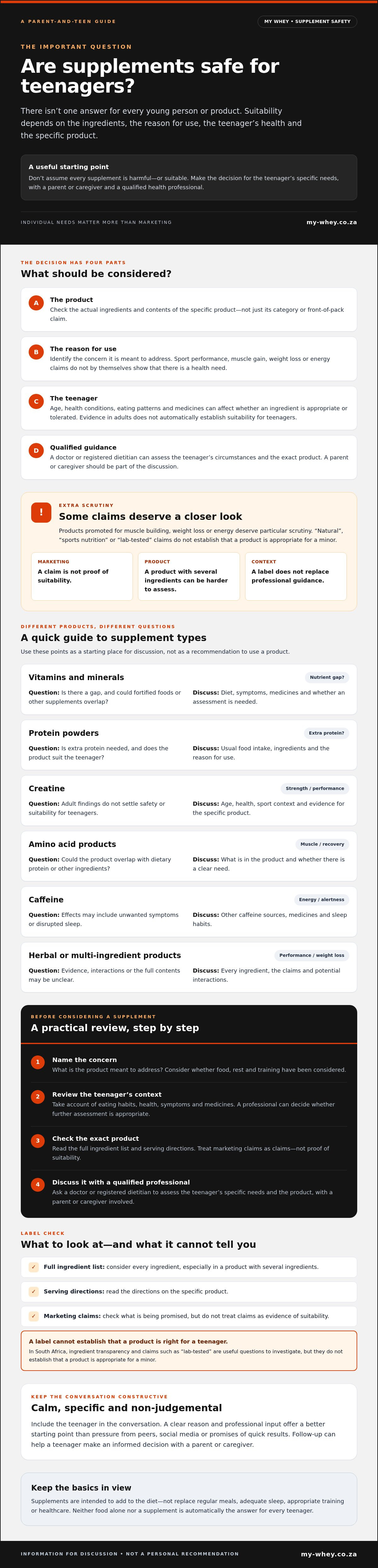
How parents and teenagers can decide whether to use a supplement
A teenager’s supplement decision should begin with a specific need, not an advertisement. This five-step process can help make the discussion practical. Keep your teenager involved, listen without judgement and avoid making the conversation about appearance or willpower.
- Define the concern. Is there a symptom, dietary restriction or specific health concern, or is the interest mainly driven by sports performance, social media or a promise of quick results? Be clear about what the product is meant to address.
- Review food and medicines. Consider the teenager’s usual meals, appetite, fortified foods, allergies, medicines and any other supplements. This can help identify possible gaps or overlapping ingredients.
- Identify the exact product. Bring the full label, including ingredients, serving information, warnings and manufacturer details. Don’t rely on a product name or promotional claim alone.
- Ask a professional. A doctor or registered dietitian can consider the teenager’s health, age and circumstances. Seek individual advice especially if there are symptoms, an existing health condition, medicines or a restricted diet.
- Agree how to reassess. If a health professional advises an option, ask what to monitor, when to follow up and when to stop or seek further advice. Don’t assume continued use is appropriate without review.
Questions to take to a doctor or registered dietitian
Ask what need the product is intended to address, whether food-based options could help, and what evidence applies to this age group. Share the full product label and a list of medicines, current supplements, allergies and relevant health conditions. Ask about possible interactions, what monitoring may be needed and what signs mean the product should be stopped. These details can make the appointment more useful.
Start with foundations for training and wellbeing
For active teenagers, start with varied meals that provide adequate energy, hydration, sleep and a training plan suited to their age and needs. If appetite is low or food choices are restricted, discuss the reason without shame or assumptions. Performance pressure deserves thoughtful attention too. A supplement can’t replace meals, accelerate healthy development or guarantee athletic results.
If you’re still asking, “are supplements safe for teenagers?”, the answer depends on assessing the specific need, product and teenager with appropriate professional input. For general ingredient information, you can review supplement product details, but supplier information can’t diagnose or prescribe for a young person.
Choosing supplement information responsibly, with a parent and professional
Use this checklist with your teenager and a parent or caregiver before considering a supplement. It keeps the decision focused on individual need and verifiable information rather than persuasive packaging.
- Specific need: Can you clearly explain what concern the supplement is meant to address?
- Professional advice: Has a doctor or registered dietitian considered the teenager’s age, health, diet and medicines?
- Complete label: Can you review the full ingredient and allergen information, serving directions, warnings and manufacturer details?
- Quality evidence: Is there clear information about what any testing claim covers and how it was established?
- Follow-up: Do you know what to monitor, when to review the decision and when to stop or ask for further advice?
A “yes” to a quality claim doesn’t answer every safety question. Consider suitability, evidence and the teenager’s circumstances separately.
Questions to ask any supplement supplier
Ask for the complete ingredient and allergen information. If a supplier describes a product as tested or quality checked, ask what was tested, which product or batch the information relates to, and whether the method and results can be explained. Check that claims are specific and understandable, rather than framed as guaranteed outcomes. Supplier information can clarify ingredients and testing, but it can’t diagnose a teenager or prescribe a supplement.
If information is incomplete or a safety question remains unanswered, don’t try to fill the gap with marketing claims. Take the label and your questions to a qualified healthcare professional before considering use.
A cautious next step for families
Some teenagers may have a specific nutritional need, but that doesn’t make every product appropriate for them. Seek professional advice before starting, combining or changing supplements, particularly if the teenager has symptoms, an existing health condition, a restricted diet or takes medicines. Keep the conversation calm and include the teenager so they can raise concerns without feeling judged.
My Whey is a supplement supplier. Its product information may help families understand what is listed, but it doesn’t establish that any product is intended or proven safe for minors. If you’d like to review ingredient information together, explore My Whey’s supplement range and product information with a parent or caregiver, then discuss any product you’re considering with a qualified health professional.
Make the next step informed and individual
So, are supplements safe for teenagers? There’s no blanket yes or no. Suitability depends on the teenager’s specific needs, health and medicines, as well as the ingredients and evidence for the exact product. Start with a clear reason for considering it, review the full label together, and seek advice from a doctor or registered dietitian before starting, combining or changing supplements.
My Whey supplies products including whey protein concentrate, creatine monohydrate, omega 3 and amino acids. The company states that its wellness products are lab-tested, but the scope of that testing should be checked. Product information can help explain ingredients; it doesn’t establish that a product is suitable for a teenager or replace professional advice.
With a parent or caregiver, review My Whey’s supplement range and product information for details to discuss with a qualified health professional. A calm conversation and an individual assessment can help your family make a considered decision.
Frequently Asked Questions
Are supplements safe for teenagers?
Some may be appropriate for a specific teenager, but safety depends on the ingredient, the reason for use, health, medicines and the exact product. A supplement recommended by a health professional for a diagnosed need is different from a product marketed for weight loss, muscle building or performance. If you’re asking “are supplements safe for teenagers?”, discuss the product with a parent or caregiver and a doctor or registered dietitian before use.
Can a teenager take protein powder?
A teenager may not need protein powder if their usual food provides enough protein and energy. Powder is a convenient food product, not an automatic requirement or a replacement for meals. Suitability depends on the teenager’s diet, health and the product’s full ingredients. Before considering one, review the label and discuss the reason for use with a parent or caregiver and a doctor or registered dietitian.
Is creatine safe for teenagers?
Don’t assume creatine is suitable for a teenager because it’s popular in adult sport or nutrition products. Adult evidence doesn’t automatically establish safety or benefit for young people, and individual health and product details matter. A teenager shouldn’t start creatine based on peer or marketing claims alone. Discuss the specific product and reason for considering it with a parent or caregiver and a qualified healthcare professional.
Can teenagers take vitamins every day?
Daily vitamins aren’t necessary for every teenager, and a supplement may overlap with nutrients in fortified foods, medicines or other products. A healthcare professional can assess dietary patterns, symptoms and any specific risk of a deficiency before advising whether a supplement is appropriate. Don’t exceed label directions or combine products without advice. If there’s a concern about nutrition or health, speak with a doctor or registered dietitian.
What happens if a teenager takes too much of a supplement?
The effects depend on the ingredient and amount. Taking too much may cause unwanted effects, and some ingredients can interact with medicines or other supplements. If a teenager has taken more than directed, contact a healthcare professional promptly for advice. Keep the packaging available and note what was taken and when. If they’re seriously unwell or having severe symptoms, seek urgent medical care rather than waiting for symptoms to pass.
How can parents check whether a supplement is safe?
Start by identifying the specific need, then review the complete ingredient and allergen list, serving directions, warnings and manufacturer details. Ask what any testing claim covers; the word “tested” alone doesn’t establish suitability for a teenager. Check for ingredients duplicated in other supplements, fortified foods or medicines. Share the exact label and a list of medicines and health conditions with a doctor or registered dietitian before use.
Do teenagers need supplements if they play sport?
Playing sport doesn’t automatically mean a teenager needs supplements. Varied meals, enough energy and fluids, sleep and a suitable training plan are important foundations for activity and recovery. If there’s a dietary restriction, symptom or concern about meeting nutritional needs, seek individual advice from a doctor or registered dietitian. Treat promises of quick performance gains cautiously, and include the teenager in a calm conversation about what’s driving their interest.