

Ashwagandha for Anxiety and Stress Relief: What the Evidence Says
What if a popular herbal supplement may support stress, but isn’t a proven answer to anxiety? Interest in ashwagandha for anxiety and stress relief is growing, and some studies suggest it may ease perceived stress or anxiety symptoms for certain people. That’s encouraging, but it doesn’t establish ashwagandha as a treatment for an anxiety disorder.
If conflicting claims have left you unsure what to believe, you’re not alone. Everyday stress and persistent anxiety can feel similar, yet may call for different kinds of support. Research findings also vary, so benefits aren’t guaranteed and the evidence has limits. This guide explains what current research can and can’t tell us, and when professional care matters more than trying a supplement.
You’ll also learn which safety considerations deserve attention, including pregnancy, thyroid or liver conditions, and possible medicine interactions. Before making a decision, look closely at the label: the plant part used, ingredient details and quality information all matter. Use this evidence-led overview to assess ashwagandha carefully, set realistic expectations and make a more informed choice.
Key Takeaways
- Learn how ashwagandha is described as an adaptogen, and why that term doesn’t mean it treats an anxiety disorder.
- See why human studies of ashwagandha for anxiety and stress relief can be difficult to compare, including differences in extracts and outcomes.
- Separate plausible benefits from claims that research has not established, so you can set more realistic expectations.
- Understand why a natural supplement may still carry risks, and when personal health circumstances make professional advice important.
- Use a practical label-reading approach to assess a supplement’s botanical name, plant part, extract details and serving directions.
Ashwagandha for anxiety and stress relief: what is it, and what can it do?
It makes sense to look for support when daily demands feel hard to manage. But everyday stress and clinical anxiety aren’t interchangeable, and a supplement shouldn’t be assumed to address both. The direct answer is that research into ashwagandha for anxiety and stress relief is promising in places, but still limited. It doesn’t establish the herb as a cure or a reliable treatment for an anxiety disorder.
Ashwagandha is a plant, Withania somnifera, traditionally used in herbal systems and often described as an adaptogen. An adaptogen is a broad wellness term for a substance claimed to help the body respond to stress. It isn’t a formal diagnosis, treatment category or guarantee of an effect. The plant’s botanical background and traditional uses are outlined in Ashwagandha (Withania somnifera).
What is ashwagandha, and what does “adaptogen” mean?
Ashwagandha’s history of traditional use helps explain why it attracts interest, but it doesn’t prove that a modern supplement will produce a particular result. Traditional practice, product marketing and clinical evidence are different kinds of information. To judge possible effects, researchers need to test specific preparations in people and assess outcomes systematically. The term “adaptogen” alone can’t tell you whether a product works, who might benefit or whether it’s suitable for you.
Are stress and anxiety the same thing?
Stress is commonly a response to pressure or demands, such as a difficult work period or a major change. Anxiety can involve persistent worry or fear that extends beyond one immediate stressor and affects wellbeing or daily life. They can overlap, but this distinction isn’t a way to diagnose yourself. If symptoms are severe, persist or disrupt sleep, relationships, work or everyday activities, seek support from a qualified health professional rather than relying on a supplement.
That distinction matters when interpreting research. A study measuring perceived stress in participants doesn’t automatically show that ashwagandha treats a diagnosed anxiety disorder. Nor does one person’s experience establish what another person will feel. Findings can depend on the preparation tested, the people taking part and the outcomes measured. Those details shape what a study can reasonably tell us.
So treat “adaptogen” as context, not proof. A label or advert may use confident language, but traditional reputation and a wellness category don’t demonstrate clinical benefit. The useful question is narrower: what has research in people actually tested, and how closely does that evidence match the product and outcome you’re considering? The next section looks at what the studies can and cannot establish.
What does research say about ashwagandha for stress and anxiety?
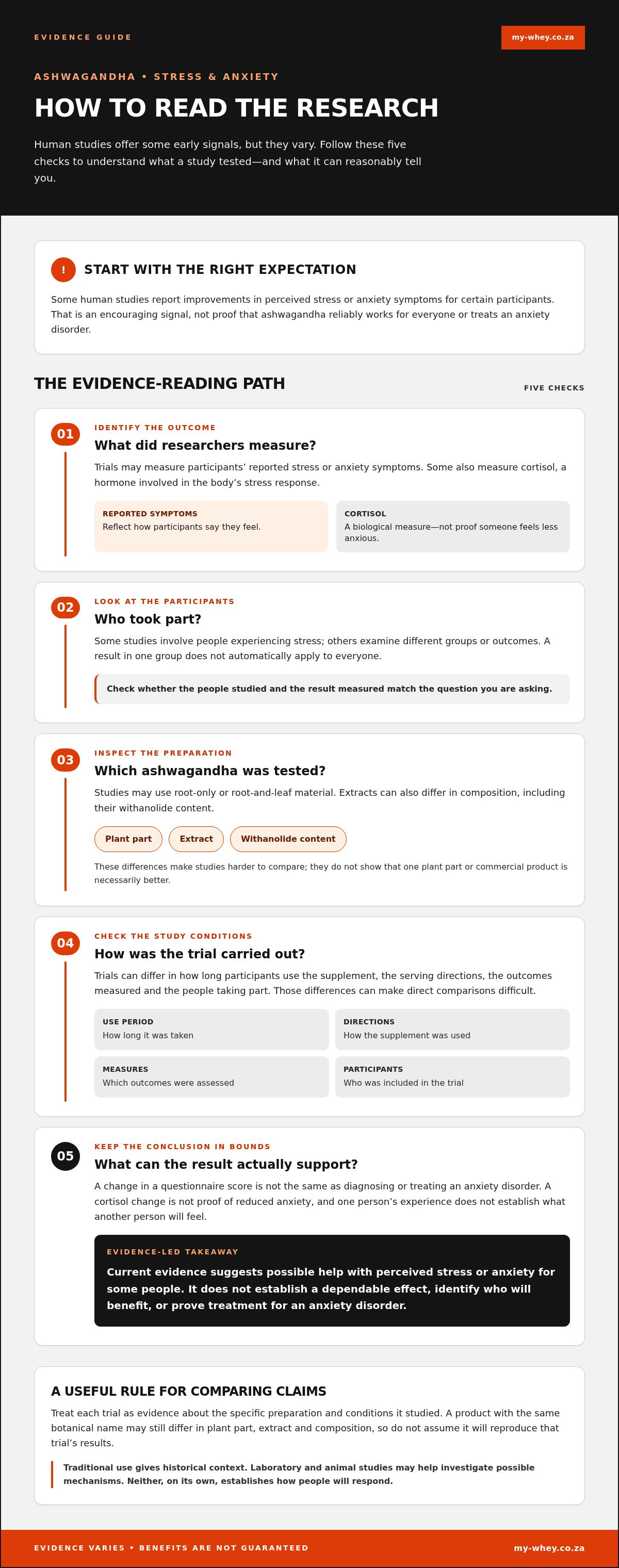
The evidence is best read as a collection of early signals, not a settled answer. Some human studies have reported improvements in participants’ stress or anxiety scores after taking ashwagandha. But studies vary, and a change in a questionnaire score is not the same as diagnosing or treating an anxiety disorder. The National Center for Complementary and Integrative Health (NCCIH) on Ashwagandha summarises both the potential benefits and the limits of the available research.
What have human studies measured?
Clinical trials have assessed outcomes such as participants’ reported stress or anxiety symptoms, sometimes alongside measures including cortisol, a hormone involved in the body’s stress response. These measures answer different questions: a cortisol change is a biological finding, not proof that someone feels less anxious. Self-reported improvement also doesn’t establish that the supplement treats a diagnosed condition or works for everyone.
Trials can differ in who takes part, how long they use the supplement, and which preparation and serving directions are tested. Some involve people experiencing stress, while others examine different groups or outcomes. Without checking those details, a headline saying “research shows” can make findings sound more consistent or broadly applicable than they are. Laboratory and animal studies may help researchers investigate possible mechanisms, but they cannot establish how people will respond. Traditional use offers historical context, not clinical proof.
Why do study findings differ?
“Ashwagandha” does not describe one identical preparation. Research may examine root-only or root-and-leaf material, and extracts can differ in composition, including their withanolide content. Trials can also use different outcome measures and participant groups, making direct comparisons difficult. These are variables to examine, not evidence that one plant part or commercial product necessarily produces better results.
Think of a trial as a test of the specific preparation and conditions it studied. A product with a similar botanical name may still differ in plant part, extract and composition. Unless those details match, it’s not sound to assume it will reproduce the trial’s results. This is why a precise label and a clearly described study matter more than a broad claim that a supplement is “clinically studied”.
Current evidence suggests ashwagandha may help with perceived stress or anxiety for some people, but it cannot establish a dependable effect, identify who will benefit, or prove that it treats an anxiety disorder. For ashwagandha for anxiety and stress relief, judge claims by asking what was measured, in whom, and with which preparation. That gives you a more useful starting point than treating a promising result as a guarantee.
Apply the same evidence-first approach to any herbal supplement: read the ingredient and quality information carefully, and separate a product’s claims from what research has actually tested. You can explore My Whey’s herbal supplement range as you learn how to assess supplement information responsibly.
Does ashwagandha work? Set realistic expectations about the evidence
Does ashwagandha work? The fairest answer is that some findings are encouraging, but they don’t establish a reliable treatment for anxiety. A study may suggest a possible effect on perceived stress in a particular group using a particular preparation. That doesn’t show the same result will occur for you, last over time or apply to people with a diagnosed anxiety disorder. Treat claims about ashwagandha for anxiety and stress relief as questions to assess, not promises.
Promising findings versus proven anxiety treatment
Research into possible support for perceived stress is worth examining, but study outcomes don’t prove that ashwagandha treats anxiety disorders. Small or short studies can offer useful early signals, yet they can’t establish long-term benefit, uncommon harms or suitability for everyone. Early evidence is not the same as an established clinical treatment, and an improvement reported by participants is not a guarantee of relief.
Use this distinction to weigh common claims:
| Claim | What the evidence supports |
|---|---|
| “It may support perceived stress.” | This is a research question with some encouraging human findings. Results depend on the study and preparation, so benefit isn’t assured. |
| “It treats an anxiety disorder.” | Findings on stress or symptom scores don’t establish ashwagandha as a treatment for a diagnosed disorder. |
| “It works for everyone, long term.” | Short or small studies can’t show that effects last or apply across different people and circumstances. |
| “It cures anxiety or balances hormones.” | These broad claims go beyond what limited findings can establish. Look for direct human evidence on the specific outcome and preparation. |
How to read strong supplement claims
Promotional wording can sound certain even when the underlying evidence is preliminary. Pause at phrases such as “cures anxiety” or “balances hormones”. Ask whether the claim refers to a human study, what outcome was measured, who participated, and whether researchers tested the same plant part and extract described on the label. Evidence about one preparation can’t automatically be transferred to another.
A practical check is to compare the wording of the claim with the actual research outcome. If a study measured self-reported stress, a claim about treating a clinical disorder overstates what was tested. If it measured a biological marker, that alone doesn’t prove a felt improvement. The closer the claim stays to the study’s participants, preparation and measured outcome, the more accurately it reflects the evidence.
Early research may suggest a possible effect on perceived stress, but it doesn’t establish ashwagandha as a proven treatment for anxiety disorders. Don’t stop or change prescribed treatment, or postpone professional mental-health care, to try a supplement. If you’re considering adding one alongside care, discuss it with a qualified health professional. Keep expectations measured and judge each claim by what the research actually tested.
Ashwagandha safety: side effects, interactions and who needs advice
“Natural” doesn’t mean risk-free. Ashwagandha may cause side effects and may not be suitable for everyone, so weigh safety alongside possible benefits. The National Center for Complementary and Integrative Health’s ashwagandha guidance describes potential side effects, interactions and groups who should take particular care. If you’re considering ashwagandha for anxiety and stress relief, your personal health circumstances matter as much as the supplement’s claims.
What side effects and warning signs should readers know about?
Reported side effects include drowsiness and stomach upset, such as diarrhoea or vomiting. Not everyone experiences them, but stop taking the supplement and seek medical advice if you develop concerning symptoms. Rare reports of liver injury have also been associated with ashwagandha. Yellowing of the skin or eyes, dark urine, unusual itching or persistent nausea warrant prompt medical attention, particularly if they occur after starting a supplement.
Thyroid effects are another reason for care: ashwagandha may affect thyroid hormone levels. That doesn’t mean everyone will experience a problem, but people with thyroid conditions should get professional advice before use. Don’t try to manage a suspected reaction by adjusting prescribed medicines yourself.
Who should speak to a healthcare professional first?
Ask a doctor or pharmacist before using ashwagandha if you take medicines or have an ongoing health condition. Potential interactions may be relevant with medicines that affect thyroid function, blood pressure or blood sugar, as well as sedatives and medicines that suppress immune activity. This isn’t a complete interaction check, and risk depends on the individual. Share the supplement label and your medicine list so a professional can assess them together.
Pregnancy and breastfeeding call for particular caution. Avoid self-selecting ashwagandha in these situations; seek personalised advice, as safety may not be established. The same approach applies if you have liver or thyroid concerns, or are preparing for surgery. A pharmacist or doctor can help weigh the product, your health history and any treatment you already use.
Use this simple safety check before deciding:
- Review your circumstances: note medicines, health conditions, pregnancy or breastfeeding.
- Read the full label: check the ingredients, plant part and serving directions, not only the front-of-pack claims.
- Get individual advice: ask a doctor or pharmacist if you’re unsure about suitability or interactions.
- Respond to symptoms: stop use and seek medical advice for an unexpected or troubling reaction; get prompt care for severe symptoms or possible signs of liver problems.
A supplement should never replace prescribed treatment or professional mental-health care. If you’re considering herbal supplements, explore My Whey’s herbal supplement range and assess any option with the same attention to its label, quality information and suitability for you.
How to assess an ashwagandha supplement before making a decision
A careful choice starts with your goal, not the product’s promises. Decide whether you’re looking for general support during a stressful period or whether persistent, disruptive anxiety needs professional care. Supplements shouldn’t replace prescribed treatment or mental-health support. If you’re considering ashwagandha for anxiety and stress relief, use the evidence and your own health circumstances to guide the decision, then inspect the label before you buy.
Which label details help readers assess a product?
A useful label helps you identify what’s in the supplement and how it’s intended to be taken. Look for the botanical name, Withania somnifera, the plant part used, the amount per serving and clear serving directions. Extract information and any standardisation details may help you compare preparations, but they don’t prove that a product will produce a clinical benefit or match a study.
- Botanical identity: Check that the ingredient is identified clearly, rather than described only with a common name.
- Plant part: See whether the label specifies root, leaves or another part. Don’t assume preparations are interchangeable.
- Extract and quantity: Look for the amount and any extract or standardisation details, then compare them with the research cited in a claim.
- Directions and quality information: Check the serving instructions and available quality details. Treat promises to cure anxiety or guarantee relief as warning signs, not evidence.
Clear information makes comparison easier, but a detailed label is not a substitute for good evidence. A standardised extract may be easier to describe consistently; that alone doesn’t establish effectiveness. Be cautious if a product’s marketing makes a clinical promise without explaining the research behind it.
A responsible decision pathway for readers
Move through these checks in order. Each one helps clarify whether a supplement is worth considering for your situation.
- Define your goal. Separate occasional stress support from symptoms that are persistent, severe or interfering with daily life. For the latter, prioritise advice from a qualified health professional.
- Review the evidence. Find out whether a claim is based on human research, what outcome was measured and whether the preparation resembles the one described on the label.
- Check personal safety. Consider your health conditions, medicines, pregnancy or breastfeeding, and discuss suitability with a doctor or pharmacist if any apply.
- Read before deciding. Compare the label details with the claim, follow the stated serving directions and avoid products that promise a cure or certain results.
Take time to assess the information rather than letting confident marketing rush your choice. For broader supplement research, you can explore My Whey’s herbal supplements and wider wellness range.
Make your next supplement choice with confidence
Let your next step be a considered one, not a response to a persuasive promise. If you’re weighing up ashwagandha for anxiety and stress relief, keep your goal in view and use clear evidence and transparent product information to guide your decision. A supplement can be one consideration in a broader wellness routine, but it shouldn’t stand in for care when you need mental-health support.
Choose habits that serve you across the supplement category: read labels closely, compare claims with reliable information and take time to consider what suits your circumstances. My Whey offers herbal supplements within its wider wellness range and describes its wellness products as premium and lab-tested.
Explore My Whey’s herbal supplements as you continue your research. A thoughtful choice starts with good questions, and you’re now better equipped to ask them.
Frequently Asked Questions
How long does ashwagandha take to work for stress?
There’s no dependable timeline for how quickly ashwagandha may affect stress; responses vary, and research hasn’t established a personal schedule. Studies use different preparations and treatment periods, so one person’s result can’t predict another’s. If you’re considering ashwagandha for anxiety and stress relief, follow the directions on that product’s label rather than increasing the serving. If stress symptoms persist or worsen, seek advice from a healthcare professional.
Can ashwagandha replace anxiety medication or therapy?
No. Ashwagandha shouldn’t replace prescribed medication, therapy or advice from a qualified professional. Evidence about a supplement isn’t equivalent to evidence for established care, and stopping treatment could affect your wellbeing. If you’re thinking about changing your care plan, speak with your prescriber first, especially before stopping or adjusting medicine. Keep taking medication as directed until you’ve received personalised professional guidance.
Can ashwagandha help with sleep as well as stress?
Sleep is another proposed use, and some research has examined sleep-related outcomes, but better sleep isn’t guaranteed. A study’s findings may relate to a particular group or preparation, and don’t establish that ashwagandha treats insomnia or another sleep condition. If poor sleep continues, affects your daytime functioning or comes with other symptoms, discuss it with a healthcare professional instead of relying on a supplement alone.
Does ashwagandha lower cortisol?
Cortisol, a hormone involved in the body’s stress response, has been measured in some ashwagandha research. A change in this biomarker doesn’t automatically mean someone feels less anxious or functions better. Read cortisol-related marketing carefully: check whether the claim comes from human research, what preparation was tested and whether researchers measured relevant experiences as well as hormone levels. A laboratory result alone can’t establish personal benefit.
Is ashwagandha root extract different from leaf extract?
Yes. Root and leaf can have different chemical compositions, and supplements may contain root alone or combine plant parts. A finding from a study of one preparation can’t automatically be applied to another. Check the label for the plant part and extract information, then compare these details with any research cited. This helps you understand what a product contains, but doesn’t show that one form is clinically superior.
Can I take ashwagandha with food?
Follow the directions on the specific product, as instructions can vary; there isn’t one universal method for taking every supplement. Food may affect how a supplement feels in your stomach, but it doesn’t guarantee better tolerance or a particular result. If the label doesn’t answer your question, or you take medicines or manage a health condition, ask a pharmacist or healthcare professional for advice before use.
What should I do if I feel unwell after taking ashwagandha?
Stop taking the supplement and seek medical advice if you develop concerning symptoms. If symptoms are severe or worsen quickly, seek urgent medical care. Keep the packaging or a clear photo of the label, and tell the healthcare professional when you took it and what other medicines or supplements you use. Don’t restart ashwagandha unless a qualified professional advises you that it’s appropriate.
To explore My Whey’s wider herbal supplement range, visit My Whey’s herbal supplements.