

Best Focus & Concentration Supplements: 2026 Guide
A “brain-boosting” label doesn’t tell you whether a supplement is useful, suited to your needs or backed by convincing evidence. If you’re searching for the best supplements for focus and concentration, it’s understandable to feel unsure: confident claims are common, but ingredient names alone rarely explain what a product may support.
A more useful question is which ingredients, if any, are worth considering in your circumstances. This 2026 guide compares familiar options, including creatine, omega-3s, caffeine with L-theanine, bacopa and ginkgo, and explains where research is mixed or limited. A promising ingredient is not a guaranteed fix for concentration.
You’ll find a consistent way to assess ingredient relevance, evidence and product quality without treating supplements as proven treatments. We’ll also consider products such as Lion’s Mane Mushroom Extract, Ashwagandha Powder and Omega 3 Softgels, without presenting them as promises of improved focus. Use the guide to narrow your choices, avoid unsuitable combinations and prepare practical questions for your healthcare provider, especially if you take medication or have an existing medical condition.
Key Takeaways
- Start with the focus challenge you want to address, then assess whether a supplement’s intended support fits that goal.
- Compare the best supplements for focus and concentration by looking beyond ingredient names to study design, dose and outcomes measured.
- Use a consistent checklist to review the full ingredient list, serving information and warnings before choosing a product.
- Consider options such as Lion’s Mane Mushroom Extract, Ashwagandha Powder and Omega 3 Softgels as products to assess, not proven concentration treatments.
- Prepare questions for your healthcare provider before taking supplements, particularly if you use medication or have an existing medical condition.
What do focus and concentration supplements support?
Concentration can vary from day to day. A demanding workload, disrupted sleep, stress, changes in diet and individual health circumstances may all affect how easily you stay on task. That variation doesn’t automatically mean you need a supplement. It does make context important when weighing up products marketed for attention or mental performance.
These products are often grouped under the broad label “nootropics”. The term covers substances promoted for cognitive effects, but the label itself doesn’t establish that an ingredient works or is appropriate for a particular person. Nootropics, also known as 'smart drugs' or cognitive enhancers, is a broad category, not a guarantee of a specific outcome.
There is no single supplement that is automatically best for every reader. The important question is whether its intended outcome, evidence and safety fit your circumstances. This distinction helps separate a product’s marketing category from what it may actually support.
Focus, alertness and memory are different outcomes
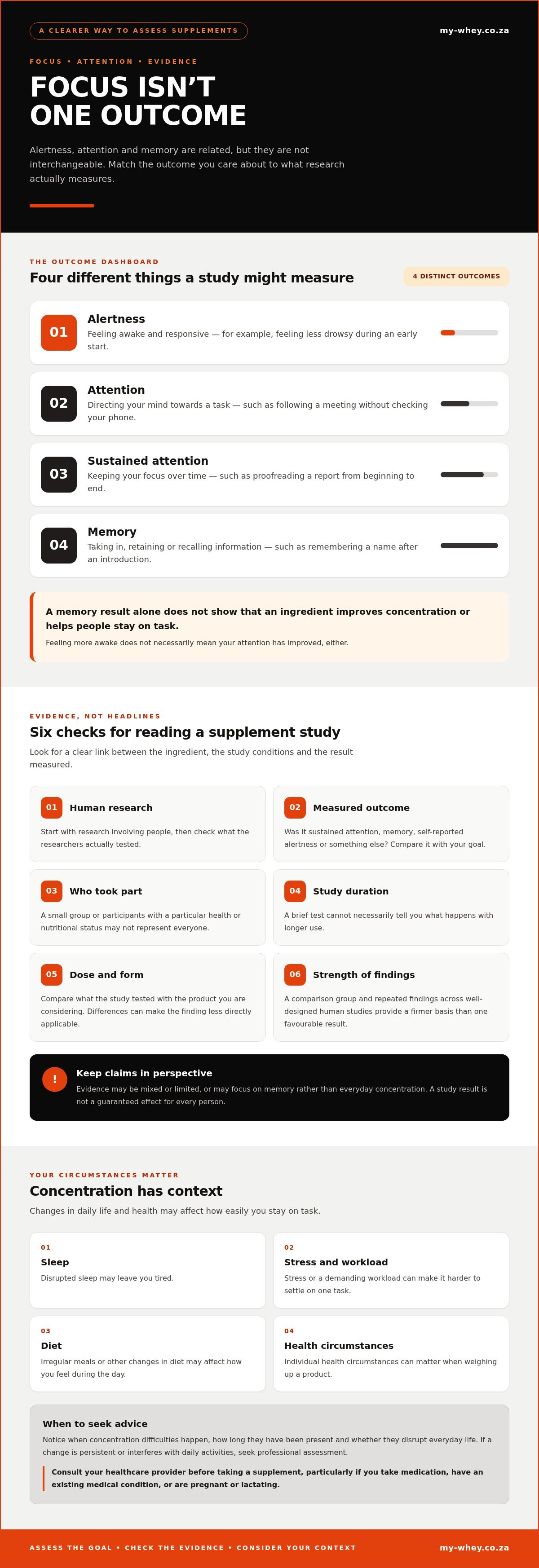
Alertness is feeling awake and responsive, such as feeling less drowsy during an early start. Attention is directing your mind towards a task, such as following a meeting without checking your phone. Sustained attention means keeping that focus over time, such as proofreading a report from beginning to end.
Memory is different: it involves taking in, retaining or recalling information, such as remembering a name after an introduction. These abilities can overlap in everyday life, but they aren’t interchangeable research outcomes. If a study measures whether participants remember information, that result alone can’t show that an ingredient improves concentration or helps people stay on task.
The same caution applies to personal experience. Feeling more awake doesn’t necessarily mean your attention has improved, and a result in a study group can’t promise the same effect for every user. When assessing the best supplements for focus and concentration, first identify the specific outcome you hope to support.
Why concentration concerns need context
Consider what else has changed alongside your concentration. Poor sleep may leave you tired; stress can make it harder to settle on one task; and irregular meals or other changes in diet may affect how you feel during the day. Health circumstances can matter too. These factors don’t point to one explanation, but they can help you describe the pattern more clearly.
Notice when the difficulty happens, how long it has been present and whether it disrupts work, study or everyday activities. If a change is persistent or interferes with daily life, seek professional assessment rather than relying on a supplement to explain or resolve it. You don’t need to diagnose yourself before asking for help.
Before taking any supplement, consult your healthcare provider, particularly if you take medication, have an existing medical condition, or are pregnant or lactating. A clear goal and an understanding of your health context make the evidence in the next section more useful.
What does the evidence say about supplements for focus?
An ingredient being sold for focus is not the same as a demonstrated clinical outcome. A label may describe a product’s intended use; it doesn’t show that the finished product improves attention in everyday life. To assess the evidence, look for a link between a specific ingredient, a studied dose and a clearly measured result.
Marketing language describes a promise; evidence tests a specific outcome under defined conditions. Keep that distinction in view as you compare the best supplements for focus and concentration. Research may offer useful clues, but it rarely justifies a guaranteed result for every person.
How to judge a supplement study
Start with human research, then check what the researchers actually measured. Was it a test of sustained attention, a memory task, a self-reported feeling of alertness or something else? A positive result on one measure doesn’t automatically establish a benefit on another. The closer the measured outcome is to your goal, the more relevant the finding may be.
Next, look at who took part and how the study was run. Findings from a small group, or from participants with a particular health or nutritional status, may not apply to everyone. Study duration matters too: a brief test cannot necessarily tell you what happens with longer use. Compare the dose and form tested with the product you’re considering. If they differ, the study may be less directly applicable.
One study is a starting point, not a verdict. Repeated findings across well-designed human studies provide a firmer basis for confidence than an isolated result. Check whether researchers used a comparison group and whether the result was meaningful for the outcome, rather than relying on a headline or one favourable measure. For some ingredients, evidence may be mixed, limited or focused on memory or another outcome rather than everyday concentration.
What broad brain-health claims cannot prove
“Brain support” can refer to several different aims, from memory to general wellbeing. Without a precise claim and supporting research, the phrase doesn’t establish that a product improves focus, prevents cognitive decline or treats a health condition. Nor does evidence about one ingredient prove that every product containing it will have the same effect. Formulation, dose and study conditions all matter.
Harvard Health has cautioned that many brain-health supplement claims lack solid proof. Read that as a reason to examine each ingredient and outcome carefully, not as proof that every ingredient is ineffective. A fair conclusion may be that a finding is promising but uncertain, applies only to a particular group, or hasn’t been shown to translate into noticeable day-to-day change.
Product quality and evidence of an effect are separate questions. My Whey products are third-party laboratory tested for purity; this quality information does not prove a concentration benefit. If you’re comparing products, explore My Whey’s cognitive-support options with that distinction in mind.
How do common focus-support ingredients compare?
Use this comparison to distinguish an ingredient’s presence in a product from evidence for a particular outcome. Research findings depend on the ingredient and formulation studied, the participants, dose and test used. For example, a result involving memory doesn’t automatically show improved concentration.
No ingredient comparison, by itself, establishes a guaranteed result for an individual. Treat the evidence notes as a guide to useful questions, not a ranking of products.
| Ingredient | Common product form | Evidence caveat | Question to consider |
|---|---|---|---|
| Lion’s Mane | Capsules or powder | Evidence for everyday focus should be assessed against the specific human outcomes studied; don’t assume a result transfers to every extract or product. | What outcome and formulation did the research examine? |
| Omega-3 fatty acids | Softgels or oils | A 2020 meta-analysis reported an episodic-memory benefit from DHA, particularly among people with low baseline omega-3 levels. Memory is not the same as sustained attention. | Does the evidence match my goal and circumstances? |
| Ashwagandha | Powder or capsules | Evidence for stress-related outcomes should not be presented as proof of a direct concentration benefit. | Is the claim about stress, focus or another outcome? |
| Creatine | Powder or capsules | A 2018 systematic review reported positive effects on short-term memory and reasoning. Those findings don’t establish a general focus benefit. | Was attention actually measured? |
| Caffeine with L-theanine | Tablets, capsules or drinks | Research has examined task performance for the combination; findings don’t establish an equivalent effect for either ingredient alone. | Does the product contain both, and what outcome was tested? |
| Bacopa or ginkgo | Extracts in capsules or tablets | Evidence varies by ingredient and outcome; findings for one use shouldn’t be treated as proof of better everyday concentration. | Are the human findings consistent and relevant to my goal? |
Lion’s Mane: assess the claim, not just the label
My Whey offers Lion’s Mane Mushroom Extract in capsule and powder forms. These formats tell you how the ingredient is presented, not whether it improves concentration. Look for human research and the outcome measured, then consider whether the study’s extract and conditions match the product. A study on a particular formulation can’t establish that all Lion’s Mane products are equivalent.
Omega-3 and ashwagandha: compare their distinct contexts
My Whey’s range includes Omega 3 Softgels and Ashwagandha Powder, which is organic, vegan and gluten-free. The omega-3 finding above concerns episodic memory, not a guaranteed focus effect; claims about ashwagandha should be judged by the specific outcome studied. For broader background on fatty acids and their roles, consult the Definitive Guide to Omega 3 alongside this comparison.
Before choosing among the best supplements for focus and concentration, match the intended outcome to relevant human evidence, then review the product’s ingredient details and warnings. Ask a healthcare provider about suitability, particularly if you take medication or have an existing medical condition.
How can you choose a focus supplement more carefully?
A clear selection process can help you avoid buying on trend alone. Start with the problem you want to address, then check whether the ingredient, evidence and product information genuinely fit. Don’t use a supplement to replace prescribed care or delay assessment of a health concern.
Start with the reason concentration feels difficult
Before comparing products, note when concentration changes, how long it has been happening and how it affects daily life. Is it occasional, tied to a particular situation, or making work and routine tasks difficult? These details help clarify your goal and can be useful in a conversation with a healthcare provider.
Also consider practical foundations such as sleep, stress and regular meals. Addressing them may support general wellbeing, but they aren’t a guaranteed fix or a substitute for professional advice. Seek assessment for persistent, sudden or disruptive changes in concentration.
Check quality, suitability and safety
Read the full label rather than relying on a front-of-pack phrase such as “brain boost”. Check the ingredient names, serving information, warnings and any other active ingredients. Compare what the product contains with the ingredient and outcome you’re considering, and don’t assume a familiar ingredient name proves the product matches a research formulation.
Use this process in order:
- Define your goal. Decide whether you’re looking for support related to alertness, sustained attention or another specific outcome. These are different aims.
- Review the evidence. Look for human research that measures an outcome relevant to your goal, and note where findings are limited or don’t directly apply.
- Read the whole label. Check all ingredients, serving information and warnings. Avoid products whose contents or intended use you don’t understand.
- Consider your health context. If you take medication, are pregnant or lactating, or have an existing medical condition, discuss suitability and possible interactions with your healthcare provider before taking a supplement.
- Make one considered decision. Avoid starting several new supplements at once, which can make it harder to identify what you’re taking and notice unwanted effects. Follow the product label and professional guidance.
My Whey products are third-party laboratory tested for purity. This is quality information, not proof that a product improves concentration. To compare options by ingredient relevance and label details, explore My Whey’s cognitive-support supplements.
Always consult your health care provider before taking any supplements. Pregnant or lactating women, people with existing medical conditions, or people taking medications should consult their health care provider/s before taking any dietary supplement. Keep out of reach of children.
These statements have not been evaluated by the Food and Drug Administration. This product is not intended to diagnose, treat, cure or prevent any disease.
Which My Whey cognitive-support options can you explore?
With the ingredient comparisons and evidence checklist in mind, you can consider My Whey’s cognitive-support options more clearly. The range includes Lion’s Mane Mushroom Extract, Ashwagandha Powder and Omega 3 Softgels. Review their ingredients and stated attributes, but don’t treat them as proven treatments for concentration.
Explore confirmed products with realistic expectations
Lion’s Mane Mushroom Extract is available in capsule and powder forms. The format may help you decide how you prefer to take an ingredient, but it doesn’t establish a difference in cognitive effect. Don’t assume research on a particular extract or formulation automatically applies to every product containing Lion’s Mane.
Ashwagandha Powder is organic, vegan and gluten-free. Those attributes may matter when considering ingredient preferences, but they don’t demonstrate a focus benefit. Omega 3 Softgels are another option in the range. As with any ingredient, assess the research against the outcome you’re interested in rather than treating the product category as evidence of improved concentration.
The aim isn’t to choose the product with the boldest brain-health language. It’s to decide whether an ingredient and its product information make sense for your circumstances. A capsule and a powder are different formats, but format alone can’t tell you whether an ingredient is relevant to your goal.
Review product information before deciding
Read the current product details and full ingredient information. Check the stated attributes, serving information and warnings, and consider whether the product matches the specific ingredient and outcome you’ve been researching. Don’t infer a benefit from the product name or category if the details are unclear.
My Whey products are third-party laboratory tested for purity. That is useful quality context, but it isn’t proof that a product improves focus, memory or another cognitive outcome. Bulk pricing is a business feature, not an indicator of efficacy. Keep product quality, value and evidence as separate parts of your decision.
If you take medication, have an existing medical condition, or are pregnant or lactating, consult your healthcare provider before taking a supplement. Product information can help you prepare specific questions, but it doesn’t replace advice tailored to your health context.
If one of these options fits the ingredient and format you want to investigate, review its product information with your intended outcome, the available evidence and your personal circumstances in mind. The best supplements for focus and concentration aren’t defined by a label alone.
Make your next choice with confidence
Your next step doesn’t need to be a purchase. Decide what you want to learn, keep your expectations realistic and use product information to make a considered choice. The best supplements for focus and concentration are options that make sense for your goal and personal circumstances, not simply those with the boldest claims.
My Whey products are third-party laboratory tested for purity. Lion’s Mane Mushroom Extract is available in capsule and powder forms, and bulk supplement pricing is part of the business’s value proposition. These details can inform your comparison, but they don’t establish a cognitive benefit. Review product information and consult your healthcare provider if you have questions about suitability.
Explore My Whey’s cognitive-support range and review the product details before deciding. Choose with the intended outcome, evidence and your personal circumstances in view.
Frequently Asked Questions
Can focus supplements replace coffee?
No. A focus supplement shouldn’t be treated as a direct replacement for coffee or a guaranteed way to improve concentration. Products vary in ingredients and intended use, and people can respond differently. Caffeine-containing drinks and supplements aren’t interchangeable categories: a supplement may contain different ingredients or none of the caffeine found in coffee. Read the label carefully, and discuss caffeine or supplement use with a healthcare professional if you have health concerns.
How long does it take for a focus supplement to work?
There’s no universal timeline for focus supplements. Ingredients differ, and research may assess different outcomes over different periods, so a claim about one product can’t set expectations for another. Don’t assume you’ll notice an immediate effect or choose a trial duration without product-specific evidence. Follow the product label, keep a simple record of what you take and how you feel, and seek professional advice if concentration concerns persist.
Can a nutrient deficiency affect concentration?
Some health or nutrition factors can affect concentration, but difficulty focusing on its own doesn’t prove you have a nutrient deficiency. For example, struggling to concentrate during a busy week isn’t enough to identify a cause or decide which nutrient to take. Avoid self-diagnosis or using supplements instead of an assessment. If the problem persists or concerns you, discuss your symptoms and overall circumstances with a healthcare provider, who can advise whether further evaluation is appropriate.
Are focus supplements safe to take with prescription medication?
It depends on the supplement’s ingredients, your medication and your individual health circumstances. “Natural” or over-the-counter doesn’t automatically mean suitable to combine with prescription treatment. Before starting a supplement, show your healthcare provider its full ingredient list and label, and ask about possible interactions. This is especially important if you’re taking medication, managing a medical condition, pregnant or lactating. Don’t stop or change prescribed medication to accommodate a supplement without professional guidance.
Do focus supplements work for everyone?
No supplement can be presented as a reliable solution for everyone. Research may apply to a particular ingredient, group of participants or measured outcome, rather than to every person or product. A product listing or positive testimonial also can’t guarantee your experience. If you’re comparing the best supplements for focus and concentration, consider whether the evidence matches your goal, whether the product suits your circumstances and what safety questions to raise before use.
What should I do if concentration problems continue?
If concentration difficulties persist, worsen or interfere with daily activities, speak with a qualified healthcare provider rather than repeatedly adding supplements. They can consider your circumstances and discuss appropriate next steps. Seek timely help for sudden or severe changes. Before an appointment, note when the difficulties began and how they affect your routine. Bring the labels or a list of any supplements you’ve taken, so your provider has clear information to consider.