

Best Natural Sweeteners for Health: How to Choose in 2026
The best natural sweeteners for health may not be the ones with the most reassuring label. “Natural” can describe ingredients with very different levels of processing and nutritional effects, so it is not a reliable shortcut to a healthier choice.
Honey, stevia and erythritol differ in more than their source. Their nutritional profiles, available evidence and performance in recipes are not the same.
This guide compares common options by nutrition, evidence and intended use, so you can choose a sweetener that suits your needs without relying on exaggerated health claims. You’ll learn what “natural” means in context, what to look for on labels, and why a sweetener that works in a drink may behave differently in baking. Choose according to evidence, everyday use and personal tolerance, not just a reassuring word on the packet.
Key Takeaways
- Learn why “natural” alone doesn’t tell you how a sweetener is made or whether it suits your needs.
- Compare the best natural sweeteners for health by nutrition, evidence, taste and practical use.
- Consider serving size and your own blood glucose response rather than relying on broad claims.
- Choose with your recipe in mind: sweeteners can behave differently in drinks, sauces and baking.
- Read the full ingredient list and nutrition panel, especially when comparing blends or sourcing ingredients for regular use.
Best natural sweeteners for health: what does natural actually mean?
Does natural automatically mean healthier? No. The word may describe where an ingredient comes from, how it is processed, or simply how it is presented on packaging. By itself, it does not tell you how much energy or carbohydrate a serving contains, how it may affect blood glucose, or whether it offers a demonstrated health advantage.
A natural sweetener is a sweet-tasting ingredient with a natural source or origin; that description alone is not evidence that it is healthier than sugar. This distinction matters when comparing the best natural sweeteners for health. Origin, processing, nutrient content and health effects are separate questions. A plant-derived ingredient can be highly refined, while a less processed syrup can still contain substantial sugars.
What counts as a natural sweetener?
The term can cover several different groups. Plant-derived sweeteners include extracts from plants such as stevia. Syrups, including honey, are sweet liquids that contain sugars. Sugar alcohols, also called polyols, are another category. Erythritol, for example, can be made through fermentation. These ingredients differ in composition and production, even when their starting materials have natural origins.
Processing affects what ends up in the packet. An extract may be separated and refined from a plant, while a syrup may retain a mixture of sugars and other components. Sugar alcohols have their own chemical structure and are not the same as table sugar. The broad range of types of sweeteners helps explain why one label word cannot describe an ingredient’s properties.
Treat “natural” as a description to investigate, not a consistent health grade. Check the ingredient name, how it is used and the product’s nutrition information. A blend may contain more than one sweetening ingredient, so consider its overall composition.
Does natural mean healthier than sugar?
Not necessarily. Nutrition facts and portion size are more useful than the word natural alone. Honey and syrups, for instance, still contribute sugars and energy. Using less may change how much you consume, but a natural source does not make those sugars nutritionally irrelevant.
Added sugars matter in the context of your overall diet. Replacing table sugar with a sweetener that contains sugars may not reduce your sugar intake if you use a similar amount. Products with little or no sugar are not automatically the best option for everyone either. Ingredients, serving habits and individual tolerance all affect whether a choice works well.
Keep the questions distinct: What is the ingredient made from? How is it processed? What do its nutrition details show per serving? And what evidence supports a health benefit? A marketing description may answer the first question, but it does not settle the others.
There is no single best choice for every person or recipe. A sweetener that suits a drink may not provide the texture or browning needed in baking, and personal preferences differ. Use “natural” as a starting point, then choose according to the ingredient, the amount you use and the job it needs to do.
How natural sweeteners affect nutrition, blood glucose and health
Sweetness alone does not tell you what an ingredient contributes. To compare products fairly, check the nutrition panel and compare the same weight, such as per 100 g, before considering your usual serving. A teaspoon-to-teaspoon comparison can mislead because syrups and granulated sweeteners differ in density, so spoonfuls may not weigh the same.
Sugar-containing sweeteners and nutrition
Honey, maple syrup and date-based syrups contain sugars and provide energy. Their carbohydrate and sugar content varies by product, so use the label rather than assuming all syrups are alike. Compare sugars and energy for an equal weight, then consider how much you actually add. A large drizzle can contribute more than a small measured amount, whatever its source.
Some syrups contain small amounts of other nutrients, but that does not make them a meaningful source of nutrition in typical portions or cancel out their sugars. The World Health Organization (WHO) recommends limiting free sugars to less than 10% of total energy intake, with a conditional recommendation to reduce them below 5% for additional health benefits. WHO includes sugars naturally present in honey and syrups among free sugars. The practical point is simple: a different source does not make sugar intake irrelevant.
Non-sugar sweeteners and individual responses
High-intensity sweeteners, such as steviol glycosides from stevia, provide sweetness in small amounts. Sugar alcohols, such as erythritol, are a separate group with different properties. Products sold as blends may contain other ingredients, so the nutrition profile of one component may not describe the whole product. Check the ingredient list and panel, particularly for carbohydrate and energy information.
Blood glucose responses depend on the sweetener, the amount consumed, the rest of the food and the individual, so a general claim cannot predict everyone’s response. A sweetener that contributes little or no sugar may affect blood glucose differently from honey or syrup, but the complete meal and personal response still matter. If you monitor blood glucose, use your own readings and any clinical advice relevant to you rather than relying on a front-of-pack claim.
Possible mechanisms and short-term measurements are not the same as proven long-term health outcomes. The WHO’s guidelines on non-sugar sweeteners recommend against relying on these sweeteners for long-term weight control, based on the evidence reviewed. This is not a finding that every approved sweetener is unsafe. It is a caution that replacing sugar with a non-sugar sweetener has not established a reliable long-term weight-control benefit.
To identify the best natural sweeteners for health for your routine, weigh nutrition, portion size, intended use and tolerance together. Clear ingredient and serving information can make comparisons easier, particularly with regular use. My Whey offers bulk sweetener ingredients for everyday recipes.
Which natural sweeteners are best for health? A practical comparison
There is no one option that is best for everyone. A useful comparison weighs sweetness, nutrition, flavour, recipe performance and personal tolerance. The table gives a general guide, not a product-specific nutrition claim: composition varies by brand, extraction method and added ingredients. Compare labels on the same basis, such as per 100 g, then consider the amount you actually use.
| Sweetener | Sweetness and flavour | Energy and carbohydrate | Possible uses and trade-offs |
|---|---|---|---|
| Stevia extracts | High-intensity; some people notice a lingering or bitter note | Pure extracts are used in small amounts; blends vary | Drinks and some recipes. Not a one-for-one sugar replacement in baking |
| Monk fruit extracts | High-intensity; flavour depends on the extract and blend | Check the full product label; carriers can add carbohydrate or energy | Drinks and recipes suited to the product’s formulation |
| Honey | Sweet, with a recognisable floral flavour | Contributes sugars, carbohydrate and energy | Drinks, sauces and dressings; its sugars still count |
| Maple syrup | Distinctive, caramel-like flavour | Contributes sugars, carbohydrate and energy | Sauces and baking where its flavour is welcome |
| Date syrup | Rich, fruity sweetness | Contributes sugars, carbohydrate and energy; values vary | Sauces and baking; may alter colour and flavour |
| Erythritol | Less sweet than sugar; can have a cooling sensation | A sugar alcohol; nutrition values and labelling depend on the product | Some drinks and baking; texture and tolerance can differ |
Stevia and monk fruit: high-intensity options
Stevia and monk fruit extracts are much sweeter than sugar, so products are designed to be used in small amounts. That does not mean every packet contains only the plant extract. Granulated versions may combine it with other ingredients to make measuring easier, changing the product’s carbohydrate content, taste and behaviour in recipes. Check the ingredient list and follow the product’s directions.
Honey, maple syrup and date syrup: sweetening with sugars
Honey, maple syrup and date syrup each bring a different flavour and texture, but all contribute sugars. Their carbohydrate and energy figures can differ between products, so use each nutrition panel and compare equal weights rather than equal spoonfuls. Trace nutrients do not establish a meaningful overall health advantage for one syrup over another. Choose according to flavour and cooking function, while keeping the amount in view.
Erythritol and other sugar alcohols
Erythritol is a sugar alcohol, not ordinary sugar. It can provide sweetness and bulk in recipes, though it may not reproduce sugar’s texture or browning. Tolerance varies, and larger amounts of sugar alcohols can cause digestive symptoms for some people. A 2023 study in Nature Medicine found an association between higher blood erythritol levels and cardiovascular events; this does not prove that eating erythritol causes those events. The evidence remains an area of research, so avoid treating it as a proven health benefit or a settled risk.
To find the best natural sweeteners for health for your needs, match the ingredient to the recipe and compare the product label. My Whey’s bulk ingredient range includes carbohydrates, fibre and sweeteners, providing a practical sourcing option for regular use.
How to choose the best natural sweetener for your needs
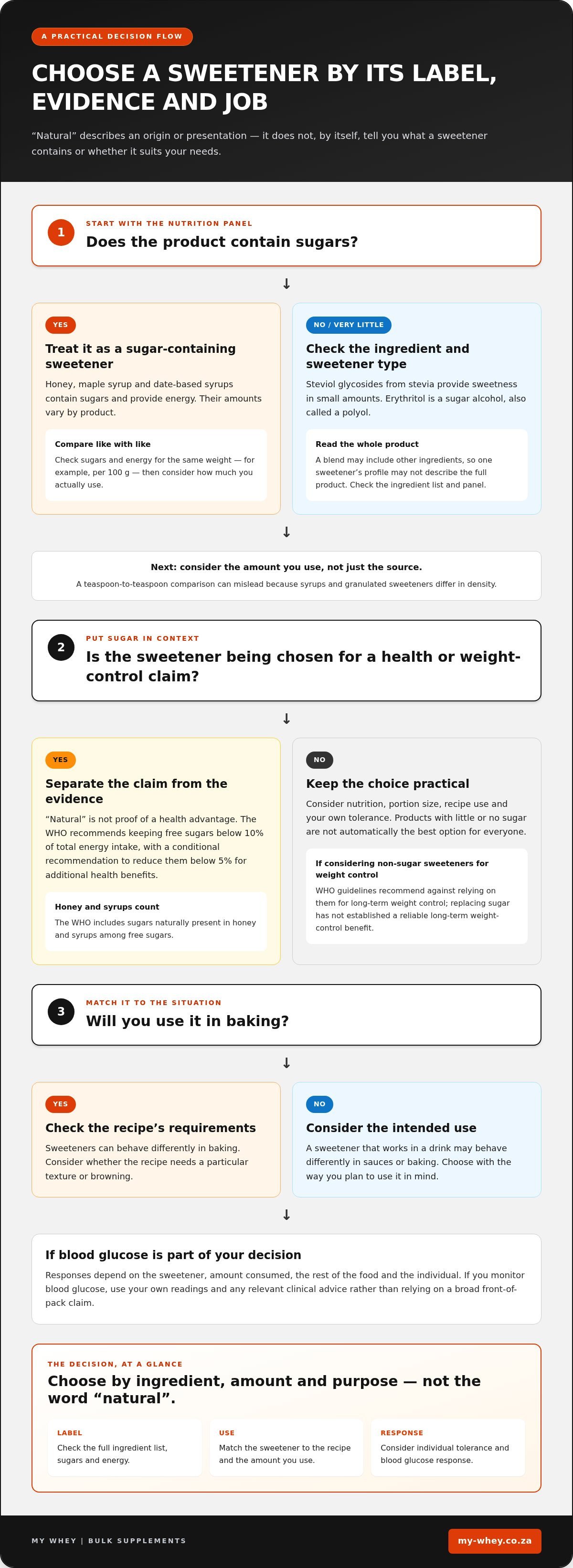
Start with the job you need the sweetener to do, not a universal health ranking. The best natural sweeteners for health are the ones that fit your priorities, recipes and serving habits. Use this decision process to narrow the options.
- Set your main priority. Are you aiming to reduce added sugar, manage carbohydrate intake, or choose a particular flavour? These goals can point to different ingredients, so be clear about which matters most.
- Check the product, not just the sweetener name. Read the ingredient list and nutrition panel. A blend may include other ingredients that affect its carbohydrate content, energy or sweetness.
- Consider your usual serving. Think about how much you add to a drink or recipe and how often you use it. Nutrition information is most useful when compared with the quantity you actually consume.
- Match it to the recipe. A high-intensity sweetener may suit a drink, while a syrup may contribute flavour and moisture to a sauce. Baking often needs more than sweetness, so a substitute may change the result.
- Assess taste and tolerance. Try a small amount first. A lingering flavour or digestive discomfort can make an otherwise suitable choice a poor fit for your routine.
Match the sweetener to your health priority
If you are reducing added sugars, focus on the sugars in the product and how much you use, rather than assuming a natural source has a special advantage. If you are managing carbohydrate intake for a medical reason, discuss choices with a qualified health professional who understands your needs. Sweetener selection can support a broader eating pattern, but it cannot replace a balanced diet.
Match the sweetener to the recipe and your tolerance
Sugar contributes bulk, moisture and browning in baking, as well as sweetness. A sugar substitute may not provide all of these, so an automatic one-to-one swap can affect texture and colour. Test a small batch, follow the product’s directions and adjust in measured steps. If sugar alcohols cause digestive discomfort, note the ingredient and amount. Tolerance varies. For wider digestive-wellness context, explore a gut health supplements guide.
For drinks or a protein shake, begin with a small amount and taste before adding more. A sweetener’s flavour can interact with the drink, so adjust gradually. If you are choosing a protein base as well, a whey protein guide can help you compare the role of that ingredient separately from the sweetener.
For regular use, compare bulk sweetener ingredients by their labels and intended application. My Whey offers bulk ingredient options for everyday recipes.
How to buy and use sweeteners thoughtfully with My Whey
Once you know what you need from a sweetener, use the label to decide whether a product fits. Front-of-pack wording can help you spot an option, but the ingredient list and nutrition panel provide more practical details. This is especially useful when comparing the best natural sweeteners for health, because products with similar claims may have different ingredients, serving guidance and nutrition profiles.
Read the label before choosing
Start with the named sweetener source, then check for other ingredients. A product described as a blend may combine a sweetener with a bulking ingredient or another component that affects taste, texture or nutrition. Do not assume two blends are interchangeable just because they use the same plant-derived sweetener.
- Check the complete ingredient list. Note each sweetening ingredient and any other components in the blend.
- Review the serving information. See how much the suggested serving weighs and how it compares with the amount you normally use.
- Compare nutrition on the same basis. Use the same quantity, such as the listed values per 100 g, before considering your usual portion.
- Read health claims critically. Treat phrases such as “natural” or “no added sugar” as prompts to examine the ingredients and evidence, not proof of a health benefit.
Then test the product in the way you intend to use it. A blend that works well in a hot drink may not give you the texture you want in a sauce or baked recipe. Follow the pack’s usage guidance and adjust gradually, rather than assuming a spoonful will replace the same amount of another sweetener.
Choose a format that suits regular use
Bulk buying can be practical if a sweetener is already part of your regular cooking or food preparation. First consider how often you will use it, how much you need and whether you can store it appropriately. Follow the product label for storage and handling after opening; conditions can vary by ingredient and format.
Value involves more than the amount in a pack. My Whey offers bulk pricing across nutritional ingredients and focuses on avoiding unnecessary retail packaging, making it a practical option for sourcing ingredients you use regularly. Choose according to intended use, label information and value, rather than buying more than your routine calls for.
A measured approach keeps the choice practical: compare the full label, try a suitable amount and note how the ingredient performs in your recipes. My Whey’s bulk sweetener ingredients are available for regular use.
Make your next choice with confidence
Your next step does not need to be a perfect, permanent choice. Pick one sweetener that fits a recipe you make often, use the label to guide your portion, and notice how its flavour and texture work for you. That practical experience can be more useful than chasing a universal answer about which option is best.
The best natural sweeteners for health are ultimately the ones that suit your needs without relying on a claim on the front of the pack. Keep your priorities clear, compare ingredients carefully and make changes at a pace that feels manageable.
My Whey’s Carbohydrates, Fibre and Sweeteners category offers ingredients for your own recipes, with bulk pricing and a focus on avoiding unnecessary retail packaging.
Explore My Whey’s bulk sweeteners and ingredients for options to use in your everyday recipes.
Frequently Asked Questions
Is stevia healthier than sugar?
Not automatically. A stevia extract may provide sweetness with little sugar, but the finished product’s ingredients matter, especially if it is blended with a bulking ingredient. If your aim is to reduce sugar, compare the amount you would use with the sugar it replaces, and check whether the taste works for you. The best natural sweeteners for health depend on your needs, not an ingredient’s reputation alone.
Can natural sweeteners affect blood glucose?
Yes. Honey, maple syrup and other sugar-containing sweeteners can contribute carbohydrate that affects blood glucose. A high-intensity extract may contribute little sugar, but a blend can contain additional ingredients. If you monitor your levels, check the full product label and compare readings under similar conditions, such as with the same meal. One person’s response does not reliably predict another’s.
How much natural sweetener is safe to have each day?
There is no one daily amount that applies to every sweetener and every person. Products differ in composition, and some approved sweeteners have specific acceptable daily intake limits, while syrups contribute sugars that count towards overall intake. Follow the product’s directions and use the smallest amount that meets your needs. If you are pregnant, managing a health condition or unsure about regular use, ask a qualified health professional for individual guidance.
What happens if sugar alcohols cause bloating or discomfort?
If you notice bloating, gas or discomfort after using a sugar alcohol, stop or reduce it and see whether symptoms settle. Check the ingredient list, as sugar alcohols may appear in products marketed as low-sugar or sugar-free. People vary in tolerance, and the amount consumed can matter. If symptoms are severe, persistent or recurring, seek advice from a health professional rather than continuing to experiment.
Are natural sweeteners suitable for people with diabetes?
Some may fit an individual eating plan, but “natural” does not mean glucose-neutral or suitable for everyone. A person with diabetes should check total carbohydrate per serving, including ingredients in blends, and account for syrups such as honey in their usual plan. Do not change medication or treatment to accommodate a sweetener. A doctor or dietitian can help match choices and monitoring to your care plan.
Is honey healthier than maple syrup?
Neither has a proven overall health advantage over the other. Both add sugars, so the better choice often comes down to the flavour you want and how much you use. Honey can bring a more pronounced floral note, while maple syrup has its own characteristic flavour. Choose the one that suits the finished dish, then measure it rather than pouring freely.
Can natural sweeteners be used in baking?
Yes, but results depend on the ingredient and recipe. Syrups add liquid as well as sweetness, so they can change moisture and texture. High-intensity extracts add little bulk and may not brown like sugar. Start with a recipe designed for that sweetener or test a small batch before adapting a favourite. Record the amount and result so you can adjust the next bake deliberately.