

Best Time to Take Creatine for Muscle Growth: 2026 Guide
In the first quarter of 2026, creatine became the most-searched wellness term on Amazon, yet thousands of lifters are still confused about the best time to take creatine for muscle growth. You have likely seen influencers arguing over whether you must take your supplement exactly thirty minutes before a session or risk wasting your money. It is exhausting to sift through conflicting advice whilst worrying that your current routine isn't delivering the strength gains you have worked for.
We are here to clear the confusion with a results-oriented approach to supplementation. This guide provides a definitive schedule to help you maximise hypertrophy and maintain muscle saturation without the stress of complex loading phases. We will explore why post-workout timing offers a physiological edge and how to pair your dose for superior uptake. You will also discover how to source high-purity, affordable creatine monohydrate right here in South Africa. We have handled the complexities of quality control so you can focus on your performance.
Key Takeaways
- Capitalise on post-workout insulin sensitivity to drive nutrients directly into your muscles for faster recovery and growth.
- Identify the best time to take creatine for muscle growth to ensure your cellular energy stores remain fully saturated throughout the week.
- Maintain your progress on rest days with a simple maintenance protocol that ignores the outdated need for supplement cycling.
- Choose between a fast-track loading phase or a steady daily dose based on your specific timeline for strength and hypertrophy gains.
- Secure long-term results by prioritising lab-tested, high-purity creatine monohydrate that provides maximum potency without filler-related costs.
Understanding Creatine and Why Timing is Debated amongst Athletes
Creatine monohydrate remains the undisputed gold standard for muscle power and recovery. It's one of the most rigorously researched substances in sports science. By Understanding Creatine and its biosynthesis, we see it isn't a stimulant but a fundamental energy precursor. Your muscles use Adenosine Triphosphate (ATP) for every contraction. This fuel source burns out in seconds during heavy lifting. Phosphocreatine steps in to donate a phosphate molecule, regenerating ATP instantly so you can push through those final, growth-triggering repetitions. Without this chemical assistance, your power output drops rapidly, limiting your ability to stimulate new muscle fibres.
The athletic community has long debated the best time to take creatine for muscle growth because everyone wants a metabolic shortcut. They look for a specific window where the body might absorb the compound more efficiently. This search for an edge is logical, especially when you're investing time and effort into a strict training regime. However, we must distinguish between two distinct goals:
- Acute effects: The immediate physiological response to a single dose.
- Long-term saturation: The cumulative buildup of creatine stores in the muscle tissue over time.
The Saturation Principle: Why Daily Use is Non-Negotiable
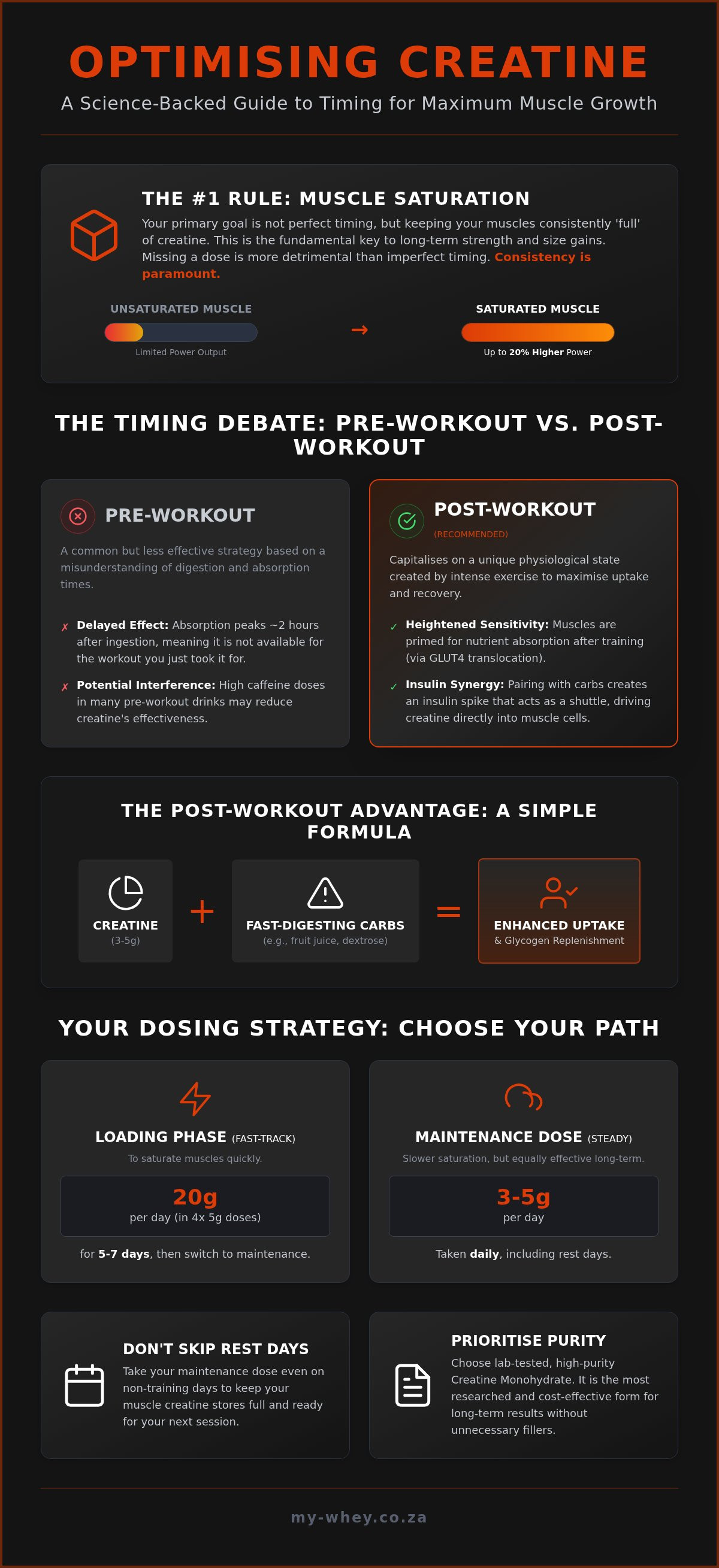
Creatine builds up in your muscle tissue over several weeks of consistent use. This state of saturation drives long-term hypertrophy. A saturated muscle contains up to 20% higher phosphocreatine levels, allowing for increased power output. Missing a dose is far more damaging to your gains than getting the timing slightly wrong on a training day. Steady daily intake ensures your muscles stay topped up and ready for exertion. Consistency is your primary lever for success.
The Science of Nutrient Partitioning
Nutrient partitioning is the physiological process by which your body directs ingested energy and compounds toward either muscle tissue for growth or adipose tissue for storage. Your body prioritises where nutrients go based on recent physical activity. Intense exercise increases blood flow to targeted muscle groups, creating a delivery highway for supplements. Aligning your intake with these periods ensures the compound reaches the cells that need it most. This is why many experts suggest the best time to take creatine for muscle growth is near your workout window.
Pre-Workout vs. Post-Workout: What Does the 2026 Research Say?
Determining the best time to take creatine for muscle growth often feels like a choice between two competing camps. On one side, lifters argue for pre-workout priming to ensure maximal power during the set. On the other, many athletes prioritise post-workout recovery to capitalise on the body's heightened state of nutrient absorption. Current 2026 Research suggests that whilst both methods are effective, the physiological conditions immediately following exercise provide a slight advantage for long-term hypertrophy and strength gains.
Pre-Workout Priming: Energy and Focus
Taking your dose 30 minutes before you hit the gym is a common practice, but it's often based on a misunderstanding of human digestion. Creatine absorption typically peaks around 2 hours after ingestion. This means a dose taken just before your first warm-up set isn't actually available to your muscles until your session is nearly finished. Additionally, some evidence suggests that high doses of caffeine, found in many pre-workout stacks, might interfere with creatine's ergogenic effects if taken simultaneously. If you prefer a pre-session routine, ensure you account for these transit times to avoid gastrointestinal discomfort whilst under heavy loads. The goal is to have your stores topped up before you start, rather than relying on a last-minute spike in levels.
Post-Workout Recovery: Uptake and Glycogen
The case for post-workout timing centres on the body's unique state after intense physical stress. Exercise triggers the translocation of glucose transporters, specifically GLUT4, to the cell surface. This process increases your muscle's sensitivity to nutrients significantly. When you pair your supplement with a carbohydrate source, the resulting insulin spike acts as a shuttle, driving the creatine into the muscle cells more efficiently. This synergy supports both rapid glycogen replenishment and cellular hydration. For those focused on efficiency, using a high-purity creatine monohydrate alongside your post-gym shake is a smart way to streamline your recovery protocol and guarantee that every gram is put to work.
While the 'anabolic window' is often exaggerated in marketing, it isn't entirely a myth. After training, blood flow to the worked muscles remains elevated for a significant period. This creates a window where nutrient delivery is optimised. Studies comparing the two timings often show that post-workout consumption leads to slightly greater increases in lean mass and strength over several months of training. It isn't a night-and-day difference, but for the athlete seeking the best time to take creatine for muscle growth, the evidence leans toward the post-exercise window. Consistency remains the most important factor, but choosing the post-workout slot ensures you are working with your biology rather than against it.
Managing Rest Days and the Importance of Muscle Saturation
Rest days are often when supplement routines fall apart. Without the structure of a gym session to trigger your memory, it is easy to skip a dose. This is a significant mistake for anyone chasing maximal hypertrophy. The best time to take creatine for muscle growth on a rest day is whenever you can be most consistent. This is because the primary goal on non-training days is maintaining muscle saturation. Your muscles don't use up their stores in a single day, but they do require a steady supply to remain topped up. If you stop taking it, your levels begin a slow decline. It takes roughly four to six weeks for these stores to return to baseline, a process known as the wash-out effect.
Many lifters still believe the outdated myth that they should cycle creatine to "reset" their body's natural production. There is no evidence to support this. In fact, stopping on rest days only delays your progress by forcing your body to re-saturate the tissue later. You might also worry about bloating if you take it without exercising. It is important to understand that creatine-related water retention is intracellular. The water is pulled into the muscle cells themselves, not under the skin. This cellular hydration is actually a key driver of protein synthesis and muscle fullness. It isn't subcutaneous bloat that hides your hard-earned definition.
Maintaining the Routine for Long-Term Gains
Integrating your dose into your morning routine is the most reliable strategy for long-term adherence. Taking it with your first meal of the day provides a consistent anchor for the habit. Many athletes find success by pairing their powder with other daily health staples like omega 3 softgels. This creates a simple, high-impact stack that you can manage regardless of your physical activity levels. Consistency is the engine of muscle growth. If you struggle to remember, keep your container next to your coffee machine or breakfast bowl to ensure you never miss a day of saturation.
Creatine and Cognitive Benefits on Rest Days
Creatine's value extends far beyond the weight room. A 2026 survey of 542 users revealed that over 23% of people aged 55 and over now use the supplement primarily for cognitive performance and focus. The brain is an energy-intensive organ that relies on the same phosphocreatine system as your biceps. Unlike your muscles, your brain doesn't have "rest days" from thinking. It requires a constant supply of energy to maintain mental clarity and executive function. Creatine enhances cognitive performance by rapidly replenishing cellular energy in the brain during periods of high mental demand. By maintaining your intake on rest days, you are supporting your mental resilience just as much as your physical recovery.
Maximising Absorption: Pairings, Dosage, and Loading Phases
Achieving results requires more than just showing up at the gym. It requires precision in your dosage. The industry standard for maintenance is 5g daily. This amount is sufficient for most athletes to keep their muscles saturated. Whilst some larger individuals might require slightly more, 5g remains the sweet spot for efficiency and cost-effectiveness. Identifying the best time to take creatine for muscle growth is only half the battle; you must also ensure your dosage is high enough to replace what is depleted during intense training sessions.
Creatine is osmotically active. It draws water into your muscle cells to support cellular energy. This means you must increase your daily water intake to support this shift in hydration. Aim for an additional 500ml to 750ml of water for every 5g of creatine you consume. This prevents dehydration and supports the volumising effect that contributes to hypertrophy. Proper hydration ensures the supplement can function effectively without causing unnecessary strain on your system.
The Loading Phase Protocol
- Step 1: Ingest 20g daily for 5 to 7 days. Split this into four 5g doses throughout the day to maximise uptake and minimise waste. This is the fast-track method to reaching full muscle saturation.
- Step 2: Transition to a 3 to 5g maintenance dose once your muscles are full. This keeps your stores topped up for the long term.
- Step 3: Monitor for digestive comfort. If the loading phase causes stomach upset, skip it. You'll still reach full saturation in about 30 days by taking 5g daily from the start.
Optimal Supplement Stacking
Pairing your dose with whey protein creates a powerful recovery environment. The amino acids in the protein work alongside the creatine to repair damaged tissue. Adding branched chain amino acids to your intra-workout drink can also help maintain intensity during your sets. Simple sugars like dextrose are the most effective transport mechanism. They trigger an insulin response that shuttles the powder into your cells. This insulin spike is the key to bypassing the digestive bottlenecks that can slow down absorption. For the best results, buy pure creatine monohydrate in bulk to ensure your stack is built on high-quality foundations without unnecessary fillers.
Choosing Pure Creatine Monohydrate for Long-Term Gains
Selecting the right supplement is as critical as identifying the best time to take creatine for muscle growth. High-purity creatine monohydrate is the baseline for all strength and hypertrophy goals. Unfortunately, the supplement market is often flooded with products containing unnecessary fillers, flavours, and additives that do nothing for your performance. These contaminants can interfere with absorption and, in some cases, cause digestive distress that halts your training progress. When you're looking at a label, you should see one ingredient: 100% pure creatine monohydrate. Anything else is just marketing noise designed to inflate the price point.
We understand that serious athletes value substance and efficiency. By choosing a lab-tested, filler-free source, you ensure that every gram you ingest is contributing directly to your phosphocreatine stores. This transparency allows you to feel secure in your wellness journey, knowing that you aren't consuming banned substances or low-grade raw materials. It's about finding a reliable ally that has already done the heavy lifting of vetting and curation for you. To identify a quality product, look for:
- Zero additives: No sweeteners, colours, or anti-caking agents.
- Lab-tested purity: Assurance that the batch is free from heavy metals.
- Micronised powder: For better solubility and easier mixing.
The Advantage of Bulk Sourcing
Retail packaging often inflates the price of simple ingredients significantly due to branding and distribution costs. Buying in bulk is the smartest way to maintain a daily habit without breaking your budget. Larger volume purchases are also more environmentally friendly, as they reduce the amount of plastic waste associated with monthly tubs. In the South African market, sourcing your supplements nationally from a bulk provider ensures that you get the freshest batches available. We focus on moving high volumes quickly so that your powder hasn't been sitting on a retail shelf for months. This methodical approach to sourcing guarantees potency and purity at a fraction of the traditional retail cost.
The My Whey Quality Guarantee
Our commitment to transparent, results-oriented nutrition is at the heart of everything we do. We provide high-purity creatine monohydrate that serves as a staple for serious South African athletes who want a no-nonsense partner in their fitness journey. We have handled the complexities of quality control so that you can focus on hitting your personal bests. There is no need for flashy marketing when the results speak for themselves. Shop our pure Creatine Monohydrate today and take the final step in optimising your muscle-building stack with a product that prioritises your goals over retail hype. By combining the best time to take creatine for muscle growth with the highest quality powder, you are setting yourself up for long-term, sustainable gains.
Mastering Your Supplement Strategy for 2026
You have explored the physiological advantages of post-workout timing and the critical role of daily muscle saturation. Whilst the best time to take creatine for muscle growth is often debated, the evidence points toward leveraging the post-exercise window for superior nutrient uptake and recovery. Consistency remains the foundation of your success; skipping doses on rest days only stalls your progress and depletes your cellular stores. Pairing high-purity powder with proper hydration and strategic carbohydrates ensures you maximise every gram for hypertrophy.
We believe in providing the tools you need without the marketing hype. Optimise your gains with pure Creatine Monohydrate from My Whey. Our 100% pure, lab-tested formulas provide maximum potency at affordable bulk prices. With national delivery across South Africa, maintaining your performance has never been more efficient. Focus on your training and let us handle the purity of your stack. Start your journey toward a stronger, more resilient physique today.
Frequently Asked Questions
Is it better to take creatine before or after a workout?
Post-workout is the slightly superior option for those seeking the best time to take creatine for muscle growth. After training, your body's insulin sensitivity is heightened and blood flow to worked muscles is increased. This state allows for more efficient nutrient uptake into the cells. Whilst taking it pre-workout isn't wrong, the physiological environment after a session offers a better window for absorption and recovery.
Can I take creatine on an empty stomach?
You can take it on an empty stomach, but many users find it more comfortable to consume with a meal. Taking it with carbohydrates or protein can actually enhance absorption by triggering an insulin response. If you experience any mild digestive discomfort when taking it alone, try mixing your dose into your post-workout shake or having it with breakfast. This simple adjustment ensures the supplement is well-tolerated.
How much water should I drink when taking creatine?
Aim to drink an additional 500ml to 750ml of water for every 5g dose you consume. Because creatine is osmotically active, it draws water into your muscle cells to support energy production. Most active athletes should target a total daily intake of three to four litres. Proper hydration prevents cramping and ensures the volumising effects of the supplement are fully realised without placing unnecessary strain on your system.
Does creatine cause hair loss or kidney damage?
No scientific evidence links pure creatine monohydrate to hair loss or kidney damage in healthy individuals. The hair loss myth stems from a single 2009 study that has never been replicated. Regarding kidney health, hundreds of long-term studies show no adverse effects on renal function for those with no pre-existing conditions. It remains one of the safest and most researched supplements available for long-term daily use.
Should I take creatine on rest days?
You must take it on rest days to keep your muscle stores fully saturated. If you stop on non-training days, your phosphocreatine levels will slowly begin to decline toward their natural baseline. Consistency is the most important factor in seeing long-term strength and hypertrophy gains. Treat your daily dose like any other health habit; take it with breakfast or your morning coffee to ensure you never miss a day.
What happens if I miss a day of creatine?
Missing a single day won't ruin your progress, but you shouldn't double your dose the following day. Simply resume your standard 5g maintenance schedule as soon as you remember. It takes several weeks for muscle stores to fully deplete, so one missed day is a minor hurdle. The best time to take creatine for muscle growth is whenever you can most reliably remember to take it every single day.
Can I mix creatine with my hot coffee or tea?
You can absolutely mix your powder with hot beverages like coffee or tea. High temperatures do not degrade the compound; the heat actually helps the micronised powder dissolve more completely. This can be a smart strategy for rest days or for those who prefer not to drink cold shakes in the morning. Just ensure you still maintain your overall daily hydration targets to support the intracellular water shift.
Do I need to load creatine every time I start a new tub?
You do not need to repeat a loading phase if you have been consistent with your maintenance dose. Once your muscles are saturated, a daily 5g dose is all that's required to keep them topped up. Loading is only necessary when you first start supplementation or if you have taken a break of four weeks or longer. Transitioning directly from one tub to the next on a maintenance schedule is the most efficient approach.