

Creatine Monohydrate vs HCL in South Africa: The 2026 Performance Guide
You're likely paying a 100% "marketing tax" every time you choose a "designer" supplement over a standard tub of pure, lab-tested powder. It's an expensive habit that rarely delivers the performance boost promised on the flashy label. When weighing up creatine monohydrate vs hcl south africa, the sheer volume of conflicting advice from retail brands can make your decision feel like a confusing gamble. You want to build lean muscle and avoid digestive discomfort, yet the massive price gap between these two forms suggests that one must be vastly superior to the other.
We understand the frustration of sifting through a market filled with over-hyped claims and unnecessary fillers. This 2026 guide reveals the scientific reality of different creatine forms to help you maximise your results and stop wasting money on clever packaging. We'll break down the SAHPRA-regulated facts on absorption rates, address the persistent myths surrounding water retention, and show you how to source high-purity ingredients at bulk rates that respect both your budget and your gut health.
Key Takeaways
- Understand why Creatine Monohydrate remains the most researched and trusted sports supplement for building lean muscle mass effectively.
- Distinguish between liquid solubility and actual muscle bioavailability to see if the higher price tag of HCL actually translates to better gains.
- Debunk the myths surrounding digestive discomfort and water retention by learning how to manage your dosage for optimal muscle volumisation.
- Evaluate the creatine monohydrate vs hcl south africa market to identify where you are paying a "marketing tax" on retail packaging instead of for pure ingredients.
- Implement a precise loading and maintenance strategy to saturate your muscles efficiently whilst avoiding unnecessary waste and costs.
Understanding Creatine Monohydrate and HCL: The Fundamentals
To understand the debate surrounding What is Creatine?, we must first strip away the glossy marketing labels. Both forms share a singular objective: saturating your muscle phosphocreatine stores to drive explosive power. When comparing creatine monohydrate vs hcl south africa, the conversation usually centres on how efficiently that fuel reaches the muscle tissue. Monohydrate consists of a creatine molecule paired with a single water molecule. In contrast, Creatine HCL is bonded with a hydrochloride group. This specific chemical shift is what drives the current debate amongst South African athletes who are increasingly wary of "filler" ingredients in retail products. We're looking for substance over style.
The Proven Track Record of Monohydrate
Creatine Monohydrate isn't just another option; it's the undisputed gold standard of sports nutrition. It stands as the most researched supplement in history, with decades of clinical trials confirming its safety and efficacy for strength and hypertrophy. Thousands of peer-reviewed studies support its role in increasing lean body mass. Historical complaints about "gritty" textures have been largely eliminated by micronisation. This process reduces the particle size to ensure the powder dissolves cleanly into your shake. For the South African consumer, the priority should be lab-tested purity. By focusing on bulk, raw ingredients, you ensure you're getting the exact material used in those clinical studies without the retail markup. It works. It's proven. It remains the benchmark for a reason.
The Modern Appeal of Creatine HCL
Creatine HCL entered the market with the promise of high-tech efficiency. By attaching a hydrochloride molecule, manufacturers created a form of creatine that is significantly more soluble in water than standard monohydrate. The theory is straightforward: if a substance dissolves better, the body might absorb it more effectively, allowing for smaller daily doses. This has made HCL a staple in the "designer supplement" category, often sold in smaller, more expensive tubs. It appeals to users who want to skip the traditional loading phase or those who are sensitive to the acidity of other powders. However, it's essential to look past the solubility in a glass and examine how these molecules actually perform once they reach your muscles. Solubility doesn't always equal results.
The Solubility Debate: Does HCL Build More Muscle?
Marketing campaigns for "designer" supplements often highlight how quickly a powder dissolves in a glass of water. Whilst HCL is undeniably more soluble than standard powders, this doesn't automatically translate to superior muscle growth. When evaluating creatine monohydrate vs hcl south africa, we must distinguish between solubility in a shaker and bioavailability in the muscle. Your body has a finite capacity to store phosphocreatine. Once your muscle cells reach their saturation point, any additional or "faster" absorption provides no extra benefit for hypertrophy or strength. It's like trying to fill a cup that is already brimming; the speed of the tap doesn't change the volume of the vessel.
Recent research, including a comprehensive Creatine HCL vs. Monohydrate Study, indicates that both forms produce nearly identical results in lean mass gains. The primary factor for success isn't the speed of delivery, but the consistency of saturation. If you're looking for the most efficient way to reach this state without the retail markup, choosing lab-tested creatine monohydrate remains the most evidence-based strategy for South African lifters.
Strength and Power Output Comparison
Clinical trials measuring one-rep max (1RM) data show no significant performance gap between the two forms. Athletes testing their explosive power in sprints and heavy compound lifts report similar improvements regardless of the chemical bond used. The traditional loading phase associated with monohydrate is simply a tool to reach muscle saturation in five to seven days rather than three weeks. Once that baseline is established, the performance outcomes are indistinguishable. Both forms provide the necessary phosphate groups to regenerate ATP during high-intensity sets.
Hormonal Response and Muscle Recovery
Newer data from 2024 and 2025 has looked closely at how these supplements affect the anabolic environment. Findings suggests that both monohydrate and HCL support a favourable testosterone-to-cortisol ratio during intense resistance training. This hormonal balance is crucial for reducing muscle protein breakdown and promoting recovery. Both forms effectively trigger muscle cell volumisation, which acts as a powerful anabolic signal for protein synthesis. Bioavailability refers to the proportion of ingested creatine that enters the systemic circulation and reaches the muscle tissue for phosphocreatine synthesis. Whether you use a smaller dose of HCL or a standard dose of monohydrate, the end result for your hormonal recovery profile remains the same.
The Truth About Bloating and Digestive Behaviour
The term "bloat" is frequently weaponised by supplement companies to push higher-priced products. When deciding on creatine monohydrate vs hcl south africa, it's vital to separate healthy muscle hydration from digestive discomfort. Most people confuse intracellular water retention with subcutaneous bloating. Intracellular hydration occurs when water is drawn into the muscle cell itself. This process, known as cell volumisation, is a powerful anabolic signal that encourages protein synthesis and muscle growth. It makes your muscles look fuller and harder, not soft or "watery".
Subcutaneous water retention, which sits under the skin and obscures definition, is rarely caused by pure creatine. This "soft" look is usually the result of poor diet, high sodium intake, or the cheap fillers found in many retail-grade supplements. Recent research comparing creatine monohydrate and HCL confirms that neither form significantly increases subcutaneous water when used correctly. The "creatine bloat" is largely a myth rooted in either poor-quality sourcing or a misunderstanding of how muscle tissue stores energy.
Managing Digestive Sensitivity
Gastric distress is the only legitimate "bloat" concern, and it usually stems from osmotic pressure. If you ingest a large dose of undissolved monohydrate, it can pull water into the intestines, causing discomfort or diarrhoea. You can easily avoid this by ensuring your powder is fully dissolved in enough liquid. Creatine HCL is more acidic and has higher solubility, which may benefit a small percentage of users with specific pH-related gut sensitivities. However, for the vast majority, simply splitting your monohydrate dose or mixing it with slightly warm water eliminates any digestive issues. Always check your labels for hidden sweeteners or thickeners. These additives are often the true culprits behind a heavy, unsettled stomach.
Physique Goals and Water Retention
Bodybuilders and athletes often worry about "holding water" before a competition or photo shoot. This has led to the false idea that HCL is a "dry" creatine whilst monohydrate is "wet". In reality, both forms aim to saturate the muscle with the same phosphocreatine molecule. If your muscles aren't hydrated, they won't perform or grow. Switching to HCL specifically to "dry out" is often unnecessary. True muscle definition comes from low body fat and proper electrolyte balance, not from avoiding the most effective muscle-building supplement in history. Focus on high-purity, raw ingredients to ensure your physique reflects your hard work without the interference of unnecessary retail fillers.
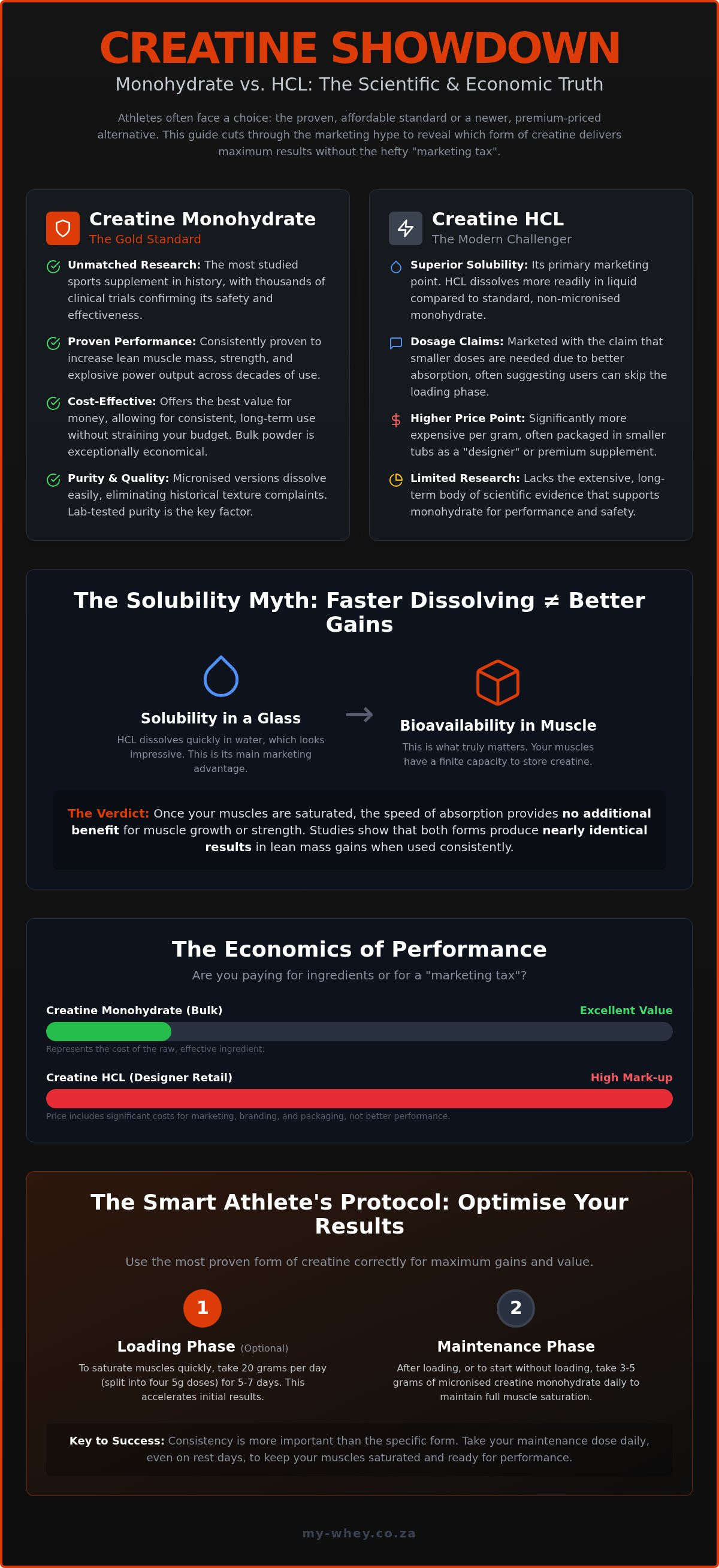
Economics of Performance: South African Market Analysis
South African athletes are becoming increasingly savvy about what goes into their supplement stacks. When you break down the actual cost of creatine monohydrate vs hcl south africa, the financial gap is staggering. Retail brands frequently market HCL as a superior, high-efficiency product, yet the price-per-gram is often double or triple that of pure monohydrate. This price hike rarely reflects a difference in raw material costs; instead, it covers the "marketing tax" of shelf space, influencer endorsements, and elaborate tub designs. For those training on a budget, the choice isn't just about science. It's about making every Rand work harder for your physique. The 2026 market shows a clear trend: serious lifters are moving away from flashy retail tubs in favour of transparent, bulk-sourced ingredients.
The Hidden Cost of "Designer" Formulations
Many commercial powders are loaded with flavour systems, anti-caking agents, and sweeteners that add nothing to your performance. These additives inflate the final price whilst diluting the actual active ingredient. Bulk suppliers like My Whey maintain lower prices by stripping away these unnecessary extras and focusing on high-purity, lab-tested raw materials. This minimalist approach doesn't just save you money. It also reduces the environmental footprint associated with excessive plastic packaging and complex supply chains. By choosing unflavoured bulk options, you ensure your investment goes directly into muscle saturation rather than artificial colouring or marketing hype. In South Africa, where supplement regulation under SAHPRA is strict, lab-testing for purity is non-negotiable. You want to know that what is on the label is exactly what is in the bag.
Investment vs. ROI for Muscle Growth
If you calculate the annual cost of a standard 5g daily dose, the savings from switching to bulk monohydrate can be substantial. These extra funds are better allocated to high-impact essentials that actually drive results. For example, pairing your creatine with a high-quality Whey Protein provides a more comprehensive foundation for recovery than any "new" molecular form of creatine ever could. Purity is a far better investment than novelty. When you buy in bulk, you gain full control over your dosages and avoid the proprietary blends that often hide low-quality fillers. You can source pure creatine monohydrate at wholesale rates to keep your performance goals on track without overpaying for retail hype.
The Verdict: How to Optimise Your Creatine Strategy
The evidence is clear: for 99% of South African athletes, pure monohydrate is the superior choice for both performance and value. Whilst HCL offers higher solubility, it doesn't provide a significant physiological advantage in muscle growth once saturation is reached. If you have a particularly sensitive stomach that reacts to the pH of standard powders, HCL might be worth the premium. Otherwise, you're better off investing in high-purity, bulk monohydrate. When comparing creatine monohydrate vs hcl south africa, consistency always beats novelty. Our focus remains on providing the raw tools you need to reach your goals without the unnecessary burden of a marketing tax.
Step-by-Step Dosing Protocol
You have two main paths to reach muscle saturation. The loading phase involves taking 20g per day, split into four 5g doses, for five to seven days. This approach saturates your muscles quickly, allowing you to see strength gains sooner. Alternatively, a steady 3-5g daily dose will reach the same saturation level in about three weeks. Timing is less critical than daily adherence, but taking your dose post-workout with a source of carbohydrates can enhance uptake through insulin stimulation. To ensure optimal solubility of bulk powders, use room temperature liquid rather than ice-cold water. Stir or shake vigorously for 30 seconds to ensure the powder is fully dissolved, which prevents the osmotic issues that lead to gastric distress.
Stacking for Success
Maximising your recovery requires more than just one ingredient. Stacking your creatine with Amino Acids helps protect muscle tissue during intense sessions and kickstarts the repair process. The synergy between creatine and carbohydrates is also well-documented; insulin helps transport the molecules into the muscle cells more effectively. When sourcing your supplements, use this final checklist for the best results in South Africa:
- Prioritise lab-tested purity to ensure the absence of fillers.
- Choose bulk pricing models to avoid paying for retail packaging.
- Look for unflavoured options to maintain control over your nutritional intake.
- Ensure the product is registered and compliant with local standards.
By following these principles, you turn your supplement budget into a high-ROI investment. My Whey is committed to this level of transparency, offering premium, lab-tested ingredients that allow you to train with confidence and clarity.
Elevate Your Training with Science-Backed Performance
Choosing the right supplement shouldn't feel like a gamble against clever marketing. We've explored the evidence behind creatine monohydrate vs hcl south africa to show that consistent muscle saturation is the true driver of your results. Whilst HCL offers high solubility, it doesn't outperform the decades of clinical success associated with pure monohydrate. By focusing on high-purity, raw ingredients, you can build lean muscle efficiently without the unnecessary retail markup or digestive discomfort caused by cheap fillers.
Success in the gym comes down to consistency and the quality of your fuel. Don't let flashy packaging distract you from the proven gold standard. You can secure your high-purity Bulk Creatine Monohydrate from My Whey today and experience the difference of lab-tested ingredients delivered across South Africa. We prioritise unbeatable bulk value so you can allocate your budget where it matters most. Take control of your supplementation strategy and start training with the conviction of an athlete who knows exactly what's in their stack. Your next personal best is waiting.
Frequently Asked Questions
Is Creatine HCL better than Monohydrate for fat loss?
No, neither form has a direct fat-burning effect. They help preserve lean muscle during a calorie deficit. HCL is often marketed as "dryer," but this is a misconception about healthy muscle hydration. Both support the metabolic rate by maintaining muscle mass. Focus on your total daily calorie intake for fat loss rather than the specific chemical bond of your creatine monohydrate vs hcl south africa.
Do I need to load Creatine Monohydrate in 2026?
Loading is optional but remains the fastest way to reach muscle saturation. You can take 20g daily, split into smaller doses, for five to seven days to see immediate strength gains. Alternatively, simply take 3-5g daily from the start. Both methods lead to the same saturation level after about three weeks. Monohydrate is significantly more cost-effective for these initial higher loading doses.
Does Creatine Monohydrate cause hair loss or kidney issues?
No clinical evidence supports the claim that creatine causes hair loss or kidney damage in healthy individuals. The hair loss myth stems from a single 2009 study that has never been replicated. For kidney health, creatine is safe provided you don't have pre-existing renal conditions. Always stay hydrated and consult a healthcare professional if you have specific medical concerns. It remains a benchmark for safety in South Africa.
Can I mix Creatine Monohydrate with my protein shake?
Yes, mixing creatine with your protein shake is an efficient way to ensure consistent daily intake. Most athletes prefer taking it post-workout when nutrient uptake is high. The presence of protein and carbohydrates can actually assist with the transport of creatine into your muscle cells. Since pure monohydrate is unflavoured, it won't alter the taste of your protein. Just ensure you shake well to avoid any residue.
How much Creatine HCL is equal to 5g of Monohydrate?
Manufacturers typically suggest that 1.5g to 2g of HCL provides similar saturation to 5g of monohydrate due to its higher solubility. However, there is limited peer-reviewed data confirming that these smaller doses lead to the same long-term muscle phosphocreatine levels. If your goal is guaranteed performance, the standard 5g dose of monohydrate is the only protocol backed by decades of research. Don't let smaller serving sizes justify a higher price.
Is it better to buy flavoured or pure unflavoured creatine in South Africa?
Pure unflavoured creatine is generally the superior choice for serious athletes. Flavoured retail products often contain artificial sweeteners, dyes, and anti-caking agents that can cause digestive upset. By sticking to unflavoured bulk powder, you avoid the "marketing tax" and gain full control over what goes into your body. It's easy to mix into any drink, allowing you to prioritise lab-tested purity and better overall value for your budget.
What happens if I stop taking creatine for a week?
Your muscle stores won't deplete overnight if you miss a week of supplementation. It takes approximately four to six weeks for phosphocreatine levels to return to baseline after stopping completely. You might notice a slight decrease in water-driven muscle fullness, but your strength won't vanish instantly. Simply resume your maintenance dose of 3-5g daily when you can. There is no need to restart a loading phase after a short break.
Is Creatine Monohydrate safe for teenage athletes in South Africa?
Research suggests that creatine is safe for healthy adolescent athletes involved in serious, supervised training. It can support performance in explosive sports like rugby or sprinting. However, it's essential to prioritise a balanced diet and proper coaching first. Under SAHPRA guidelines, supplements are intended to complement nutrition. We recommend that younger athletes discuss supplementation with their parents and a sports nutritionist to ensure they are using high-purity, lab-tested products.