

How to Check Supplement Quality in South Africa: 2026 Guide
A confident label isn’t proof of a quality supplement. If you’re searching for how to check supplement quality south africa, look beyond polished packaging and persuasive claims. Quality depends on evidence you can examine, from clear ingredient and serving information to relevant testing records.
Labels can be difficult to compare. Technical terms may blur important differences, and “lab-tested” doesn’t tell you which product or batch was tested, what was assessed or what the results show. Marketing language can sound reassuring, but it shouldn’t replace specific, verifiable information.
This guide gives you a practical way to assess supplements sold in South Africa. You’ll learn which label details to review before buying, what testing documents can and can’t demonstrate, and how to spot claims that need stronger evidence. Use the same checklist across products to compare them consistently and make a decision based on substance, not slogans.
Key Takeaways
- Use a repeatable label check to compare product identity, serving details, ingredients, claims and batch information.
- Learn how to check supplement quality south africa by looking for evidence behind claims instead of relying on persuasive wording.
- See why terms such as “pure”, “natural” and “lab-tested” can mean different things, and what supporting information may clarify them.
- Understand what testing documents can indicate about a product, and what they cannot prove on their own.
- Apply a practical before-buying checklist to online listings and labels, including when comparing bulk formats.
What does supplement quality mean in South Africa?
Supplement quality isn’t established by one impressive-sounding claim. Consider whether the product is correctly identified, its ingredients and declared amounts are clear, its purity and safety are supported by relevant controls, and its label gives useful information. Calling a product “premium” or “pure” doesn’t establish these things on its own.
A verifiable quality signal is specific information that can be checked against the product or its records; a marketing description expresses a benefit or impression without showing how it has been established. That distinction is central to how to check supplement quality south africa. A Dietary supplement can take different forms and contain different ingredients, so the checks should reflect the product you’re assessing.
Quality and suitability are separate questions. A well-made supplement may still be unsuitable for someone because of their health, medicines, dietary needs or intended use. Evidence can help you assess what a product is and how it was checked; it can’t predict an individual result or replace personalised medical advice.
Which evidence matters when assessing a supplement?
Start with the label, then look for an ingredient specification, a batch number and relevant test evidence. Check whether a document names the product and, where applicable, identifies the batch being sold. A general statement that products are “lab-tested” is a starting point, not a complete account of which products or batches were tested, what was measured or what the results showed.
Each record has limits. A test document applies to the sample and scope it identifies. It doesn’t automatically prove every quality attribute or guarantee how an individual will respond.
Why supplement quality checks vary by product type
Different ingredients call for different questions. With protein, compare the declared protein amount and serving information with the product’s ingredient details; the whey protein selection guide explores further selection factors. For creatine, check the ingredient identity and amount declared per serving. Omega 3 has different relevant label details from protein or creatine, so don’t assume the same evidence answers every question. Herbal products also need to be assessed in light of their specific ingredients and claims.
Use product-specific evidence rather than applying one universal test to every category. Packaging size and price, including for bulk formats, don’t establish quality by themselves. Check whether the product’s identity, label and available evidence fit together clearly.
How to check a supplement label and its testing evidence
A label is most useful when its details can be compared with product-specific evidence. Use this sequence to assess the basics before you buy:
- Confirm the product’s identity. Check the product name and form of the supplement, such as powder, capsule or softgel.
- Read the serving information. Note the serving size and, where stated, how many servings the container provides.
- Review the ingredients. Identify the active ingredient, its declared amount per serving if provided, and other ingredients such as flavourings or sweeteners.
- Put claims in context. Look for information that explains a claim. Don’t treat words such as “pure” or “premium” as proof.
- Check batch details. Look for a batch or lot reference that can connect the product to relevant records or test results.
Ingredient order and declared amounts need context. The order can help you see how ingredients are listed, but it doesn’t by itself confirm the quantity or quality of each one. Compare stated amounts with the serving information and the product category. A protein powder, for example, raises different label questions from a herbal supplement.
What should a Certificate of Analysis show?
Assess a Certificate of Analysis (CoA) by checking what it actually contains. Look for the product or ingredient identity, a batch or lot reference, the test date and reported results. Check which substances or contaminants were included in the test scope. A document reporting results for one analyte doesn’t show that every possible risk was assessed.
A test report supports only the results and sample it identifies; it doesn’t automatically establish the quality of every batch or every aspect of a product. A CoA is not automatically proof of certification or comprehensive product approval. Check that the document’s identity and scope match the claim being made.
How to read ingredient and serving information
Where an active ingredient and amount per serving are declared, compare them with the serving size so you know what the stated quantity refers to. Separate active ingredients from flavourings, sweeteners and other listed ingredients, as each has a different role in the formula. For products in the gut health category, the gut health supplement guide offers category-specific context.
This evidence-led approach makes how to check supplement quality south africa more practical: compare the label with relevant available records instead of relying on broad claims. You can review product information across My Whey supplements using the same checklist.
Which supplement quality claims can you trust?
Quality claims are useful only when they point to something you can assess. “Pure”, “clean”, “natural”, “premium” and “lab-tested” aren’t interchangeable standards. Treat the wording as a prompt to look for relevant evidence, not as proof that a supplement is effective, safe for everyone or superior to alternatives.
| Claim | Evidence to look for | What it cannot establish alone |
|---|---|---|
| Pure | A stated definition of purity and relevant test results for the product or identified batch. | That every possible contaminant was tested for, or that the product suits every person. |
| Clean | A clear explanation of what the term means for the formula, such as which ingredients are included or excluded. | A recognised quality standard unless one is specifically identified. |
| Natural | Ingredient details that clarify what the description refers to and how the ingredients are identified. | That the product is automatically safer, more effective or free from processing. |
| Premium | Specific, checkable details about ingredients, formulation or quality controls. | Any measurable quality advantage based on the word alone. |
| Lab-tested | Information about the sample, test scope, date and reported result, ideally linked to the product or relevant batch. | That every batch, quality attribute or health claim has been assessed. |
Does “lab-tested” mean a supplement is high quality?
Not by itself. Testing adds useful information when the sample and test are relevant to the claim. A test for ingredient identity or a particular contaminant may support that specific point, but it doesn’t establish broader claims about effectiveness, overall quality or personal suitability. Third-party testing can add information; consider whether the laboratory is independent and whether the test scope is clear. Don’t infer a method, result or batch coverage from the phrase alone.
My Whey’s wellness products are lab-tested. As with any such claim, its meaning depends on the product coverage and supporting evidence. A general statement doesn’t identify a particular test result, method or batch coverage.
What do purity, potency and certification actually tell you?
Purity needs a stated basis: what was assessed and against which criteria? Potency concerns the measured amount of an ingredient compared with the amount declared. Certification refers to a named standard and its defined scope, issued by an identified body. Don’t treat any of these terms as a blanket endorsement beyond what the evidence covers.
A high price, attractive packaging or one favourable test result can’t prove overall quality. When considering how to check supplement quality south africa, weigh each claim against its evidence and limits. Packaging and price may inform a purchase, but they don’t replace product-specific information.
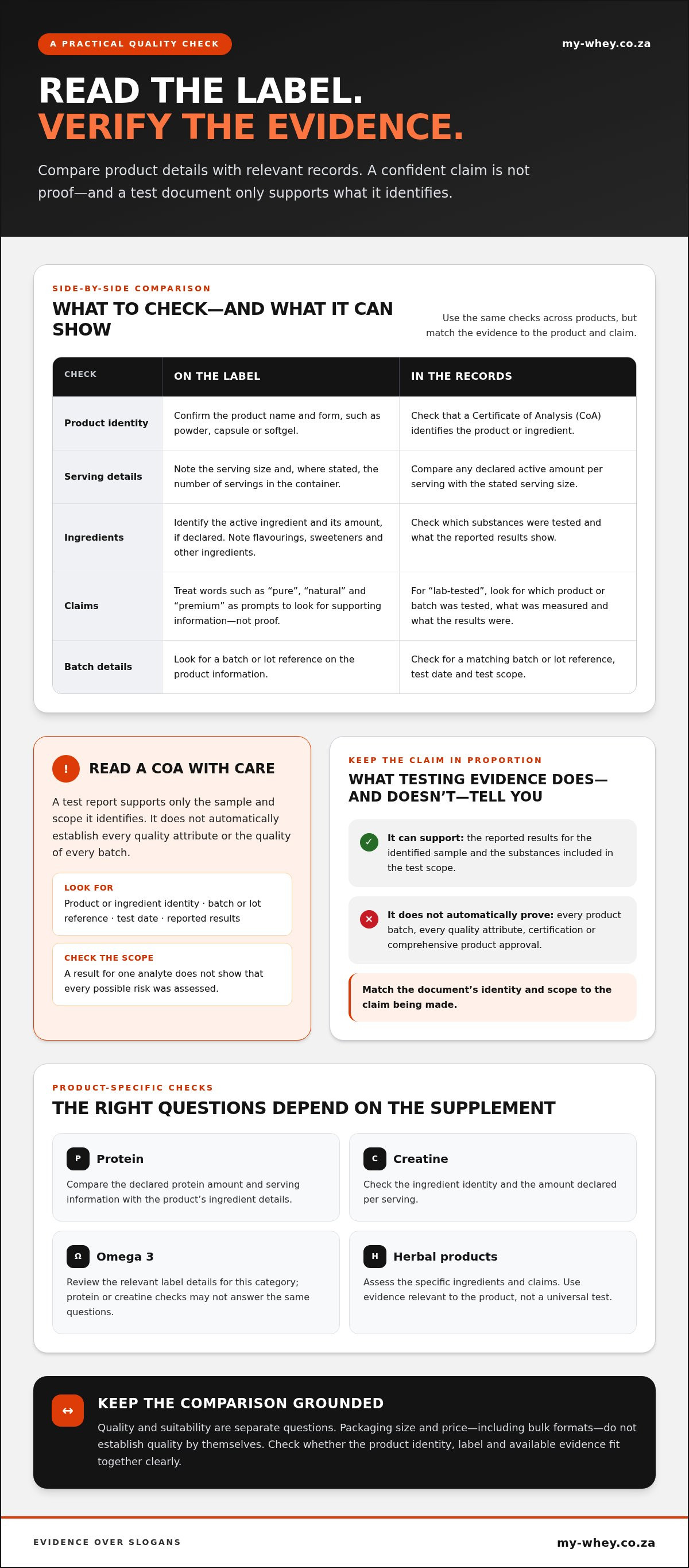
A practical checklist for checking supplement quality in South Africa
Use this checklist on both an online listing and the product label. If key information appears in one place but not the other, note the gap before deciding. The aim isn’t to find a single perfect signal; it’s to see whether the product’s identity, claims and available evidence make sense together.
- Confirm the product identity. Check that the product name and supplement type are clear and consistent across the listing and label.
- Read the full ingredient information. Look for named ingredients, declared amounts where provided, and other components such as flavourings or sweeteners.
- Understand the serving. Check the serving size and what the quantities refer to. Avoid comparing amounts based on different serving sizes.
- Look for traceability details. Check the physical label for a batch or lot reference and relevant date information. These details can help connect a product to its records.
- Match evidence to claims. If testing or other quality evidence is mentioned, consider whether it identifies the product or batch and explains what was assessed.
- Compare like with like. Apply category-specific questions: evidence relevant to protein may not answer the same questions as evidence for Omega 3 or herbal supplements.
For online purchases, product photographs may not show every label detail. Treat missing information as something to investigate, not as proof of a problem or a guarantee of quality. Note what the listing says, then compare it with the packaging you receive.
Which South African regulatory details should shoppers understand?
Regulatory classification and requirements can differ according to the product and the claims made about it. SAHPRA and the Department of Health are relevant official sources for understanding applicable South African requirements, but don’t assume every supplement follows one universal approval route. Check current official guidance for the product’s classification and relevant labelling terminology rather than relying on a seller’s broad statement of compliance.
What are warning signs on a supplement listing?
Pause if ingredient details are missing, serving information is unclear or the product is difficult to identify. Be cautious about claims that promise to prevent, treat or cure a disease; such promises deserve particular scrutiny and should not be accepted as evidence of quality. Missing online access to an optional document doesn’t, by itself, prove a product is unsafe. Assess the information available and whether the claims are supported.
For how to check supplement quality south africa, use the same checklist consistently while adapting your questions to the supplement category. The My Whey supplements range can be assessed against these details.
Choosing a quality-focused supplement supplier: next steps
Make your decision in a clear sequence: identify what you’re looking for, inspect the label, assess the evidence behind relevant claims, then compare suitable options. This keeps the product’s purpose separate from its packaging and marketing. It also gives you a consistent way to apply the principles of how to check supplement quality south africa without expecting one claim to answer every question.
How to compare products without relying on packaging or hype
Compare products in the same category. Note the ingredient identity, declared amount per serving, serving information and relevant product-specific evidence. Keep flavour, convenience and packaging preferences separate: they can affect what you choose, but they don’t demonstrate composition or quality. A short table or note on your phone can help you compare details accurately instead of relying on memory.
Bulk formats can suit different purchasing preferences, but size and price alone don’t establish quality. Use the same evidence-based approach for a small pack or a bulk format, and compare only details you can assess on the same basis.
Apply the checklist to My Whey’s supplement categories
My Whey’s range includes Whey Protein Concentrate 80%, Creatine Monohydrate and Omega 3 softgels, alongside other supplement categories. Each calls for relevant questions. For protein, review the declared protein information and serving details. For creatine, focus on the named ingredient and its declared amount where provided. For Omega 3 softgels, assess the product’s own ingredient and serving information. Evidence relevant to one category doesn’t necessarily cover another.
My Whey’s wellness products are lab-tested. Consider that claim alongside the evidence available for the relevant product. The product-specific details matter: a general statement doesn’t identify a particular test result, method or batch coverage. Build comparisons from clear product information and evidence that matches the claim, not from a slogan or presentation alone.
Identify your need, compare the relevant details and choose based on the evidence you can assess. Explore My Whey supplements.
Make your next supplement choice with confidence
Good supplement decisions start with clear information, not persuasive packaging. Check the product identity, ingredients and serving details, then weigh each quality claim against evidence that relates to the product and, where relevant, its batch. A test result can inform your assessment, but its scope matters. Quality doesn’t automatically mean a product is right for everyone.
Use this practical approach to how to check supplement quality south africa: identify what you need, compare products within the same category and keep track of the details that matter. My Whey’s wellness products are lab-tested, and the relevance of that claim depends on its product-specific scope and supporting evidence. The catalogue includes Whey Protein Concentrate 80%, Creatine Monohydrate, Omega 3 softgels and Amino Acids.
Ready to put the checklist into practice? Explore My Whey supplements and assess each option by its label and available evidence. A measured, informed choice is a strong next step towards your wellness goals.
Frequently Asked Questions
Is a lab-tested supplement automatically safe and high quality?
No. A lab test provides information only about the sample, substances and methods covered by that test. Check whether the report identifies the product or relevant batch, gives the test date and explains what was measured. A result may support a specific quality claim, such as ingredient identity or a particular contaminant check, but it doesn’t prove every aspect of quality, safety or effectiveness.
How can I check whether a supplement is pure?
Start with the product identity and complete ingredient list, then look for relevant product-specific test evidence. Check what the testing covered and whether a batch reference connects the evidence to the product, where applicable. “Pure” isn’t enough on its own: consider what the term means and what supports it. Relevant purity evidence depends on the ingredients and potential contaminants for that product category.
What should I look for on a supplement label in South Africa?
Check the product name, ingredients, serving information, supplier details, batch identification, directions and relevant warnings. Assess whether claims are specific and supported instead of relying on words such as “natural” or “premium”. A practical approach to how to check supplement quality south africa is to compare the label with relevant product evidence. Labelling obligations can depend on classification and current rules, so verify requirements using official South African sources.
Can I ask a supplement supplier for a Certificate of Analysis?
Yes. You can ask whether product-specific testing information is available and what it covers. A useful Certificate of Analysis should identify the product or batch, state the test date, name the measured substances and report the results. Read it within that scope: a certificate doesn’t automatically prove comprehensive testing, certification or effectiveness. A result for one sample shouldn’t be assumed to apply to every batch.
Does a higher price mean a supplement is better quality?
No. Price alone doesn’t establish ingredient identity, purity, potency or testing standards. Compare the declared ingredients and quantities, serving information, traceability details and relevant evidence instead. Packaging, flavour and brand presentation may matter to your shopping preferences, but they can’t substitute for product-specific quality information. The same principle applies to bulk formats: a larger pack or different price doesn’t prove that its contents are better or worse.
How do I know whether a supplement claim is misleading?
Look for a claim that is precise enough to assess and evidence that directly relates to it. Be cautious with absolute promises, vague terms and statements suggesting a supplement can treat or prevent disease. Check whether the supplier explains what the claim covers and whether the label gives enough detail to understand the product. For claims about regulatory status, consult current official guidance rather than relying on marketing wording.
Are all supplements in South Africa approved by SAHPRA?
Don’t assume every supplement follows the same classification or approval route. Requirements can depend on the product and its claims, and regulatory arrangements may change. Check the product’s classification and consult current official South African guidance, including relevant SAHPRA information, before treating registration or approval wording as proof of quality. Regulatory status doesn’t replace reviewing the ingredients, label and relevant testing evidence.