

How to Check Supplement Quality in South Africa: The 2026 Buyer’s Guide
If your protein powder label doesn't come with a batch-specific Certificate of Analysis, you aren't buying nutrition; you're buying a gamble. In a market where nitrogen spiking and under-dosed fillers remain common frustrations, understanding supplement manufacturing standards south africa is your only real defence. You likely feel the sting of wasting money on retail products that promise the world but hide behind vague proprietary blends. It's exhausting to keep up with the shifting landscape of SAHPRA regulations and the 2026 mycotoxin limits while simply trying to support your health.
We agree that transparency should be the baseline, not a premium feature. This guide gives you the exact framework to verify the purity and potency of any local brand. You'll learn which certifications, such as the R638 Certificate of Acceptability, actually guarantee safety and how to find high-purity bulk options. We're stripping away the marketing hype to show you how to vet every scoop with professional precision. By the end of this guide, you'll have the tools to ensure your investment in wellness is backed by hard data rather than empty promises.
Key Takeaways
- Understand how the South African Health Products Regulatory Authority (SAHPRA) categorises supplements to ensure your products meet legal safety requirements.
- Master the ability to verify supplement manufacturing standards south africa by prioritising batch-specific testing from independent, ISO 17025 accredited laboratories.
- Learn to decode a Certificate of Analysis (COA) to confirm that the protein and nutrient levels on the label match the actual laboratory results.
- Protect your health and budget by identifying common deceptive practices like nitrogen spiking and "fairy dusting" used by retail brands.
- Discover how bulk sourcing allows you to inspect raw ingredient quality directly while eliminating the cost of unnecessary fillers and branding.
The South African Supplement Regulatory Landscape in 2026
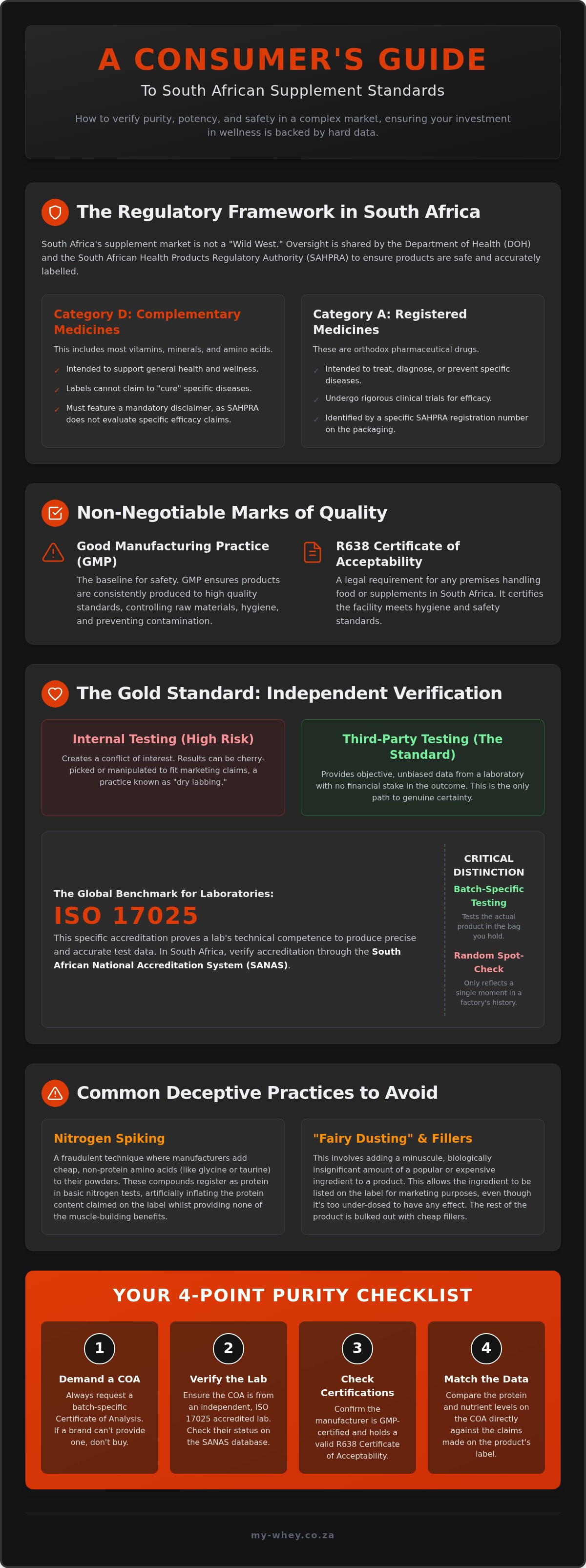
The notion that South African supplements exist in a regulatory "Wild West" is a persistent myth. While a Dietary supplement doesn't face the same decade-long clinical trial process as a pharmaceutical drug, the market is strictly governed. Oversight is shared between the Department of Health (DOH) and the South African Health Products Regulatory Authority (SAHPRA). By 2026, the enforcement of supplement manufacturing standards south africa has become significantly more robust. This follows years of legal clarity regarding the Medicines and Related Substances Act, ensuring that products are safe for public consumption and accurately labelled.
Category D vs. Registered Medicines
Vitamins, minerals, and amino acids are classified as Category D: Complementary Medicines. This distinguishes them from Category A medicines, which are orthodox drugs intended to treat specific diseases. The 2026 regulatory environment has tightened the rules around health claims. Labels can no longer use vague language to imply a "cure" for serious ailments without substantial evidence. To identify a registered medicine, look for a SAHPRA registration number. Most health supplements will instead feature a mandatory disclaimer. This indicates the product is intended to support health rather than replace medical intervention.
The Importance of GMP Certification
Good Manufacturing Practice (GMP) represents the baseline for safety in South African production facilities. It is a rigorous system designed to ensure products are consistently produced according to high quality standards. A GMP-certified facility must demonstrate strict control over raw material sourcing, equipment maintenance, and staff hygiene to prevent cross-contamination. In 2026, this includes adherence to the new mycotoxin regulations (R. 7091), which set strict permissible levels for contaminants in foodstuffs. You should verify a manufacturer's compliance by checking for a valid Certificate of Acceptability (COA) under Regulation R638. This certificate is a legal requirement for any premise handling food or supplements in South Africa.
The mandatory disclaimer on your bottle isn't a sign of poor quality; it's a legal requirement. It informs you that SAHPRA hasn't evaluated the product's specific claims for efficacy. Because the regulator doesn't test every individual batch, the responsibility for safety falls on the manufacturer. This is why we advocate for sourcing from providers who go beyond the minimum legal requirements. When a brand adheres to high supplement manufacturing standards south africa, they provide the lab data to back up their claims, giving you the confidence that the "Category D" product you're using is both pure and potent.
Essential Quality Marks: ISO 17025 and Third-Party Testing
Relying on a brand's internal testing is a significant risk. When a retail company tests its own products, a natural conflict of interest arises. They're incentivised to see the best possible results, which can lead to "dry labbing" or simply ignoring outliers that don't fit the marketing narrative. To uphold genuine supplement manufacturing standards south africa, independent verification is the only path to certainty. This moves the responsibility from a marketing department to a scientist with no stake in the brand's profit margins.
The global benchmark for this objectivity is ISO 17025. Unlike general business certifications, this specific accreditation proves a laboratory's technical competence to produce precise and accurate test data. In our local market, the South African National Accreditation System (SANAS) acts as the sole authority for accrediting these facilities. If a lab isn't SANAS-accredited, their results shouldn't be the basis of your health decisions. It's also vital to distinguish between a "random spot-check" and batch-specific testing. A spot-check only tells you about one day in the factory's history; batch-specific testing tells you exactly what's in the bag you're holding.
Verifying Laboratory Credentials
Don't take a brand's word for it. You can easily verify a laboratory's status by searching the SANAS national registry database. If a supplier refuses to name their testing partner, it's a massive red flag. Reputable providers are proud of their associations with high-calibre labs. They'll often provide a link or a PDF of the actual lab report. This level of transparency ensures that the supplement manufacturing standards south africa are being met at every stage of the supply chain, from raw ingredient arrival to the final packaged product.
Banned Substance Screening for Athletes
For competitive athletes, the stakes are even higher. A single instance of cross-contamination in a shared manufacturing facility can result in a positive doping test and a ruined career. This makes sourcing clean whey protein an absolute priority. You should look for marks from Informed-Sport or similar global anti-doping bodies. These organisations don't just test the final product; they audit the entire manufacturing process to ensure no banned substances ever enter the building. It's about creating a "clean" environment from the ground up.
We believe this level of scrutiny shouldn't be reserved for elites. Every consumer deserves to know their supplements are free from hidden contaminants and fillers. If you're looking for a partner that prioritises these rigorous benchmarks, explore our range of batch-tested bulk supplements designed for maximum purity and performance.
Decoding the Certificate of Analysis (COA)
A Certificate of Analysis (COA) is a batch-specific document that confirms laboratory test results. It serves as the only objective proof of a supplement's purity and potency, acting as a bridge between a manufacturer's claims and the physical reality of the raw ingredients. Whilst marketing materials focus on emotional benefits, the COA focus is purely on data. It provides a detailed breakdown of microbial limits, ensuring that pathogens like E. coli, Salmonella, yeast, and mould are well within safe thresholds. High-quality supplement manufacturing standards south africa dictate that these tests are non-negotiable for every batch released to the public.
Beyond biological safety, a comprehensive COA must include a rigorous heavy metal analysis. This section outlines strict limits for Lead, Mercury, Arsenic, and Cadmium. These elements are often found in soil and can accumulate in botanical extracts or marine sources. By reviewing these results, you ensure that your daily intake doesn't exceed safe toxicological levels. It's a vital step in maintaining long-term health whilst pursuing performance goals.
Assay Precision and Variance
The assay section is where you confirm that you're getting exactly what you paid for. If a bag of Whey Protein Concentrate 80% claims to be 80% protein, the "actual" result on the COA should reflect this with minimal deviation. South African labelling guidelines allow for slight variances, but a significant drop indicates poor quality control. Certain ingredients, such as raw branched chain amino acids, require even higher assay precision. Because these are often used in specific ratios, even a 5% variance can alter the effectiveness of your supplementation strategy.
Contaminant Limits and Safety
Understanding "Parts Per Million" (PPM) is essential when reading safety reports. This unit measures the concentration of a substance, where 1 PPM is equivalent to one milligram per kilogram. For products like omega 3, specific testing for mercury and PCBs (polychlorinated biphenyls) is vital due to the risk of bioaccumulation in fish oils. These reports ensure the oil is refined to the highest standards of purity.
Always check the date and batch number on the document. A common tactic for low-tier suppliers is to provide an outdated COA from a "golden batch" produced years ago. To maintain true supplement manufacturing standards south africa, the COA must match the batch number on your specific container. If the lab's signature is pixelated or the contact details for the testing facility are missing, you're likely looking at a forged document. Reputable suppliers will always provide a clear, verifiable report upon request to empower your buying decision.
Identifying Deceptive Practices: Spiking and Fillers
Understanding the legal framework is only half the battle. Even when a product meets basic supplement manufacturing standards south africa, brands often employ legal yet deceptive tactics to increase profit margins at your expense. These techniques, such as nitrogen spiking and fairy dusting, are designed to make a mediocre product look like a premium one on the shelf. You shouldn't have to guess if your hard-earned money is buying results or just clever chemistry.
The Truth About Protein Spiking
Most laboratories measure protein content by testing for total nitrogen. Because protein is rich in nitrogen, this is usually a reliable metric. However, unscrupulous manufacturers add cheap, non-proteinogenic amino acids like glycine or taurine to their powders. These aminos are high in nitrogen but contribute nothing to muscle protein synthesis. On the label, it looks like you're getting 25g of protein per scoop. In reality, a significant portion of that "protein" is just cheap filler that won't support your recovery goals. Always cross-reference the ingredient list with the nutritional table; if glycine or taurine appears near the top but isn't listed as a separate benefit, you're likely seeing a spiked product. A high protein count doesn't always equal high muscle-building potential if the amino acid profile is compromised.
Transparency vs. Proprietary Blends
Proprietary blends are the industry's way of hiding under-dosed ingredients behind a fancy name. When you see a "Performance Matrix" or "Energy Blend", you're only seeing the total weight of the mixture, not the specific dosage of each component. This often leads to "fairy dusting", where a brand adds a tiny, uselessly small amount of an expensive ingredient just to list it on the label for marketing. It's especially common in gut health supplements South Africa, where specific probiotic strains and dosages are critical for efficacy. Every milligram should be accounted for on a professional supplement label to ensure you're receiving a therapeutic dose.
Beyond active ingredients, pay close attention to excipients. Maltodextrin is a common, high-glycaemic filler used to add bulk and improve texture, but it can spike insulin levels unnecessarily. Excessive sweeteners and thickeners like xanthan gum are often used to mask the taste of poor-quality raw materials. These additives dilute the purity of the product and offer zero nutritional value. We believe in a no-nonsense approach where the raw quality of the ingredient speaks for itself, allowing you to avoid the "filler" of traditional retail branding.
If you're tired of guessing what's actually in your tub, switch to a partner that prioritises total transparency. Shop our range of filler-free bulk supplements and take control of your nutrition with lab-tested purity today.
Sourcing Excellence: The My Whey Approach to Purity
While the previous sections highlighted the risks prevalent in the retail market, we focus on a different path. We bypass the marketing hype and high retail markups to concentrate entirely on raw ingredient quality. By adopting a direct-to-consumer bulk model, we eliminate the unnecessary fillers and proprietary blends that often obscure the truth about what you're consuming. This approach allows us to uphold the highest supplement manufacturing standards south africa has to offer, ensuring that every bag of Creatine Monohydrate or Whey Protein Concentrate 80% meets strict laboratory benchmarks.
Transparency isn't just a buzzword for us; it's the foundation of our business model across South Africa. When you buy in bulk, you have the unique opportunity to inspect the product without the "filler" of heavy branding. You're seeing the raw material in its purest form. Our rigorous vetting process involves batch-testing every single shipment to verify that it meets our internal purity targets before it ever reaches your door. We've done the heavy lifting of sourcing so you can focus on your performance with total peace of mind.
Bulk Purity vs. Retail Marketing
We maintain pharmaceutical-grade standards whilst keeping our operational costs low by avoiding expensive retail storefronts and glossy advertising campaigns. This creates a significant advantage for the serious athlete. By choosing unflavoured, pure ingredients, you gain complete control over your nutrition. You can build your own custom stack using lab-tested, standalone components like Amino Acids or Carbohydrates, tailored specifically to your body's requirements. It's a methodical way to ensure you aren't consuming hidden sweeteners or thickeners that don't align with your performance goals.
Your Quality Assurance Checklist
Before you make your next purchase, take these final steps to protect your health and your investment. First, always check for the batch number on the packaging. Second, don't hesitate to request a batch-specific COA from your supplier; any company that prioritises supplement manufacturing standards south africa will provide this document without hesitation. Finally, look for a local partner that openly names their testing labs and sourcing origins. Choosing a transparent, South African-based partner ensures long-term safety and results because we are directly accountable to the local regulatory environment. It's about building a relationship based on data and reliability rather than empty marketing promises.
Secure Your Performance with Lab-Tested Purity
Mastering the supplement market in 2026 requires a shift from trusting marketing labels to verifying laboratory data. You now have the framework to distinguish between genuine quality and deceptive practices like nitrogen spiking or proprietary blends. By prioritising ISO 17025 accredited testing and demanding batch-specific Certificates of Analysis, you ensure that every gram of nutrition supports your specific physical goals. Adhering to rigorous supplement manufacturing standards south africa isn't just a regulatory hurdle; it's the only way to guarantee the safety and potency of your wellness journey.
We've eliminated the guesswork by focusing on raw ingredient transparency. Our model provides you with ISO 17025 lab-tested ingredients that contain no hidden fillers or "fairy-dusted" additives. This commitment to purity is backed by affordable national shipping across South Africa, bringing professional-grade quality directly to your door. Take control of your nutrition by choosing components that are as dedicated to your results as you are.
Shop Lab-Tested Bulk Supplements at My Whey
Frequently Asked Questions
Is it legal to sell supplements in South Africa without SAHPRA approval?
Yes, it's legal to sell supplements without formal registration, provided they follow the "Category D" labelling requirements. SAHPRA currently allows these products on the market if they include the mandatory disclaimer stating the regulator hasn't evaluated the claims. However, manufacturers must still comply with supplement manufacturing standards south africa regarding safety and hygiene under the Foodstuffs, Cosmetics and Disinfectants Act.
How can I tell if my protein powder has been "spiked" with cheap fillers?
You can identify "spiked" protein by cross-referencing the ingredient list with the nutritional table. If you see amino acids like glycine, taurine, or creatine added to a protein powder without being highlighted as separate benefits, they're likely used to inflate the nitrogen count. This makes the protein percentage look higher on paper than it is in reality. Always look for a full amino acid profile to verify the quality of the protein source.
Where can I find the Certificate of Analysis for my bulk supplements?
You should always request the Certificate of Analysis (COA) directly from your supplier. A transparent brand will provide a batch-specific document that matches the lot number on your product. If a company refuses to share this data or provides an outdated report, it's a sign that they aren't maintaining rigorous quality control protocols. Reputable providers often make these documents available via their website or customer support channels.
What are the most common dangerous ingredients in low-quality supplements?
Low-quality supplements often contain dangerous levels of heavy metals like lead and arsenic, or unlisted stimulants. Mycotoxins are another concern, which is why the 2026 regulations (R. 7091) set strict permissible limits for food safety. Avoid products that use vague "proprietary blends" as these frequently hide under-dosed active ingredients and excessive artificial fillers that can cause digestive distress.
Do bulk supplements have the same quality as expensive retail brands?
Bulk supplements often contain the exact same raw ingredients as premium retail brands. The primary difference is the absence of expensive flavour systems, marketing markups, and unnecessary anti-caking agents. Buying bulk allows you to focus on the raw purity of the ingredient itself rather than paying for a brand's advertising budget. It's a pragmatic choice for those who prioritise ingredient potency over glossy packaging.
How do I verify if a manufacturer is truly GMP-certified in South Africa?
To verify GMP status, ask the manufacturer for their Certificate of Acceptability (COA) under Regulation R638. This document is a legal requirement for any South African facility handling food or supplements. It proves the site has been inspected for hygiene and safety standards, providing a baseline level of manufacturing integrity. You can also check if they are registered with the South African Bureau of Standards (SABS) for additional quality audits.
What does "third-party tested" actually mean for a South African consumer?
For a South African consumer, "third-party tested" means the product has been verified by an independent laboratory with ISO 17025 accreditation. This accreditation, overseen by the South African National Accreditation System (SANAS), ensures the lab is technically competent. It proves the results aren't biased by the manufacturer's internal interests, confirming that supplement manufacturing standards south africa are being met objectively.
Can I trust supplements sold on large online marketplaces in South Africa?
Trusting large online marketplaces is risky because they often host third-party sellers with little oversight. These platforms can struggle with counterfeit products or supplements stored in non-temperature-controlled warehouses. It's always safer to buy directly from a specialist supplier that maintains direct control over their storage conditions and supply chain transparency. This ensures the product remains potent and uncontaminated from the factory to your door.