

How to Read a Supplement Facts Panel Correctly: A Practical Guide
What if the clearest picture of a supplement isn’t on the front of the pack? If you’ve ever confused an amount per serving with an amount per capsule, or found ingredient names and units hard to compare, you’re not alone. Knowing how to read a supplement facts panel correctly starts with setting aside the sales claims and checking the label in a consistent order.
Start with the serving size, so you know what the listed amounts refer to. Then check the active ingredients and their quantities, paying attention to units and how ingredients are described. Review the other ingredients, too. Treat front-of-pack claims as a reason to look closer, not as a substitute for the panel. This guide takes you through each step, so you can compare products using their stated ingredients and amounts. It also explains when to check with a qualified health professional, such as if you take medicines or have a health condition.
Key Takeaways
- Learn how to read a supplement facts panel correctly by following a repeatable order, starting with the serving basis and then checking the listed amounts.
- Compare active ingredients by their names, forms and units, rather than assuming similar-looking numbers mean the same thing.
- Check whether an ingredient is individually quantified or included in a blend, then review the ingredient and allergen information.
- Treat front-of-pack claims as prompts to inspect the label, not as proof of a specific result.
- Use a short comparison checklist to assess products consistently, and seek advice from a qualified health professional when your circumstances call for it.
How to read a supplement facts panel correctly: start with the serving size
The front of a pack is designed to catch your eye; the information panel is where to check what the product contains. To learn how to read a supplement facts panel correctly, begin with the serving size, not the container’s appearance or a prominent claim. The serving size is the stated quantity used to calculate the amounts shown on the panel. Those figures generally refer to that quantity, not automatically to one scoop, capsule or softgel.
Panel formats and requirements can vary between markets. The Dietary Supplement Health and Education Act of 1994 (DSHEA) provides background on the US framework behind the “Supplement Facts” panel, but it shouldn’t be treated as a guide to South African requirements.
What serving size and servings per container tell you
Find the quantity that makes up one serving, then check how many servings the container states it holds. A serving might be measured in scoops or consist of several capsules or softgels. Follow the units printed on the specific label; don’t assume one item equals one serving.
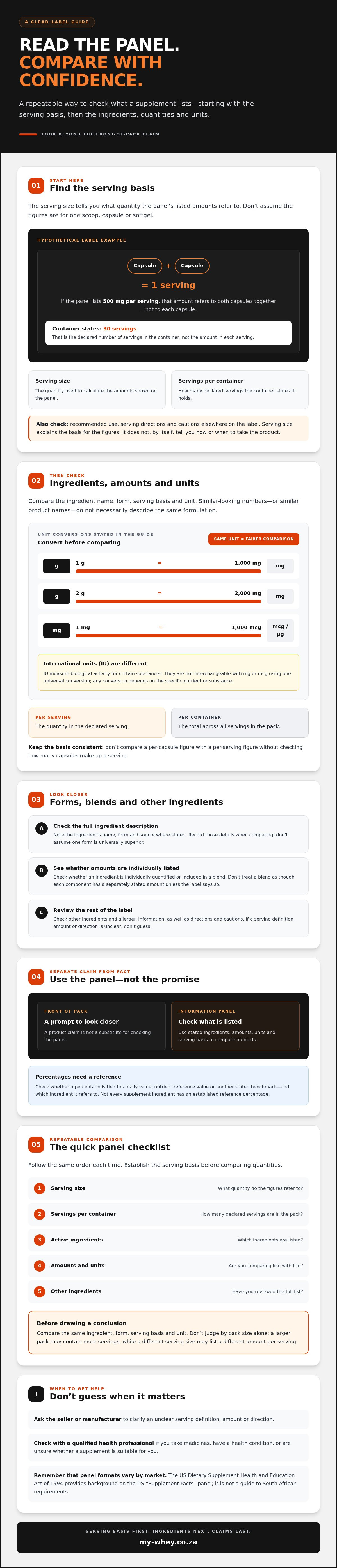
Hypothetical example: A panel lists a serving as two capsules and shows 500 mg of an ingredient per serving. That amount refers to both capsules together, not to each capsule. If the container says it holds 30 servings, that is the number of declared servings, not the amount in each one.
Check the recommended use and serving directions elsewhere on the label. The panel’s serving size tells you the basis for its figures; it doesn’t, by itself, tell you how or when to take the product. Read the full directions, including any cautions, before use.
How to make a quick first pass over the panel
Use the same sequence each time: check the serving size, note the servings per container, identify the active ingredients, check their units, then review the other ingredients. This gives you a consistent basis for comparing products, including creatine, whey protein or omega 3 softgels, without assuming their formats are alike.
Container totals can mislead. A larger pack may contain more servings, while a product with a different serving size may list a different amount per serving. Compare like with like: establish the serving basis first, then compare ingredient quantities and units. Don’t judge the amount by pack size alone.
If a serving definition, amount or direction is unclear, don’t guess. Ask the seller or manufacturer to clarify the label. If you’re unsure whether a supplement is suitable for you, check with a qualified health professional.
How to interpret active ingredients, amounts and units on supplement labels
Once you’ve established the serving basis, focus on the active ingredients: the components presented as contributing to the product’s specific purpose. Check each ingredient’s name and listed amount rather than relying on a product name or front-of-pack description. For example, a label for a creatine product should make it possible to identify the ingredient and the quantity declared. Don’t assume that ingredients with similar names, or products in the same category, have identical formulations.
How to compare an active amount fairly
Compare like with like: the same ingredient, form, serving basis and unit. A quantity in milligrams (mg) is not directly comparable with one in grams (g) until you convert it. For example, 1 g equals 1,000 mg, so 2 g equals 2,000 mg. Micrograms (mcg or µg) are smaller still: 1 mg equals 1,000 mcg.
Amount per serving is the quantity in the declared serving, whilst amount per container is the total across all servings in the pack. Don’t compare one product’s per-capsule figure with another’s per-serving figure without checking how many capsules make up a serving.
International units (IU) measure biological activity for certain substances; they aren’t interchangeable with mg or mcg using one universal conversion. Any conversion depends on the specific nutrient or substance, so use a reliable, ingredient-specific reference rather than estimating. Ingredient form and source may also affect how a label describes what’s present. Record those details when comparing products, but don’t assume one form is universally superior.
What percentages and daily reference values mean
A percentage beside an ingredient is meaningful only alongside its stated reference basis. Check whether the label identifies a daily value, nutrient reference value or another benchmark, and confirm which ingredient the percentage refers to. Not every supplement ingredient has an established reference percentage, so a blank or absent percentage doesn’t, by itself, explain the amount’s significance. Labelling terminology and rules can differ by market; don’t assume US conventions apply in South Africa.
For a separate perspective on the language used for product claims, the FDA guidelines on supplement claims describe US categories. They’re useful context, not a substitute for checking South African requirements.
Keep a simple comparison note with the ingredient, form, amount, unit and serving basis. If you’re reviewing options such as whey protein concentrate and creatine, apply the same checks to each label and verify details against the current packaging. This makes differences easier to assess without treating a larger number or stronger-sounding description as proof of a better fit.
How to compare ingredient lists, blends and allergen information
After checking the active amounts, look beyond them to the rest of the label. An amounts panel and an ingredient list can serve different purposes: one may give quantities for selected ingredients, whilst another names components such as flavourings, sweeteners or capsule materials. The layout and terminology can vary, so read the complete label rather than assuming everything appears in one place. This is an important part of learning how to read a supplement facts panel correctly.
Here’s a hypothetical comparison. The figures are illustrative only, not details from a My Whey product.
| Label format | What it tells you | What remains unclear |
|---|---|---|
| Fully quantified ingredient | Ingredient A: 300 mg per serving | Check the serving basis, ingredient form and other listed components. |
| Proprietary blend | Blend: 300 mg per serving; lists Ingredients A, B and C | The individual quantity of each ingredient isn’t shown in this example. |
What a proprietary blend does and does not reveal
A blend may name several ingredients but give only a combined amount. That total doesn’t tell you how much comes from each component. Don’t divide the total evenly or infer an ingredient’s contribution from its position in the list. Compare the information that is available, including the serving basis and named ingredients. If a key quantity matters to your decision and isn’t clear, ask the manufacturer for clarification.
How to assess allergens and other ingredients
Check the full, current packaging for allergen statements and any wording about possible cross-contact. Also scan the ingredient list for flavourings, sweeteners, fillers and capsule ingredients, including the material used to make the capsule. These details may affect suitability or preference, but their presence alone doesn’t prove that a product is high or low quality.
If you manage an allergy or intolerance, review every part of the label, including warnings and directions, and check again if the packaging or formulation changes. Don’t rely on an old product page or an incomplete ingredient summary. Contact the manufacturer if wording is unclear, and seek personalised advice from a qualified health professional when needed. Label checks can help you identify information to follow up, but they aren’t a substitute for medical advice.
How to assess supplement claims without mistaking them for panel facts
Claims on the front of a pack can describe a nutrient amount, suggest a general benefit or promise an outcome. These are not the same as measurable panel details, such as an ingredient’s identity and quantity. Treat a claim as a prompt to check the full label, not as proof that the product will produce a particular result. A facts panel can show what is declared, but it can’t, by itself, prove effectiveness.
Which questions help test a label claim
Use these checks to assess a statement without relying on its wording alone:
- Is the named ingredient listed? Look for it on the panel or ingredient list, and check whether its quantity is disclosed.
- What kind of claim is it? Does it state a nutrient amount, describe a general benefit or promise a specific outcome?
- Is the promise supported? Look for credible evidence relevant to the ingredient, amount and context, rather than treating confident wording as evidence.
- Is key information missing? Note unclear wording, quantities that aren’t provided or certainty that seems stronger than the information shown.
Label transparency and proven effectiveness are not interchangeable: a clearly stated ingredient and amount do not, on their own, prove that a supplement will deliver a particular result.
Be especially cautious of wording that implies a supplement can diagnose, treat, cure or prevent a disease. Don’t use a marketing statement to replace professional care or make decisions about treatment. If a claim is unclear, check the evidence and ask the manufacturer for clarification rather than interpreting it as a guarantee.
When to seek professional or official guidance
Ask a qualified health professional before using a supplement if you take medicines, have a health condition, are pregnant or aren’t sure whether it’s suitable for you. They can consider your circumstances; a label can’t. Don’t use this guide to diagnose a condition or determine a personal dose.
For questions about whether a claim or label meets local requirements, consult relevant South African official sources. Rules can depend on the product and how it is presented, so avoid assuming that guidance from another country applies here.
Keep the decision practical: verify the ingredient, check whether its amount is clear and question unsupported certainty. If you’re comparing ingredient information across supplement products and ingredients, read the actual product label alongside any claims. That’s a useful step in learning how to read a supplement facts panel correctly, while keeping marketing language in its proper place.
A practical supplement facts panel checklist for comparing products
A repeatable method makes comparisons easier, whether you’re looking at whey protein, creatine monohydrate or omega 3. Use the checklist below to record what each label tells you and identify what still needs clarification. It puts panel details ahead of front-of-pack claims and helps you apply how to read a supplement facts panel correctly to different product categories.
A repeatable checklist for your next label comparison
- Confirm the serving basis. Record the serving size and servings per container. Check whether the serving is measured in scoops, capsules, softgels or another unit.
- Note disclosed active amounts. Write down each named active ingredient and its amount per stated serving. Don’t infer quantities that aren’t shown.
- Check units and ingredient forms. Record whether amounts use grams, milligrams, micrograms or another unit, and note the form or source if the label provides it.
- Read the rest of the ingredient information. Look for flavours, sweeteners, fillers, capsule materials and any allergen or cross-contact wording relevant to you.
- Review directions and cautions. Check the full packaging for recommended use, warnings and other instructions.
- Write down what’s unanswered. If a quantity, term or direction is unclear, ask the manufacturer or seller instead of filling the gap with a marketing claim.
Keep the same comparison notes for each product. If serving sizes differ, don’t compare amounts as though they represent the same basis. If a blend doesn’t disclose individual quantities, mark those amounts as unknown rather than estimating them.
Apply the checklist to supplement categories
For whey protein, compare the declared serving basis, protein quantity and ingredient information on each current label. A whey protein guide can provide broader category context, but the packaging remains the source for product-specific details. For omega 3, check what the label identifies and quantifies, then consult an omega 3 selection guide for further background. With creatine monohydrate, verify the ingredient name, amount and serving basis rather than assuming all labels use the same serving.
My Whey’s range includes whey protein concentrate, creatine monohydrate and omega 3 softgels, and the business describes its wellness products as lab-tested. Use the checklist to assess the relevant label details for any option you’re considering. Explore My Whey’s supplement and ingredient categories to apply these checks to its range.
Make your next label comparison with confidence
Knowing how to read a supplement facts panel correctly gives you a practical way to look past front-of-pack claims and assess what’s actually disclosed. Start with the serving basis, then compare active ingredients by amount, unit and form. Check the full ingredient list, allergen information, directions and cautions, and note missing details rather than guessing.
A clear label helps you understand what a product says it contains, but it can’t prove a particular result or tell you whether a supplement is right for your circumstances. If you take medicines, have a health condition, are pregnant or feel unsure about safe use, speak with a qualified health professional.
My Whey describes its wellness products as lab-tested, with a range that includes whey protein concentrate, creatine monohydrate, omega 3 softgels and amino acids. Use the same careful checks as you compare options. Explore My Whey’s supplement range and compare product information, then make your next choice with greater clarity and confidence.
Frequently Asked Questions
What should I look at first on a supplement facts panel?
Start with the serving size, then check the number of servings per container. These details show how to interpret the listed quantities. Next, identify the active ingredients and their amounts, noting the units and ingredient forms. Review the other ingredients, allergen information, directions and cautions as well. This consistent order is a practical way to learn how to read a supplement facts panel correctly without letting front-of-pack claims lead the comparison.
How do I calculate the amount of an ingredient in one serving?
First check whether the listed quantity is already given per serving. If so, that is the amount for the declared serving, which might include several capsules or more than one scoop. If the label gives an amount per capsule, multiply it by the number of capsules in the serving. For example, 100 mg per capsule across two capsules equals 200 mg per serving. Keep units consistent when calculating.
What is the difference between serving size and servings per container?
Serving size is the quantity used as the basis for the amounts shown on the panel. Servings per container is the number of those declared servings in the pack. For example, a serving might consist of two softgels, while the container holds multiple servings. Neither figure alone tells you the amount of an ingredient across the entire pack, so check the listed ingredient quantity and serving basis together.
Can two supplements list the same ingredient but provide different amounts?
Yes. Two products may name the same ingredient but list different quantities, serving sizes or ingredient forms. Compare the amount on the same basis, such as per serving, and check that the units match. Also note whether the ingredient form or source differs. A larger number doesn’t automatically mean a better choice; consider the full label and your needs, and ask a qualified health professional if you’re unsure what’s suitable.
What does a proprietary blend mean on a supplement label?
A proprietary blend is a group of ingredients presented together, often with a combined total amount. The individual quantity of each component may not be disclosed, so the total doesn’t show how much of each ingredient the blend contains. Don’t assume the amounts are evenly divided or infer them from marketing language. Compare the information available, and ask the manufacturer for clarification if a specific quantity is important to your decision.
How can I tell whether a supplement label lists allergens?
Check the complete, current packaging for allergen statements and wording about possible cross-contact, as well as the full ingredient list. Look beyond the main panel for relevant warnings or details about flavourings and capsule materials. If you manage an allergy or intolerance, don’t rely on an old product page or assume that an unclear statement means the product is suitable. Contact the manufacturer, and seek personalised advice from a qualified health professional.
Does a supplement facts panel prove that a product works?
No. A panel can tell you which ingredients and quantities the label declares, but it can’t by itself prove that the product will deliver a particular result. Assess claims separately by checking what they promise and whether credible evidence supports that claim in context. Be cautious of guaranteed outcomes or disease-treatment promises. If you have a health condition, take medicines, are pregnant or are uncertain about safe use, consult a qualified health professional.