

How to Tell if Creatine Is Working: Signs to Track
What if the scale moves, but your training doesn’t? Body weight can change with creatine use, but that alone doesn’t show whether your performance is improving. If you’re wondering how to tell if creatine is working, look beyond the scale. Progress can be gradual, and changes in training, food or sleep can affect how a session goes.
Measurable signs are more useful than a quick impression. This guide explains which training changes to track, how to compare them consistently, and why muscle fullness or weight changes need context. You’ll also learn how to account for everyday variables, so you can assess your progress without expecting a fixed timeline or guaranteed result. The aim is to help you judge whether consistent creatine use fits your training goals.
Key Takeaways
- To judge how to tell if creatine is working, look for repeatable changes in training and body-weight trends, not one weigh-in or sensation.
- Use a workout log to compare repetitions, loads and completed sets under similar conditions. Remember that several factors can influence performance.
- Set a baseline and record your creatine routine alongside your training. Reviewing patterns over time can make progress easier to assess.
- A plateau or scale change is information, not proof that creatine caused a result. Keep measurements and training conditions consistent before drawing conclusions.
- Creatine monohydrate may support repeated intense efforts. Your tracking can help you assess progress, but it cannot identify the cause of every change.
How to tell if creatine is working: what changes should you look for?
Look for repeatable changes across training sessions and body-weight records, not one unusually good workout, a muscle sensation or a single weigh-in. Here, “working” means creatine may be contributing to your ability to train. It doesn’t mean visible muscle gain is guaranteed, or that every change can be credited to the supplement.
Responses differ between people, and results also depend on training, nutrition, sleep and consistent use. Careful comparison is more useful than expecting a particular feeling or result by a set date. For background on the compound and its role in the body, see this comprehensive overview of creatine.
A measured trend is a repeatable change recorded over time. It is evidence to consider, not proof that creatine caused the change.
Which changes could be relevant to creatine use?
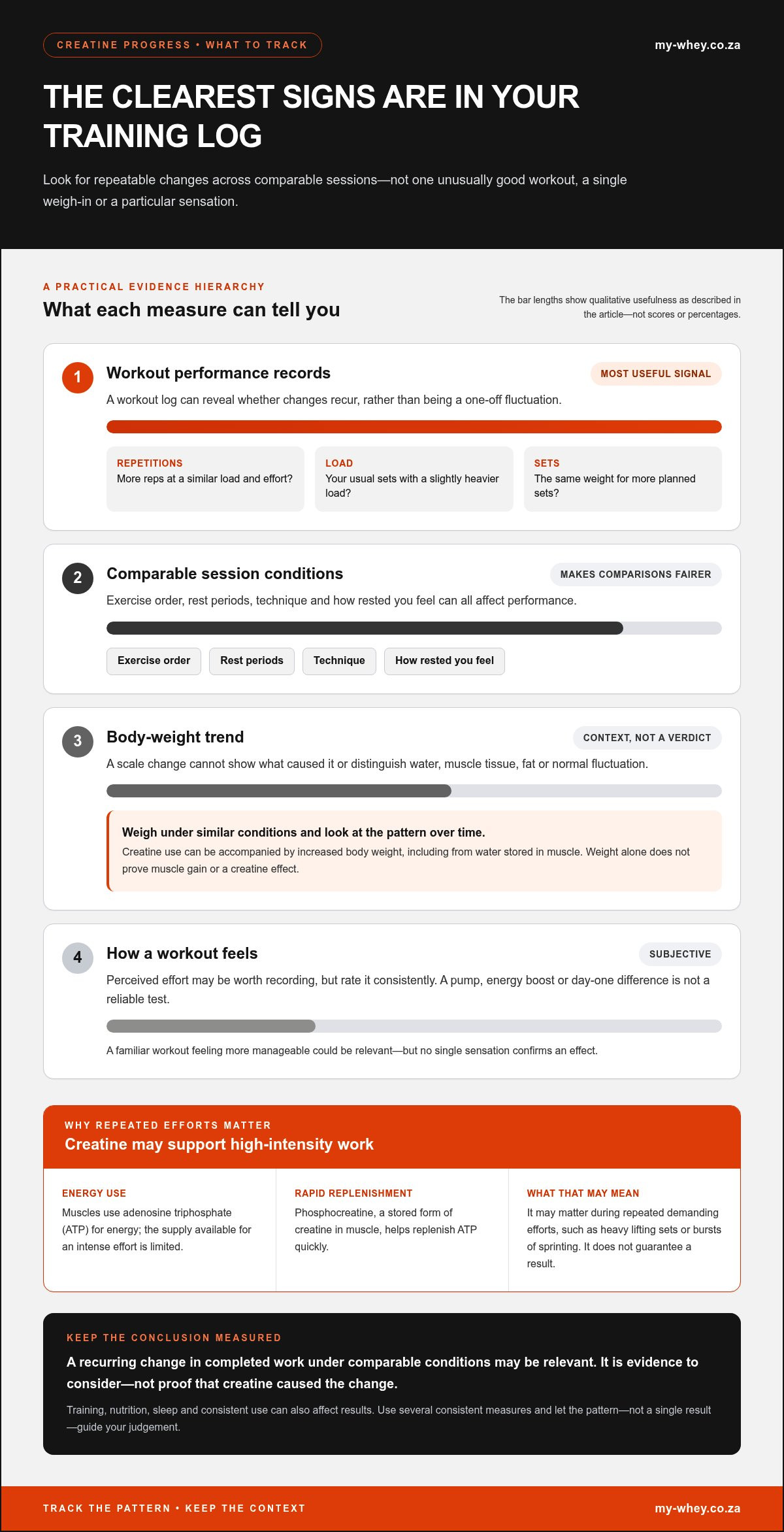
Creatine is most relevant to repeated, high-intensity efforts. Look for patterns across comparable sessions rather than judging one workout. Record details such as:
- Completed repetitions: Are you managing more reps at a similar load and effort?
- Load and sets: Are you lifting the same weight for more planned sets, or completing your usual sets with a slightly heavier load?
- Perceived effort: Does a familiar workout feel more manageable? Rate effort consistently, as this remains a subjective measure.
Compare like with like where possible. Exercise order, rest periods, technique and how rested you feel can all affect performance. A workout log helps you see whether an apparent improvement recurs, rather than being a one-off fluctuation.
Track body weight as context, not as a verdict on muscle gain. A change on the scale alone can’t show what caused it or whether it represents muscle. Consider it alongside training records and consistent weigh-in conditions, rather than interpreting each reading in isolation.
Why you may not feel creatine working
You don’t need to notice a distinct sensation to assess a response. An immediate pump, energy boost or day-one difference isn’t a reliable test of whether creatine is helping. Its potential contribution may show up in workout patterns instead, and those changes can be subtle.
Likewise, no single sign confirms an effect. A weight change, a stronger session or feeling fuller might be relevant, but each has other possible explanations. If you’re trying to work out how to tell if creatine is working, use several consistent measures and let the pattern, not a single result, guide your judgement.
How creatine may affect training, strength and body weight
Creatine’s role is easiest to understand through the body’s rapid energy system. Muscles use adenosine triphosphate (ATP) for energy, but the supply available for an intense effort is limited. Phosphocreatine, a stored form of creatine in muscle, helps replenish ATP quickly. This may matter during short, demanding efforts, such as repeated sets of heavy lifting or bursts of sprinting.
What creatine does during short, intense efforts
With more phosphocreatine available, the body may be better able to support repeated high-intensity work. That doesn’t mean you’ll automatically lift more or feel stronger in every session. Any effect can depend on the activity, your individual response, training and recovery. The International Society of Sports Nutrition’s position stand, available through the scientific consensus on creatine’s effectiveness, discusses its potential to support high-intensity exercise capacity.
A plausible mechanism explains how creatine might support performance; it cannot guarantee a particular result for an individual. A change in workout performance is worth tracking, but it doesn’t by itself establish that creatine caused the change or that muscle has grown.
Why body weight can change without proving muscle gain
Creatine use can be accompanied by an increase in body weight, including from water stored in muscle. This may be more noticeable early on, but the scale can’t distinguish water from muscle tissue, fat or other sources of normal weight fluctuation. A higher reading is not, on its own, evidence of new muscle or proof that the supplement is working.
Body weight and body composition are different measures. The scale records total weight, whereas body composition concerns the proportions of different tissues in the body. Even a steady upward trend needs context, including changes in eating habits, training and measurement conditions.
For a more useful picture, consider weight records alongside your workout log. Weigh under similar conditions and look at the pattern over time rather than reacting to one reading. If your training records also show a recurring change in completed work under comparable conditions, that may be relevant, but it still doesn’t isolate creatine as the cause. This measured approach can help answer how to tell if creatine is working without mistaking a possible mechanism or scale shift for a guaranteed outcome.
If creatine monohydrate is part of your routine, explore My Whey’s creatine monohydrate as one option. Assess it with consistent tracking rather than expecting a specific result.
Which measures best show whether creatine is supporting your progress?
Use measures that are repeatable and relevant to your training. A workout log is usually more useful than relying on how you feel after one session, while weight and other body measurements can add context. The Mayo Clinic’s overview of how creatine affects performance can help explain why training data may be worth monitoring, but no measure can show that creatine alone caused a change.
| Measure | What it can show | Main limitation |
|---|---|---|
| Repetitions, load and completed sets | Whether your recorded training output changes across comparable sessions. | Programme changes, rest, technique and recovery can also affect performance. |
| Perceived effort | Whether a familiar workout feels easier or harder over time. | It’s subjective and can shift with mood, sleep and stress. |
| Weekly average body weight | The direction of your weight trend, with less emphasis on daily fluctuations. | Weight doesn’t identify changes in muscle, water or other body tissues. |
| Waist measurement or progress photos | How body measurements or appearance may change under consistent conditions. | Neither can identify what caused the change; photos also depend on lighting and pose. |
Use a training log to compare like with like
Record the exercise, load, repetitions, completed sets and perceived effort each time. Compare similar sessions, such as the same exercise performed in the same place in your programme. Don’t compare unrelated workouts or a routine session with a personal-best attempt.
Make a brief note if your programme, recovery or nutrition changes significantly. These details help explain why a session may differ and stop you attributing every improvement or dip to creatine.
Track body trends without overreading daily fluctuations
If you choose to monitor body weight, weigh under similar conditions and use a weekly average where practical. This makes it easier to notice a broader trend without giving one day’s reading too much significance. Consider it alongside your training log, not as a standalone result.
Waist measurements or progress photos can provide additional context if you take them consistently, using the same measurement method or similar lighting, pose and clothing. They still can’t establish the cause of a change. Consistent measures can help answer how to tell if creatine is working, but they support an informed judgement rather than proving creatine was the sole reason for progress.
How to track creatine progress consistently and assess a plateau
A simple routine makes your records easier to interpret. Before deciding whether creatine may be helping, establish a baseline and keep your measurements consistent. You don’t need to track everything. A few reliable notes are more useful than a complicated system you won’t maintain.
Build a simple baseline before judging results
Choose a small number of exercises you perform regularly, then record your usual load, repetitions, completed sets and perceived effort. Note your training frequency and any major changes to your programme, nutrition or sleep. If you track body weight, use consistent weighing conditions and focus on the trend rather than individual readings.
Then follow this process:
- 1. Set a baseline. Record your current training measures and, if useful, a consistent body-weight trend.
- 2. Log use and training. Note whether you followed your chosen creatine routine, alongside workouts and relevant changes in recovery, sleep or nutrition. Keep to the routine you’ve chosen rather than changing several things at once.
- 3. Review comparable sessions. Look for patterns in similar workouts over time, not isolated personal bests or unrelated sessions.
- 4. Adjust expectations. Consider what else may explain the pattern before deciding whether creatine is making a difference.
Keep the record practical. A brief note about a missed session, illness or disrupted sleep can be enough to explain why a workout doesn’t compare neatly with your usual training.
What to review if progress seems to have stalled
A plateau doesn’t, by itself, mean creatine has stopped working. First check whether you’ve used it consistently and compare equivalent workouts. Then look at training frequency, programme changes and recovery. Missed sessions, illness or poor sleep can affect performance and make a short-term comparison misleading.
If several factors changed at once, treat the records as less conclusive. Return to consistent training and measurement practices, then review the pattern again rather than making a decision based on one flat period. Tracking can help you judge how to tell if creatine is working, but it can’t prove the supplement is the sole cause of a change.
If you have a health condition, take medication or have concerns about using creatine, speak with a qualified healthcare professional. If you’re ready to include creatine monohydrate in a consistent routine, explore My Whey’s creatine range.
What to do next if your creatine tracking shows a trend
Your tracking is most useful as a guide to your next decision, not a verdict on what caused every change. A consistent upward pattern in comparable workouts may be encouraging, but it doesn’t guarantee further gains or prove creatine was the only factor. Keep training, recovery and measurement practices steady as you decide what the trend means for you.
How to interpret a positive, unclear or flat result
If the trend is positive, such as completing more work in similar sessions, that may support continuing your chosen routine and monitoring it. Keep expectations realistic: progress can vary, and past improvement doesn’t guarantee future results.
If the picture is unclear, check whether your records are complete and whether you’re comparing similar workouts. Consider changes in your programme, sleep, nutrition or recovery before adjusting several things at once. Changing multiple variables makes it harder to understand what may be contributing to the pattern.
If progress looks flat, don’t assume the supplement has stopped working. Review your overall training consistency and programme, and consider whether the measures you chose are useful and repeatable. A flat period is information to assess, not a reason to blame one supplement automatically.
Choose creatine with clear expectations
Product choice comes after setting realistic expectations and building a routine you can follow. Creatine monohydrate is one option available from My Whey. My Whey describes its supplements as lab-tested; use product information to understand what you’re choosing, but don’t treat a quality claim as a promise of individual performance results.
In practice, how to tell if creatine is working comes down to reviewing consistent records alongside the wider context of your training and recovery. Keep the approach simple, look for patterns rather than dramatic changes, and make your decision calmly. If you choose to include creatine monohydrate in your routine, explore My Whey creatine monohydrate.
Keep tracking, then make your next move
To understand how to tell if creatine is working, look for repeatable patterns in comparable workouts, not one standout session or a change on the scale alone. Your training log, body-weight trend and recovery context can help you make a more informed judgement, but they can’t prove creatine caused every change.
Keep your routine and measurements consistent while you review progress. If results are unclear or flat, check your tracking and wider training context before changing several things at once. A measured trend is useful information, not a guarantee of what comes next.
My Whey offers creatine monohydrate and describes its supplements as lab-tested. Bulk pricing is part of the business model. If you’re considering creatine as part of a consistent routine, explore My Whey creatine monohydrate.
Stay patient, keep good records and let your own training data guide your next step.
Frequently Asked Questions
How long does it take to tell if creatine is working?
There’s no single timeline that can predict your individual response. To work out how to tell if creatine is working, establish a baseline, follow a consistent routine and compare similar training sessions over time. Changes in performance may be gradual, while body weight can shift for reasons unrelated to creatine. Treat an early change, or the absence of one, as inconclusive rather than proof that it is or isn’t helping.
Can you tell if creatine is working by how you feel?
Not reliably. You don’t need to feel a noticeable sensation to assess whether creatine may be helping. A log of comparable exercises, repetitions and loads gives you a more useful reference than a pump, an energy feeling or day-to-day motivation. Those sensations can vary with sleep, food, stress and training, so they aren’t proof on their own. Record performance consistently and look for patterns rather than relying on memory.
Does gaining weight mean creatine is working?
No. A change on the scales can reflect water, food intake, ordinary daily variation or other changes. It doesn’t prove muscle gain or show that creatine caused the increase. Weigh under consistent conditions and consider weekly averages alongside training performance and other measures. If a weight change concerns you, particularly if it comes with other health symptoms, seek advice from a qualified healthcare professional.
Can creatine be working if your weight stays the same?
Yes. Body weight alone can’t show whether creatine may be supporting your training. Track repeatable performance measures, such as completed repetitions and load on comparable exercises, and note changes to your programme and recovery. A stable scale reading doesn’t prove creatine has had no effect, just as a rising reading doesn’t prove that it has. Use several consistent measures to form a more balanced view.
Should you feel different after taking creatine?
No particular feeling is required. You may not notice an immediate or distinct sensation, and subjective feelings can be affected by many factors. Focus instead on following your chosen routine in line with reliable product information and reviewing training records over time. Don’t increase your use simply because you don’t feel an effect. If you have personal health concerns, speak with a qualified healthcare professional before making changes.
Can you tell whether creatine is working without tracking workouts?
It’s difficult to assess a possible effect reliably without a baseline. Memory can miss ordinary variation, so record a few repeatable exercises, including repetitions, loads and relevant training context. You don’t need a complex app or extensive measurements. A simple, consistent log gives you a clearer comparison than trying to remember how training felt weeks earlier, especially if your programme or recovery has changed.
What should you do if creatine does not seem to be working?
First check whether your use and training have been consistent, then compare similar workouts and consider sleep, nutrition, recovery and programme changes. A plateau doesn’t prove the supplement has stopped working, so avoid changing several things at once. Review your training as a whole before drawing conclusions. If you have a medical condition, take medication or have safety concerns, speak with a qualified healthcare professional.