

Maca Root Powder Benefits for Energy: What the Evidence Says in 2026
Maca may support energy, but it isn’t a proven stimulant. That distinction matters when claims combine alertness, mood, exercise performance and fatigue into one promise. If you’re weighing the maca root powder benefits for energy, the evidence is limited: some small studies report changes in self-reported energy or mood, but they don’t establish maca as a reliable fix for tiredness. A change in mood isn’t necessarily the same as improved physical performance or reduced fatigue.
It’s understandable to want a clear answer before adding another supplement to your routine. This guide separates what research suggests from what remains uncertain, so you can set realistic expectations and make an informed choice. We’ll look at the types of energy researchers have studied, why maca shouldn’t be expected to act like caffeine, and what to consider when reviewing product information and safety. The aim isn’t to promise a boost, but to help you assess whether maca fits your needs and judge supplement claims with care.
Key Takeaways
- Maca powder comes from the root of Lepidium meyenii; traditional use alone doesn’t establish a modern energy benefit.
- When weighing maca root powder benefits for energy, distinguish self-reported changes in mood or energy from measured exercise performance and endurance.
- Check what a study measured, who took part and how long it ran before applying its findings to your own goals.
- Read product labels for details such as maca type and processing, while remembering that these don’t prove effectiveness.
- Use a simple decision check: define your goal, assess the evidence, review product information and consider whether personal health factors call for professional advice.
What is maca root powder and why is it linked to energy?
Maca powder comes from the root of Lepidium meyenii, a plant traditionally cultivated in the Andean region of Peru. It is eaten as a food and also sold as a supplement. This history helps explain the interest in maca, but traditional use and modern claims about stamina or vitality aren’t the same as clinical evidence that it improves energy.
In brief: maca root powder is a food-derived supplement made from the dried root of an Andean plant. It isn’t a caffeine-based stimulant, so it shouldn’t be expected to produce the immediate alertness associated with stimulant effects. This distinction matters because “energy” can describe several different experiences, and evidence for one doesn’t automatically demonstrate another.
Where does maca come from?
Maca grows in the high-altitude environment of the Peruvian Andes, where people have cultivated it as a food plant. Its botanical name, Lepidium meyenii, identifies the plant species; “maca” is its common name. The Lepidium meyenii (Maca) overview describes its botanical background, cultivation and traditional uses.
Maca’s place in food traditions provides useful context, not proof of a specific health effect. A long history of use doesn’t answer whether a supplement improves alertness, reduces fatigue or increases exercise capacity in a controlled study. Those questions require research that measures the outcomes directly.
What does “energy” mean in maca research?
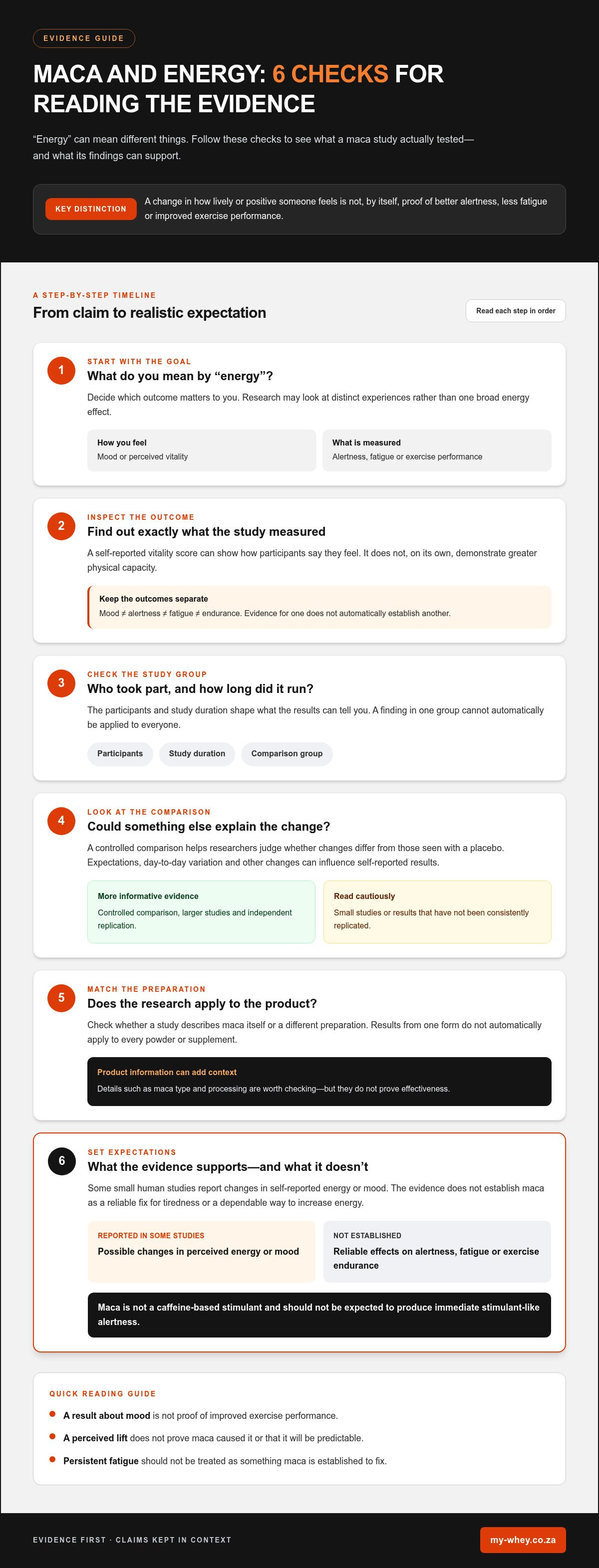
Energy isn’t a single research outcome. A participant might report feeling more lively or positive, while another study measures tiredness using a fatigue questionnaire. Alertness concerns wakefulness and attention; physical endurance concerns performance during exercise. These measures capture different experiences, so they shouldn’t be treated as interchangeable.
For example, a change in a self-reported vitality score wouldn’t, by itself, show that someone can exercise for longer. A result related to mood wouldn’t establish that maca improves daytime alertness or addresses persistent fatigue. To judge claims about maca root powder benefits for energy, look for the exact outcome measured, who took part and whether the study assessed perceived feelings or objective physical performance.
Maca is best understood as a plant-based food supplement being studied for possible effects, not as an established pick-me-up. It isn’t a substitute for adequate sleep, balanced nutrition or investigation of ongoing fatigue. Define your goal first, then assess whether a claim answers the question you actually have rather than relying on the broad word “energy”.
What does research say about maca root powder and energy?
The evidence is suggestive in places, but it doesn’t establish maca as a dependable way to increase energy. Some small human studies report improvements in participants’ own ratings of energy or mood. These findings are preliminary: expectations, day-to-day variation and other changes can influence self-reported results, so a perceived lift doesn’t prove maca caused it.
Feeling more positive or lively is not the same as being more alert, having less fatigue or performing better during exercise. Research on one outcome can’t be used as proof of another. The Maca Root Information from MSKCC summarises maca’s proposed uses, including energy and strength, but proposed uses should not be confused with established clinical effects.
What have human studies measured?
Energy-related claims draw on outcomes such as self-reported vitality and mood. These measures can help researchers understand how participants feel, but they don’t directly show a change in physical capacity. To establish an effect on endurance, a study would need to assess exercise performance using relevant measures, rather than rely only on participants’ impressions.
Findings from a particular group also can’t automatically be applied to everyone. The participants, comparison group and duration all affect what a study’s results can tell us. Without those details, it isn’t sound to present a finding as a proven benefit for the general population.
How strong is the evidence for an energy benefit?
For maca root powder benefits for energy, the most responsible summary is that limited human research has reported possible changes in perceived energy or mood, whilst evidence for a reliable effect on alertness, fatigue or exercise endurance remains insufficient for firm conclusions. The findings don’t support a promise of an energy boost.
Study quality matters as much as a positive result. A controlled comparison helps researchers judge whether changes differ from those seen with a placebo; larger studies and independent replication can show whether an apparent effect holds up. Where studies are small or results aren’t consistently replicated, a placebo effect or chance finding remains possible. That doesn’t mean maca cannot affect how some people feel. It means the evidence can’t establish a predictable response.
When reading a claim, check the exact outcome measured, the participants and the comparison used. Did the study test perceived vitality, mood, fatigue or an objective exercise result? These are different endpoints. Also check whether the research describes maca itself or a different preparation, since results from one form don’t automatically apply to every powder or supplement.
Keep supplement decisions grounded in evidence and transparent product information. My Whey’s wider range of herbal supplements and superfoods includes product categories that can be considered as part of a broader wellness routine, without implying a guaranteed answer to low energy.
Maca for energy: realistic expectations versus common claims
Maca is often described as an energy booster, but that phrase can imply more than the evidence supports. A possible shift in how someone rates their vitality isn’t proof of sharper alertness, less fatigue or better athletic performance. For a claim to be meaningful, it needs to specify the outcome and be supported by research that measures it directly.
Realistic expectation: maca is being studied for possible effects on perceived energy and wellbeing, but current evidence doesn’t establish it as a reliable way to increase energy or endurance.
| Claim | What research would need to show | What readers can conclude |
|---|---|---|
| Maca supports vitality | Controlled studies would need to measure participants’ self-reported vitality and show consistent differences from a comparison group. | This is a possible area of interest, not a guaranteed or established effect. |
| Maca improves alertness or relieves fatigue | Studies would need to assess alertness or fatigue specifically, rather than use mood or general wellbeing as a substitute. | Evidence about one feeling doesn’t establish an effect on another. |
| Maca boosts stamina or endurance | Research would need to measure physical performance or endurance using suitable exercise outcomes. | A feeling of greater energy alone doesn’t prove improved performance. |
Does maca work like caffeine?
No. Caffeine is a stimulant; maca shouldn’t be presented as its equivalent or as an immediate pick-me-up. The available evidence doesn’t establish that maca produces an instant increase in alertness. Nor should a reported effect on perceived vitality be treated as evidence of the same mechanism or outcome as caffeine. Each claim needs its own research.
What can and cannot be concluded from current claims?
Keep three levels separate. Traditional use describes how maca has been used as food or in traditional practices. Preliminary findings refer to early or limited research that may suggest a possibility. An established conclusion requires sufficiently reliable evidence to support a clear claim. Moving from one level to another takes more than a positive anecdote or an appealing label.
Be cautious with sweeping promises such as “instant energy”, “cures fatigue” or “guaranteed endurance”. The Forbes Health overview of maca root benefits discusses proposed benefits, but a summary of claims isn’t proof that a particular result is dependable.
Read “may support” as a possibility, not a promise. It doesn’t say how likely an effect is, who might experience it or whether strong human research has demonstrated it. For maca root powder benefits for energy, match the wording of a claim to the outcome actually studied and keep expectations measured. A considered wellness routine starts with clear information, including transparent product details. My Whey’s range includes herbal supplements and superfoods, broad categories to explore without assuming any one supplement guarantees an energy result.
How to approach maca powder use, product information and safety
A careful approach starts with a clear question, not an energy promise. Decide whether you’re interested in perceived vitality, mood or exercise capacity, then assess the product and your personal circumstances. This helps you separate what you notice from what you hoped to notice, and avoid treating a supplement as a substitute for sleep, nutrition or medical care.
- Clarify your goal. Be specific about what you want to observe, such as your general sense of vitality or how you feel during activity.
- Read the label. Check the ingredient identity, serving information, product form and directions.
- Consider safety. If you have a health condition, take medicines, are pregnant or breastfeeding, seek advice from a qualified healthcare professional before use.
- Observe your experience. Note any changes alongside sleep, diet and activity, rather than attributing every difference to maca.
How can maca powder fit into a routine?
Maca powder is commonly mixed into food or drinks, such as a smoothie, porridge or yoghurt. Follow the product’s own directions rather than assuming every powder or extract is used in the same way. Product form and preparation can affect how it is used, but they don’t prove that it improves energy.
If you choose to try a supplement, keep track of what you notice and the wider context. Sleep, meals, stress and activity can all affect how energetic you feel. A personal observation may help you decide whether a routine suits you, but it can’t establish that maca caused a change or that others will experience the same effect.
What should readers check on a supplement label?
Start with the ingredient name and serving information. Check whether the label identifies the product as root powder or an extract, and read its preparation and storage directions. If the form isn’t clearly described, don’t assume a concentrated extract and a whole-root powder are equivalent. Clear information helps you understand what you’re taking, even though it doesn’t establish an energy benefit.
Look for specific, readable details rather than relying on broad terms such as “powerful” or “premium”. Don’t treat label statements as proof of a quality certification, purity standard or maca-specific testing unless product information provides evidence for that claim. Processing terms, including “gelatinised”, describe preparation; they don’t demonstrate effectiveness for energy.
Keep the decision measured. If persistent fatigue is affecting daily life, don’t rely on maca to identify or treat its cause; discuss it with a qualified health professional. The same applies if you’re unsure how a supplement could fit alongside a condition or medicine. Informed choices begin with transparent product information and realistic expectations, not a guaranteed energy fix.
My Whey’s wider supplement range is available at My Whey.
Making an informed choice about maca and your energy goals
Maca may interest people curious about plant-based supplements and possible changes in perceived vitality. The evidence doesn’t make it a dependable answer for low energy, so decide based on a specific goal rather than a broad promise. Feeling more alert, being in a better mood and improving exercise performance are different outcomes. A claim about one shouldn’t be taken as proof of another.
Keep the foundations in view. Sleep, balanced nutrition and regular activity all contribute to wellbeing; a supplement shouldn’t replace them or be relied on to explain persistent tiredness. If low energy continues or affects daily life, consider speaking with a qualified health professional rather than trying to manage it through supplements alone.
A quick checklist before choosing a supplement
- Name your goal. Are you interested in alertness, perceived vitality, mood or exercise performance? A clear goal helps you judge whether the evidence addresses what you actually want to know.
- Check the evidence. Look for research that measures your intended outcome, and treat preliminary findings as possibilities rather than guarantees.
- Read the label. Check that the ingredient and form are identified, and review serving, preparation and storage information.
- Consider personal safety. If you have a health condition, take medicines, are pregnant or breastfeeding, ask a qualified health professional for advice before choosing a supplement.
What is a sensible next step?
Compare the wording of a claim with what the evidence actually measured. “May support energy” signals possibility, not a confirmed result for every person or every type of energy. A study about a self-reported feeling, for instance, doesn’t establish better endurance. This simple check can help you look past headline promises and assess whether a claim is relevant to your goal.
Persistent low energy can have many causes beyond supplement choice. If it’s ongoing, new or interfering with your usual activities, seek appropriate health advice rather than assuming maca is the answer. For readers exploring maca root powder benefits for energy, the sensible position is open but measured: emerging interest may justify further research, not a promise of results.
Choose supplements as one considered part of a wider wellness routine, with clear information and realistic expectations. My Whey’s wider wellness range includes herbal supplements and superfoods.
Choose your next step with confidence
Before adding any supplement to your routine, decide what a worthwhile outcome would look like for you. A clear personal benchmark can help you assess whether your choice fits your needs, rather than relying on a broad promise of “more energy”. That’s a useful way to approach maca root powder benefits for energy: stay curious, but let evidence and your own priorities guide the decision.
Keep the wider routine in view, too. Supplements are considered choices alongside the everyday habits that support wellbeing, not shortcuts or guarantees. My Whey offers a range of wellness products, including herbal supplements and superfoods. These are broad product categories, not a claim about maca specifically.
Explore My Whey’s wellness range and choose your next step with care.
Frequently Asked Questions
Does maca root powder give you energy straight away?
No reliable immediate energy effect has been established for maca root powder. If you feel more energised after taking it, that experience alone can’t show that maca caused the change; sleep, food, stress and expectations may also play a part. If you need a quick alertness effect, don’t assume maca will work like a stimulant. Persistent or sudden fatigue is better discussed with a health professional.
How long does maca take to work for energy?
There isn’t a well-established timeline for maca to improve energy, and research doesn’t show that everyone responds in the same way. Be cautious of product claims promising a specific number of days before results. If you’re considering maca, note how you feel over time and what else is changing in your routine. That can help you make a personal decision, but it won’t prove a general effect.
Does maca powder contain caffeine?
Pure maca root powder isn’t a caffeine source. However, a blended product may contain other ingredients, so read the full ingredient list rather than relying only on the front label. If you’re avoiding caffeine for sleep, sensitivity or another reason, check for tea, coffee, guarana or added caffeine in a blend. The product’s ingredient information is the best guide to what’s included.
Can you take maca powder with coffee?
You can mix maca powder into a coffee drink if its label gives no preparation restriction, but that doesn’t mean the combination has a proven added energy benefit. Any immediate alertness you notice is more plausibly associated with the coffee’s caffeine than with maca. Consider your caffeine sensitivity and avoid increasing coffee intake to compensate for tiredness. If you take medicines or have a health condition, ask a health professional about supplements.
Is maca root powder safe for everyone?
No supplement is right for everyone. Maca may cause unwanted effects, including digestive discomfort or headaches, and people who are pregnant or breastfeeding, have a thyroid or hormone-sensitive condition, or take medicines should seek advice from a qualified health professional before use. Stop taking it if you experience a concerning reaction. If you have ongoing symptoms or a complex health history, discuss your plans with a clinician first.
What is the difference between maca powder and maca extract?
Maca powder is made from processed maca root, whilst an extract is produced by separating and concentrating components from the source material. Products may therefore differ in form and concentration, so don’t assume a scoop of powder is equivalent to the same amount of extract. Check the ingredient description and serving directions on the label. Neither format, by itself, proves that the product will improve energy.
Can maca powder replace sleep or a balanced diet for better energy?
No. Maca powder can’t replace the recovery provided by adequate sleep or the nutrients supplied by a balanced diet. If you’re regularly tired, first consider practical factors such as sleep quality, meal patterns, hydration and changes in activity. Don’t use a supplement to mask persistent exhaustion or delay getting advice. Ongoing low energy can have causes that need attention beyond a change to your supplement routine.