

SA Supplement Certificate of Analysis: Purity Guide
That shiny tub of whey protein on your kitchen counter might look professional, but the marketing on the front tells you very little about what you're actually consuming. In reality, a certificate of analysis supplements south africa brands provide is the only label that truly matters; everything else is just noise. You're right to feel sceptical about "amino spiking" or hidden heavy metals in imported ingredients. It's frustrating when complex lab terminology feels like it was designed to keep you in the dark whilst you're simply trying to make healthy choices.
We believe you deserve total transparency. This guide will empower you to decode a Certificate of Analysis (CoA) so you can ensure your supplements are pure, potent, and free from harmful contaminants. You'll learn exactly how to read a lab report and which specific red flags to look for in the results. We'll also help you identify transparent South African suppliers who follow SAHPRA guidelines and Good Manufacturing Practices. By the end of this article, you'll have the expert knowledge needed to move past the hype and focus on the tangible quality of your nutrition.
Key Takeaways
- Understand that a batch-specific Certificate of Analysis is the only objective proof of purity, moving beyond the "typical analysis" often found on standard marketing labels.
- Learn how to verify laboratory accreditation and match batch numbers to ensure your report corresponds directly to the specific supplement you have purchased.
- Discover how to spot common red flags, such as "dry basis" protein claims that can misleadingly inflate the nutritional profile of your supplements.
- Gain the skills to decode a certificate of analysis supplements south africa suppliers provide to recognise heavy metal contamination and identify "amino spiking" additives.
- Understand why bulk sourcing simplifies the testing process, allowing for more rigorous batch verification and greater transparency for the end user.
What is a Certificate of Analysis (CoA) for Supplements?
A Certificate of Analysis isn't just a piece of paperwork; it's a verified record of a product's identity. At its core, it's a document issued by an accredited laboratory that confirms a specific batch of supplements meets its predetermined specifications for purity and potency. To understand the technical foundation, you can review the general definition of What is a Certificate of Analysis, which outlines how these documents serve as a quality assurance tool across various industries.
In the South African supplement market, where regulatory oversight can sometimes feel inconsistent, these documents are essential. They bridge the gap between what a brand claims on its colourful label and what's actually inside the tub. For the consumer, it's the difference between guessing and knowing that your Whey Protein Concentrate 80% actually contains the protein levels promised. Beyond just protein content, a CoA is your primary defence against heavy metals like lead, arsenic, and mercury. These contaminants often hide in poorly sourced raw materials, especially in herbal supplements or imported minerals. A rigorous lab report will list these specific tests, confirming that the product falls well below safety thresholds defined by health authorities.
The Legal and Ethical Importance in South Africa
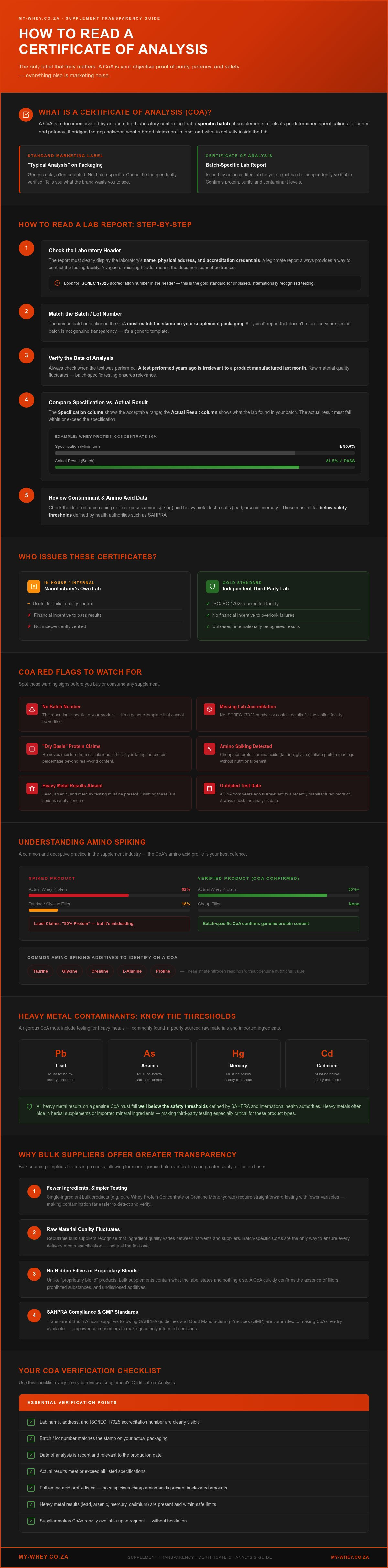
Local brands often face pressure to lower costs, which sometimes leads to "amino spiking"—adding cheap, non-protein amino acids like taurine or glycine to artificially inflate protein readings. A batch-specific certificate of analysis supplements south africa providers offer exposes these shortcuts by detailing the exact amino acid profile. Ethical suppliers prioritise this level of detail because it builds genuine consumer trust in a crowded wellness industry. Transparent suppliers don't rely on "typical" data from years ago. They understand that raw material quality can fluctuate. By providing batch-specific reports, they ensure that every scoop of Creatine Monohydrate or Omega 3 is free from hidden fillers and prohibited substances that shouldn't be there.
Who Issues These Certificates?
You'll typically encounter two types of lab reports: manufacturer internal tests and independent third-party verifications. While in-house labs are useful for initial quality control, independent ISO-accredited facilities are the gold standard for unbiased results. An external facility has no financial incentive to overlook a failed test or a heavy metal spike. To verify a document's validity, look for an ISO/IEC 17025 accreditation number in the header. This signals that the lab follows international standards for testing and calibration. If a supplier is hesitant to share these details or provides a report with no clear lab contact information, it's a significant red flag. Reliable partners, like those specialising in high-purity bulk ingredients, make this information readily available to empower their customers.
How to Read a Supplement Lab Report: A Step-by-Step Guide
Reading a certificate of analysis supplements south africa retailers distribute shouldn't feel like deciphering an ancient script. Start at the top. The header must clearly display the laboratory's name, physical address, and accreditation credentials. A legitimate report always provides a way to contact the testing facility for verification. If the header is vague or missing contact details, the document lacks the necessary accountability to be trusted.
Locate the batch or lot number next. This unique identifier must match the stamp on your supplement packaging. If a supplier provides a "typical" report that doesn't reference your specific batch, they aren't offering true transparency. You're effectively looking at a generic template rather than a verified test of the specific powder you're about to ingest. Always check the "Date of Analysis" as well. A test performed years ago is irrelevant to a product manufactured last month.
Contrast the "Specification" column with the "Actual Result" column. The specification represents the acceptable range or minimum standard the product must meet to be considered safe and effective. The result is the lab's specific finding for that batch. For instance, a specification for whey protein might require a minimum of 80% protein content. If the actual result sits at 81.5%, the batch is confirmed as high quality and meets its label claims.
The Core Analytical Data
Potency testing is the primary tool for exposing amino spiking. It confirms that the nitrogen levels in the powder stem from complete proteins rather than cheap, individual amino acid fillers. Microbial analysis is another critical pillar, screening for pathogens like E. coli, Salmonella, and various mould counts. These safety checks align with international FDA cGMP regulations, ensuring that the manufacturing environment remains sterile and free from biological hazards. Heavy metal screening for Lead, Arsenic, and Mercury is particularly vital for herbal products and plant-based proteins, as these ingredients are prone to environmental contamination from the soil.
Physical Characteristics and Sensory Tests
Beyond the chemical makeup, lab technicians evaluate the physical profile of the powder. They record the colour, odour, and mesh size, which describes the fineness of the particles. A consistent mesh size ensures your supplements mix easily without clumping. Bulk density is a key metric for branched chain amino acids; it measures how much space the powder occupies. Significant variations in density often signal changes in the raw material source or the presence of unwanted additives. You can explore our pure bulk ingredients to see this commitment to consistency and lab-verified quality in practice.
CoA vs. Marketing Claims: Spotting the Red Flags
Marketing departments are experts at using colourful labels to distract from a lack of substance. Whilst a flashy tub might claim "ultra-pure" status, a certificate of analysis supplements south africa brands provide is the only objective evidence available. One common industry tactic is the use of a "typical analysis". This is essentially a historical average that doesn't reflect the specific batch in your hand. It's a placeholder, not a proof of quality. If a brand can't produce a report dated within the last few months that matches your batch number, they're asking you to rely on blind faith rather than data.
Another deceptive practice involves protein percentages. You'll often see "dry basis" protein claims on marketing materials. This figure represents the protein content after all moisture has been theoretically removed. It's a laboratory abstraction that inflates the number. In contrast, "as is" protein content reflects what you're actually consuming in its powder form. If a brand only provides dry basis figures, they're hiding the reality of the product's nutritional density. Proprietary blends further complicate this by masking the exact ratios of ingredients, making it impossible for a CoA to verify the potency of individual components. These "mystery mixes" are a major red flag for anyone seeking pure, single-ingredient transparency.
Common Pitfalls in Supplement Documentation
Watch out for the "outdated CoA" trick. Some suppliers will show you a lab report from 2022 to "prove" the quality of a batch manufactured in 2026. This is useless; raw material quality fluctuates with every harvest and production run. You should also be wary of generic reports. A supplier might present a CoA for the raw whey protein concentrate but fail to provide one for the finished, flavoured blend. This gap in documentation means there's no verification of what happened during the final mixing and packaging stages. Finally, ensure the report isn't cherry-picking data. A document that only confirms protein levels whilst ignoring microbial counts or heavy metal screenings is fundamentally incomplete. A true purity guide requires a full spectrum of results, not just the ones that look good on a social media post.
How to Verify Lab Results Independently
If you suspect a document has been tampered with, look for font inconsistencies or missing signatures. Forged reports often show signs of digital "patchwork" where dates or results have been poorly edited. You can verify the authenticity of a report by contacting the issuing laboratory directly. Reputable labs keep records of every batch number they test and will confirm if the document in your hand matches their files. Cross-reference the lab's accreditation with bodies like SANAS (South African National Accreditation System) to ensure they meet national standards. Confirming a certificate of analysis supplements south africa companies use is authentic is a simple phone call away. Reputable brands like My Whey welcome these enquiries. We believe that a transparent supplier should have nothing to hide, which is why we prioritise batch-specific purity over marketing fluff.
Why Bulk Suppliers Offer Greater Transparency
Bulk suppliers operate on a model that prioritises substance over shelf appeal. When a business deals in large volumes of raw ingredients, the cost of commissioning a comprehensive certificate of analysis supplements south africa becomes a highly feasible investment. For retail brands, small batches of complex, multi-ingredient "performance stacks" make rigorous testing per batch prohibitively expensive. This often results in companies relying on older, generic reports. By choosing a bulk supplier, you're tapping into a supply chain where transparency is a functional requirement rather than a marketing afterthought.
The absence of retail "fluff" like artificial dyes, thickeners, and complex flavour systems significantly simplifies the analytical process. Every additional ingredient in a supplement creates a new variable that must be tested for purity and potential contamination. Raw ingredients are inherently easier to verify. When you're looking at a lab report for a single-ingredient powder, the data is clear and unambiguous. You aren't forced to guess which component might be hiding a heavy metal spike or a microbial issue. This simplicity offers a level of certainty that complex blends simply cannot match.
Purity in Simplicity
Specific products require specialised testing that often gets overlooked in the retail space. For example, high-quality omega 3 softgels must undergo TOTOX (Total Oxidation) testing to ensure the oil hasn't turned rancid. A bulk-focused CoA will clearly state these oxidation levels, providing peace of mind that the fats you're consuming are fresh and effective. Similarly, sourcing gut health supplements South Africa through a bulk provider ensures you receive pure ingredients without hidden binders that might irritate a sensitive digestive system. You gain the advantage of knowing exactly what constitutes 100% of the supplement's weight.
Sourcing Locally Tested Ingredients
Choosing a South African supplier that understands local purity expectations is a strategic move for your wellness journey. Bulk suppliers often serve both large-scale manufacturers and individual consumers, meaning their standards must meet the highest industry benchmarks to maintain their reputation. This dual responsibility creates a self-regulating environment where transparency is non-negotiable. It transforms the transaction from a simple purchase into a long-term performance partnership based on verified facts. If you're ready to stop guessing and start measuring your progress with certainty, view our lab-tested bulk ingredients and experience the difference of verified purity.
The My Whey Commitment: Lab-Verified Bulk Nutrition
My Whey was founded on a simple premise: supplements should be judged by their data, not their marketing budgets. We've eliminated the unnecessary packaging and expensive "fluff" that inflate retail prices, focusing instead on the tangible quality of our raw ingredients. This results-oriented approach ensures that every product in our catalogue meets the same rigorous standards required by professional food manufacturers. We act as your knowledgeable guide, bridging the gap between complex industry regulations and your practical wellness needs without the typical marketing hype.
Our selection process for raw material suppliers is uncompromising. Before any ingredient enters our inventory, it must pass a comprehensive vetting process centred on its laboratory credentials. A valid certificate of analysis supplements south africa athletes can trust must accompany every batch, detailing its purity, potency, and safety profile. We've done the heavy lifting of curation and quality control, allowing you to focus on your training whilst we handle the complexities of sourcing and verification. It's about providing the conviction of an expert so you can feel secure in your choices.
We empower South African athletes by providing the same high-purity ingredients used by professional manufacturers, but at direct-to-consumer prices. This means you don't have to settle for lower standards just to stay within your budget. Whether you're a competitive athlete or a weekend warrior, your body deserves nutrition that's been verified in a lab, not just promised on a social media feed. We've removed the middlemen and the retail markups to ensure that transparency is accessible to everyone.
Our Testing Standards
We prioritise high-purity concentrates like our Whey Protein Concentrate 80% because they offer the most efficient route to your fitness goals. This purity-first approach extends to our cognitive support and herbal ranges, ensuring every extract is verified for active compounds. If you want to verify your purchase, simply request the batch-specific documentation. We make this data available to reinforce our commitment to your safety and ensure you're never left guessing about what's inside your tub.
Start Your Performance Journey with Confidence
Demand professional-grade nutrition for your daily routine. Our range of Creatine Monohydrate, Amino Acids, and Superfoods allows you to build a personalised stack based on verified facts rather than marketing trends. By sourcing bulk, you avoid hidden fillers and "amino spiking" whilst securing better value for your investment. Join a community of informed South Africans who prioritise substance and explore our lab-tested bulk range to start your journey with total confidence.
Take Control of Your Nutritional Purity
Decoding a lab report is the most effective way to protect your health and your wallet. You now have the tools to look past flashy labels and verify the substance of what you consume. Remember that a batch-specific certificate of analysis supplements south africa providers offer is your only definitive proof against fillers, heavy metals, and amino spiking. By choosing bulk ingredients, you simplify the path to purity. This ensures that every gram of your supplement is accounted for and verified by an accredited laboratory.
My Whey is committed to this level of transparency, providing high-purity raw ingredients tested for potency without the distraction of marketing hype. We offer bulk pricing with efficient national delivery, ensuring you receive professional-grade nutrition wherever you are in the country. It's time to stop guessing and start fuelling your performance with verified facts.
Browse our lab-verified bulk supplements at My Whey and experience the clarity of substance over style. Your journey to better results starts with ingredients you can actually trust.
Frequently Asked Questions
What is a Certificate of Analysis (CoA) for supplements?
A CoA is a technical document issued by an accredited laboratory that confirms a specific batch of product meets its safety and quality specifications. It details the results of various tests, including identity, purity, and potency. For a certificate of analysis supplements south africa consumers can trust, the document must include the lab's accreditation details and specific batch identifiers. It serves as the final verification that what's on the label is actually inside the container.
How do I know if my supplement has been lab tested in South Africa?
You can confirm a supplement has been tested by requesting the batch-specific lab report from the supplier. Legitimate South African brands should be able to provide a document showing tests for microbial contamination, heavy metals, and active ingredient potency. Look for laboratories accredited by SANAS or international bodies like ISO. If a supplier is hesitant to share these results or only offers generic marketing claims, it's a sign that the product hasn't undergone rigorous local testing.
What should I look for on a protein powder lab report?
Focus on the "as is" protein content and the amino acid profile to ensure the product hasn't been spiked with cheap fillers. You should also check for microbial levels, such as E. coli and Salmonella, and heavy metal counts for lead or arsenic. A comprehensive report for Whey Protein Concentrate 80% will show that the protein levels match the label's claims. Ensure the test date is recent and that the batch number corresponds directly to your packaging.
Are all supplement CoAs third-party verified?
No, not all reports are third-party verified; some brands rely on in-house testing which may lack objective oversight. Independent third-party verification is the gold standard because the testing lab has no financial interest in the product's success. When reviewing a certificate of analysis supplements south africa retailers provide, check if the lab is an external, ISO-accredited facility. This independence ensures that the results for purity and potency are unbiased and accurate for the end user.
Can a brand use the same CoA for every batch of creatine?
A brand cannot ethically use the same CoA for every batch because raw material quality fluctuates with every production run. Each new batch of Creatine Monohydrate requires its own unique testing to verify that no contaminants were introduced during manufacturing. Reliable suppliers perform batch-specific testing to maintain high standards and ensure consistency. If you see the same lab report date and batch number on different tubs purchased months apart, the documentation is likely outdated and invalid.
Why do some supplements not provide a Certificate of Analysis?
Some brands omit these documents because lab testing is expensive and may reveal that their products don't meet label claims. High-retail brands often prioritise marketing spend over batch-specific verification, leading to a lack of transparency. Bulk suppliers like My Whey avoid this by specialising in raw ingredients where testing is a fundamental requirement. If a company refuses to provide a CoA, they're often hiding "amino spiking" or the presence of unnecessary fillers and binders.
How do I verify the batch number on my supplement tub?
You can verify a batch number by cross-referencing the code printed on your supplement container with the one listed in the "Batch/Lot Number" field of the lab report. This code is usually found near the expiry date or on the bottom of the tub. Once you have the report, you can contact the issuing laboratory directly to confirm that they actually tested that specific lot. This step ensures the document hasn't been tampered with or forged by an unscrupulous supplier.
What are the red flags to look for on a supplement CoA?
Major red flags include missing lab contact details, inconsistent fonts, and reports that are several years old. Be wary of documents that only show "typical analysis" instead of actual batch results, as these are just historical averages. Another warning sign is a report that omits heavy metal or microbial testing, focusing only on protein levels. If the certificate lacks a signature from a qualified lab technician or an accreditation number, it shouldn't be considered a valid proof of purity.