

Spot Fake Whey Protein in South Africa: 2026 Guide
What if the "premium" whey protein you just purchased is actually a mix of cheap fillers, hidden sugars, and nitrogen-spiking agents? In a market where proteins and amino acids are the fastest-growing segments, counterfeiters are more active than ever. You have likely felt that nagging worry about whether you are consuming harmful heavy metals or simply wasting your hard-earned Rands on "spiked" powder. Learning how to spot fake whey protein south africa is no longer just about glancing at a tub; it's about knowing exactly what to look for in the 2026 regulatory landscape.
We understand that you want results without compromising your health. This guide ensures you master the technical and physical checks required to identify counterfeit supplements with absolute certainty. We will explore the latest R3337 labelling regulations, explain how to read a Certificate of Analysis (COA) like an expert, and detail the SAHPRA standards that govern product safety. By the end, you'll have the tools to verify your protein's purity and potency, allowing you to focus on your goals with total peace of mind.
Key Takeaways
- Identify the hidden dangers of amino spiking and the common household fillers used to artificially inflate protein counts in counterfeit products.
- Master the physical inspection of packaging and induction seals to understand how to spot fake whey protein south africa before you make a purchase.
- Learn to read a Certificate of Analysis (COA) like an industry expert to verify the laboratory-proven purity of your specific supplement batch.
- Navigate the 2026 SAHPRA regulations for Category D complementary medicines to ensure your stack meets the latest safety and labelling standards.
- Understand the benefits of transparent bulk sourcing and why third-party testing is essential for maintaining a genuine 80% whey concentrate profile.
The Hidden Risks: Why Fake Whey Protein is a Crisis in South Africa
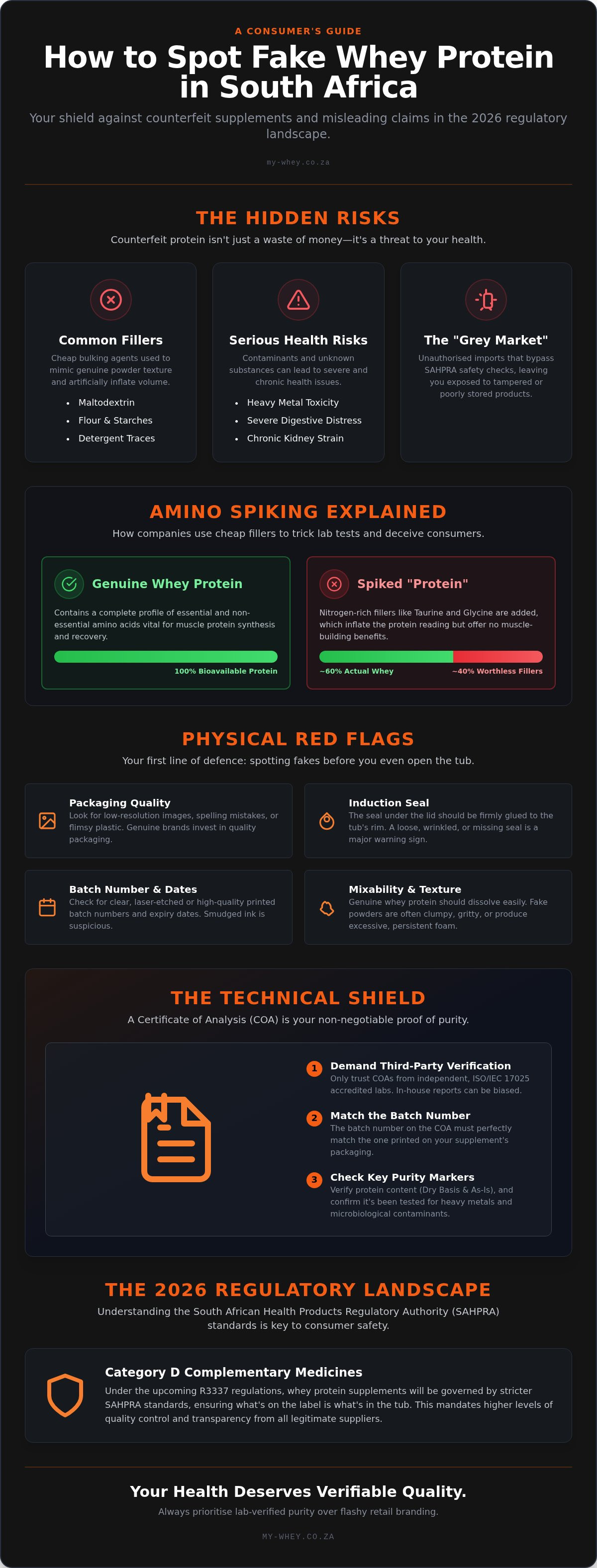
The South African supplement market is currently experiencing a surge in demand; unfortunately, this growth has invited a wave of sophisticated counterfeiters. When you buy a tub of protein, you expect the contents to match the label. However, many products on local shelves contain hidden fillers like maltodextrin, flour, or even traces of detergent to mimic the texture of genuine powder. These contaminants don't just waste your money. They pose significant health risks, including heavy metal toxicity and severe digestive distress. Understanding What is Whey Protein? is the first step in realising that its complex biological structure cannot be easily or cheaply replicated by fraudsters.
Knowing how to spot fake whey protein south africa requires an understanding of the "grey market." These are unauthorised imports that bypass the safety checks mandated by the South African Health Products Regulatory Authority (SAHPRA). Without these checks, there is no guarantee that the product hasn't been tampered with or stored in unsanitary conditions. Consuming unverified, contaminated protein powders over a long period can lead to chronic issues like kidney strain and metabolic imbalances. You deserve to know exactly what is entering your body.
Understanding Amino Spiking and Nitrogen Testing
Amino spiking is a deceptive practice where manufacturers add cheap, individual amino acids like Taurine or Glycine to the mix. Standard laboratory tests often measure total nitrogen content to calculate protein levels. Because these added aminos are nitrogen-rich, they artificially inflate the protein count on the label. You might think you're getting 25g of whey, but a large portion could be non-proteogenic fillers that don't support muscle recovery. This is why a high protein percentage isn't always a badge of quality. Actual bioavailable whey protein provides a complete amino acid profile that spiked products simply lack. Focus on the source, not just the number.
The Economic Incentive for Counterfeiting
Whey protein is a high-value commodity in South Africa. The significant cost of raw whey makes it an attractive target for fraudsters looking to maximise margins. You will often see "proprietary blends" used as a smokescreen to hide the absence of genuine whey concentrate. If a price seems suspiciously low compared to established bulk suppliers, it's a major red flag. Fraudsters rely on flashy packaging to distract you from the lack of a verifiable Certificate of Analysis. Learning how to spot fake whey protein south africa means looking past the marketing and demanding transparency. Always prioritise lab-verified purity over retail branding to ensure your hard-earned Rands are buying actual nutrition.
The Technical Shield: How to Read a Certificate of Analysis (COA)
While physical checks provide an initial layer of defence, a Certificate of Analysis (COA) is the only objective shield against supplement fraud. A COA is an accredited laboratory document that confirms a specific batch of product meets its chemical and biological specifications. Think of it as the "birth certificate" for your supplement. If a supplier cannot produce this document for the exact batch number on your tub, you are likely dealing with an unverified or counterfeit product. Understanding how to spot fake whey protein south africa requires moving past marketing claims and prioritising verifiable data.
Always distinguish between internal "in-house" reports and third-party independent verification. In-house reports are generated by the manufacturer, which can lead to biased results or overlooked contaminants. Independent labs with ISO/IEC 17025 accreditation provide the neutral validation you need to trust what you are drinking. Essential identifiers on a valid COA include a unique batch number that must correspond to the one printed on your packaging. The date of analysis should be recent; a document from two years ago is no guarantee of current quality. Learning how to spot fake whey protein south africa involves looking past the shiny label and demanding a clear paper trail. Knowing how to vet your supplements through these documents is the mark of an informed consumer.
Decoding Purity and Potency Markers
When you examine a COA for whey protein, you will see results listed as "Dry Basis" and "As Is". "Dry Basis" removes moisture from the calculation, often showing a higher percentage, whilst "As Is" reflects the actual powder in the scoop. High-quality 80% concentrate standards must be met consistently across every production run to ensure you get what you pay for. High-Performance Liquid Chromatography (HPLC) is the gold standard for amino acid profiling, providing a precise breakdown of a product's chemical composition. This level of detail ensures that the protein content is derived from whey rather than cheap amino acid alternatives.
Screening for Contaminants and Heavy Metals
Purity isn't just about what is in the powder; it's about what is left out. A COA should list Colony Forming Units (CFU/g) for mould, yeast, and bacteria to ensure the product is hygienically safe for consumption. It must also show safe thresholds for heavy metals like Arsenic, Cadmium, Lead, and Mercury, measured in parts per million (ppm). These markers are non-negotiable for long-term health. Similarly, omega 3 testing requires additional TOTOX (total oxidation) markers to ensure the oil hasn't turned rancid. You can find these standards upheld across our range of pure bulk supplements.
Physical Red Flags: Spotting Fakes Before You Scoop
Before you even break the seal, the packaging itself often tells a story. Counterfeiters in the South African market frequently struggle with high-end printing costs. Look for pixelated logos, faded colours, or spelling errors on the label. These are immediate indicators of a fraudulent operation. A legitimate brand invests in high-quality, durable packaging that doesn't peel or smudge easily. Mastering how to spot fake whey protein south africa starts with this visual audit. If the tub looks like it was printed in a backroom, it probably was.
Pay close attention to the seal. A genuine product typically uses an induction seal, which is heat-fused to the rim of the tub. If you find a simple pressure-sensitive liner that merely sticks to the cap, or if the seal appears loose or re-glued, treat the contents with extreme suspicion. Tampered seals are a gateway for contaminants and cheap fillers. Fraudsters often buy genuine tubs, replace the premium powder with cheap alternatives, and attempt to reseal them. Don't ignore a compromised seal just to save a few Rands.
The physical properties of the powder are equally revealing. Genuine whey protein is usually fine and has a slightly "sticky" texture due to its moisture and fat content. If the powder is overly dry, like flour, or contains hard clumps, it has likely been replaced. A University of Pretoria study on supplement quality revealed that 68.6% of local protein supplements had protein contents that differed significantly from their label claims. This highlights why physical vigilance is your best tool when lab tests aren't immediately available. Mixability is another factor; whilst some foaming is natural, excessive clumping that won't dissolve usually signals a high concentration of cheap thickening agents.
The Senses: Smell, Taste, and Texture
Your senses are remarkably good at detecting fraud. Genuine unflavoured whey protein has a mild, slightly milky aroma. If the powder smells like chemicals or has no scent at all, it's a red flag. A bitter chemical aftertaste or an overly chalky mouthfeel often suggests the presence of synthetic fillers or nitrogen-spiking agents. You can also perform a "burn test" at home. Pure protein smells like burnt hair when exposed to a flame because of its amino acid structure. If it smells sweet like caramel or marshmallows, it is likely packed with hidden sugars or maltodextrin.
Batch Code and Expiry Verification
Every legitimate supplement batch has a unique identifier. You should be able to cross-reference batch codes with the official manufacturer's database or website. Be wary of supplements with no visible batch or manufacturing date. In the South African market, "re-stickering" is a common tactic where fraudsters place new expiry stickers over old ones to sell expired or degraded stock. Check the bottom of the tub and the side of the label for consistency. If the batch code looks tampered with or is missing entirely, do not consume the product. Knowing how to spot fake whey protein south africa means verifying the paper trail on the packaging as much as the powder inside.
The South African Regulatory Landscape in 2026
In 2026, the South African Health Products Regulatory Authority (SAHPRA) has solidified its oversight of the supplement industry. Whey protein is now firmly classified under "Category D" as a complementary medicine. This change means that every product on the shelf must adhere to stricter safety and quality standards than basic food items. Understanding these legal frameworks is a vital part of how to spot fake whey protein south africa. If a product lacks the required SAHPRA-compliant labelling or the mandatory warning for products exceeding 30g of protein per day, it's a clear signal that the supplement hasn't been vetted for the local market.
The Department of Health's R3337 regulations, finalised in mid-2026, have introduced mandatory front-of-pack labelling. These rules are designed to stop manufacturers from hiding artificial sweeteners or excessive sodium behind flashy branding. Whilst Good Manufacturing Practice (GMP) remains the industry baseline, it's important to remember that GMP only covers the manufacturing process. It doesn't guarantee the purity of the raw ingredients used. You should also look for compliance with the Meat-Analogue Regulation (Government Notice R. 6436), which set a precedent in July 2026 for stricter compositional standards in protein-based products across the country.
SANAS Accreditation and Local Lab Testing
The South African National Accreditation System (SANAS) is the primary body vetting local laboratories. When you review a Certificate of Analysis, you must check if the laboratory holds ISO/IEC 17025 accreditation. This authorised status proves the facility has the technical competence to produce accurate and reliable results. Local testing is essential for any supplements manufactured or repacked within South Africa. It acts as a final safeguard against contaminants like heavy metals or bacteria that might enter the supply chain during the transit of raw bulk materials.
Consumer Rights and Reporting Fraud
You have a legal right to request quality documentation from any supplement supplier operating in South Africa. If a brand refuses to provide a batch-specific COA, they're likely hiding a lack of purity or actual protein content. Local laws have evolved to discourage "proprietary blends" that mask specific ingredient dosages. If you suspect you've purchased a counterfeit product, you can report it to the National Consumer Commission or SAHPRA directly. Protect your health by choosing lab-tested whey protein that meets every current South African regulatory standard.
My Whey’s Commitment: Transparent Bulk Sourcing
Our philosophy at My Whey is simple: we prioritise lab-verified purity over expensive retail packaging. In a market where flashy tubs often disguise low-quality contents, we choose a different path. By stripping away the marketing hype and focus on bulk sourcing, we ensure that your budget goes towards the highest quality ingredients rather than glossy labels or celebrity endorsements. This transparency is the ultimate answer to how to spot fake whey protein south africa. When the packaging is minimal, the product has nowhere to hide. Every batch of My Whey bulk protein undergoes rigorous third-party testing to ensure it meets our exacting standards before it ever reaches your door.
One of the most significant advantages of our unflavoured bulk protein is the lack of artificial sweeteners and flavour systems. These additives are frequently used by dishonest manufacturers to mask a bitter chemical aftertaste or an inferior amino acid profile. With our Whey Protein Concentrate 80%, you get a clean, neutral product that reflects its true quality. We vet our international manufacturing partners with a strict quality control protocol, requiring comprehensive documentation for every shipment. This methodical approach allows us to provide a level of certainty that retail brands, focused on high-volume turnover, often struggle to match. Knowing how to spot fake whey protein south africa becomes effortless when you have direct access to the source data.
Sourcing Pure Bulk Ingredients
Our commitment to quality extends across our entire range. We ensure that our branched chain amino acids meet strict identity and potency tests to guarantee they support your recovery as promised. We focus on 80% Whey Protein Concentrate because it offers the optimal balance of bioavailable protein and essential macronutrients without unnecessary processing. This same dedication to purity applies to our gut health supplements, which contain only active ingredients designed for maximum efficacy. We believe that supplements should be tools for health, not a source of hidden fillers or contaminants.
Empowering the South African Fitness Community
We want to provide you with the tools to take total control of your nutritional standards. Transparency isn't just a buzzword for us; it is the foundation of long-term muscle recovery and athletic performance. By providing clear, accessible information and verifiable lab results, we act as a reliable ally in your wellness journey. You no longer have to guess about the safety or potency of your stack. We invite you to view our latest batch reports for total peace of mind and the confidence that you are consuming the purest whey available in South Africa.
Secure Your Performance with Verified Purity
Mastering how to spot fake whey protein south africa is no longer an optional skill for the health-conscious consumer. You now have the technical knowledge to demand a batch-specific Certificate of Analysis and the physical expertise to identify tampered seals or suspicious textures. These checks ensure that every scoop supports your recovery rather than compromising your health with unverified fillers or heavy metals. By prioritising transparency and adhering to the 2026 SAHPRA safety standards, you can build your stack with absolute confidence.
We have done the heavy lifting by vetting international partners and conducting independent batch testing for all our bulk proteins. Our focus remains on providing high-purity ingredients with zero fillers or "fluff" to the South African market. Transparency is our foundation, allowing you to focus entirely on your training goals while we handle the complexities of quality control. Take the final step in securing your nutritional standards today.
Shop Lab-Tested Bulk Supplements at My Whey
Your journey towards peak performance deserves a partner that values integrity as much as you do. Stay vigilant, stay informed, and enjoy the results of pure, potent nutrition.
Frequently Asked Questions
What is the difference between a COA and a standard nutrition label?
A nutrition label is a general declaration of what a product should contain, whereas a Certificate of Analysis (COA) is a batch-specific document that proves what the product actually contains. While the label remains the same for every tub, the COA changes with every production run to reflect the exact laboratory results for that specific batch. It acts as the verifiable "birth certificate" of your supplement.
Is it legal to sell whey protein in South Africa without a Certificate of Analysis?
Under SAHPRA regulations, manufacturers and importers must maintain quality control records, which include a Certificate of Analysis for every batch. While a retailer might not display it on the shelf, they are legally required to have this documentation available to prove the safety and composition of their Category D complementary medicines. Selling unverified supplements bypasses these critical safety checks and puts consumers at risk.
Can a supplier fake a Certificate of Analysis?
Fraudulent suppliers can unfortunately forge documents, but you can verify them by contacting the issuing laboratory directly. A genuine COA will include a unique report number and the laboratory's official contact details. If you have doubts about how to spot fake whey protein south africa, simply email the lab with the batch number and report ID to confirm the results are authentic and untampered.
How do I check if a South African laboratory is SANAS accredited?
You can verify a laboratory's status by visiting the official SANAS website and searching their accredited facilities directory. A valid report must feature the SANAS logo and a unique accreditation number, such as T0123. This ensures the facility meets ISO/IEC 17025 standards, meaning their testing methods for protein purity and contaminants are technically sound and internationally recognised.
What does "HPLC tested" actually mean on a supplement report?
HPLC, or High-Performance Liquid Chromatography, is a sophisticated analytical technique used to separate and identify the individual components of a substance. On a supplement report, it means the lab has verified the specific amino acid profile of the whey. This is the most reliable way to ensure the protein content is genuine and not artificially inflated by cheap, nitrogen-rich fillers.
Why is heavy metal testing critical for protein powders?
Heavy metal testing is critical because protein sources can absorb contaminants like lead, arsenic, and cadmium from the environment during production. Since these toxins accumulate in the body over time, they can cause chronic health issues if consumed daily in your shakes. A clean COA ensures these metals remain well below the safety thresholds defined by South African health regulations.
How can I tell if my protein has been "amino spiked"?
You can identify amino spiking by checking the ingredient list for added Taurine, Glycine, or Glutamine that isn't part of the natural whey profile. If these are present and the total protein count seems unusually high for the price, the product is likely spiked. Learning how to spot fake whey protein south africa involves requesting an HPLC report to see the actual ratio of essential amino acids versus cheap fillers.
What should I do if a brand refuses to provide their lab results?
If a brand refuses to provide their lab results, you should stop using the product immediately and switch to a transparent supplier. Lack of transparency is a major red flag for counterfeit or sub-standard goods. You can also report the brand to the National Consumer Commission (NCC) or SAHPRA to protect other consumers in the South African fitness community from potential harm.