

Supplement Lab Reports: A Guide to Purity and Potency
Hundreds of FDA recalls have been issued for supplements found to contain undeclared pharmaceutical drugs, a sobering reminder that a premium price tag doesn't always equal premium quality. If you've ever felt a sense of dread about heavy metal contamination or wondered if your protein is spiked with cheap fillers, you aren't alone. Understanding what to look for in a supplement lab report is the only way to move past marketing hype and verify what's actually entering your body.
It's exhausting to navigate technical jargon whilst trying to make a simple choice for your health. We believe you deserve total transparency, which is why we've simplified the complexities of the Certificate of Analysis (CoA), a document that should be a standardised part of your buying process. You'll learn to distinguish between purity and potency, identify acceptable microbial limits, and gain the confidence to source pure bulk ingredients without the guesswork. We're stripping away the confusion to help you become your own quality control expert.
Key Takeaways
- Understand the vital difference between a marketing label and the Certificate of Analysis (CoA) which acts as the definitive proof of quality.
- Learn exactly what to look for in a supplement lab report to ensure batch numbers and testing dates are current for your 2026 purchases.
- Identify common red flags like generic or outdated reports that fail to provide batch-specific verification.
- Gain the technical skill to interpret safety data for heavy metals and microbial contaminants to protect your wellness journey.
- Discover how to source premium bulk ingredients like whey and creatine with the confidence of a professional quality controller.
What is a Supplement Lab Report? Understanding the Certificate of Analysis (CoA)
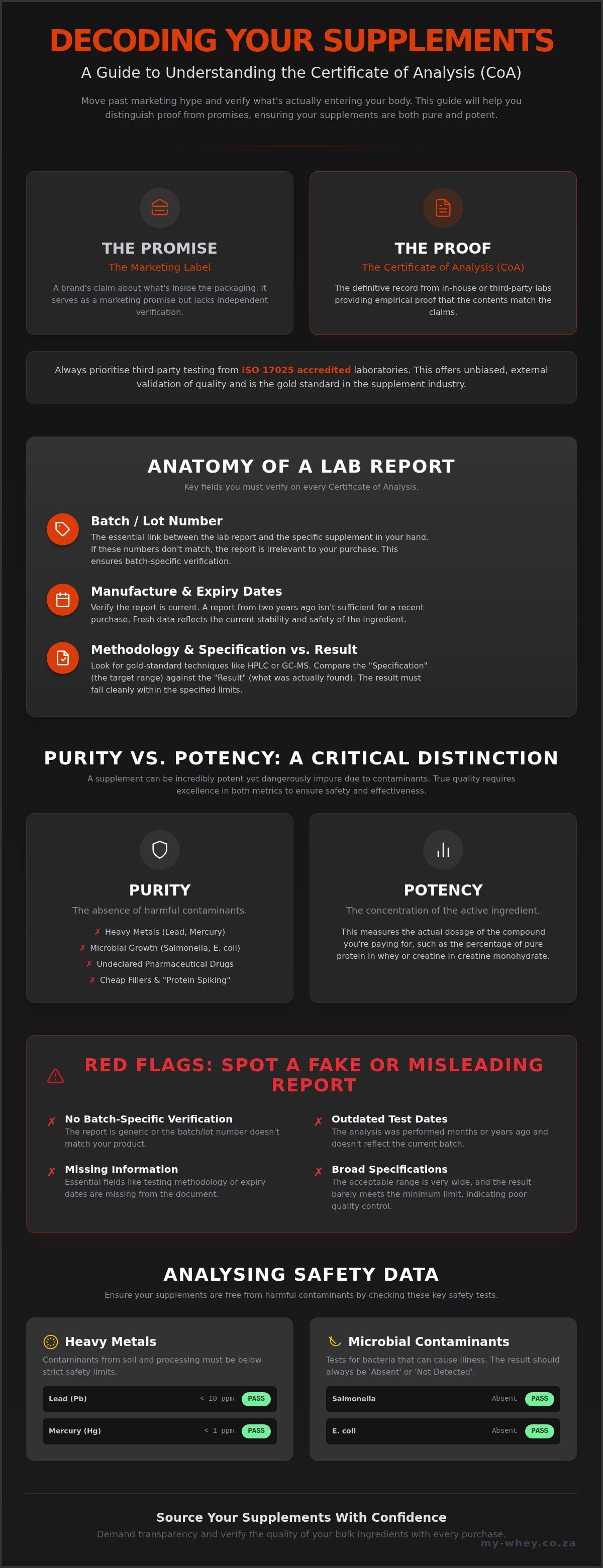
A supplement lab report is the definitive record of a product's chemical and physical identity. Specifically known as a Certificate of Analysis (CoA), this document serves as the master record for a specific batch of raw material or finished product. Whilst a standard supplement label acts as a marketing promise, the CoA provides the empirical proof that the contents match the claims. For anyone wondering what to look for in a supplement lab report, the primary objective is to verify that the substance is exactly what the manufacturer says it is.
The supplement industry relies on two main types of testing: in-house and third-party. In-house testing is conducted by the manufacturer themselves, which can be efficient but carries an inherent risk of bias. Third-party testing, ideally performed by ISO 17025 accredited laboratories, offers an unbiased, external validation of quality. When you purchase bulk ingredients like Creatine Monohydrate or Whey Protein Concentrate 80%, you should prioritise these reports over fancy tubs or colourful labels. Packaging doesn't improve your performance; verified purity does.
The Difference Between Purity and Potency
It's vital to distinguish between these two metrics to ensure your safety. Purity refers to the absence of harmful contaminants, such as lead, mercury, or microbial growth like Salmonella and E. coli. Potency, on the other hand, measures the concentration of the active ingredient. A product can be incredibly potent yet dangerously impure. For instance, a herbal supplement might contain the advertised dosage of active compounds but remain contaminated with heavy metals due to poor soil quality or processing standards. True quality requires both high potency and absolute purity.
Why Transparency Matters in the South African Market
The South African market faces unique challenges with unverified imports and a lack of stringent local oversight. For local athletes, transparent lab reporting isn't just a bonus; it's a necessity for long-term health and performance. Knowing what to look for in a supplement lab report allows you to bypass the risk of "protein spiking" or hidden fillers. By demanding batch-specific data, you build a relationship with your supplier based on evidence rather than marketing slogans. This level of verification ensures that your body receives only the high-grade raw ingredients required to reach your fitness goals.
The Anatomy of a Lab Report: Key Fields to Verify
Knowing what to look for in a supplement lab report involves more than just glancing at a pass or fail mark. A genuine Certificate of Analysis (CoA) is a technical map of a specific batch, providing a transparent look at its chemical profile. To ensure global safety and standardisation, reputable suppliers follow industry guidelines for Certificates of Analysis, which dictate the essential data points required for consumer protection. If a report lacks these foundational fields, it's a significant red flag regarding the product's legitimacy.
The first item to check is the batch or lot number. This code is the essential link between the lab report and the specific bag of supplement in your hand. If these numbers don't match, the report is essentially irrelevant to your purchase. Additionally, verify the manufacture and expiry dates. In 2026, a report from two years ago isn't sufficient; you need data that reflects the current stability and safety of the ingredient. High-quality suppliers, such as My Whey, maintain strict traceability to ensure every batch of Whey Protein Concentrate 80% or Creatine Monohydrate is precisely accounted for.
When you are learning what to look for in a supplement lab report, the methodology column is where you find the truth about a lab's precision. Look for gold-standard techniques like High-Performance Liquid Chromatography (HPLC) or Gas Chromatography-Mass Spectrometry (GC-MS). These methods allow for the molecular separation of compounds, ensuring the active ingredients are present at the correct concentration. You must also compare the "Specification" (the target range) against the "Result" (what was actually found). A result that barely meets the lower limit of a broad specification may indicate poor quality control.
Understanding Technical Limits (LOD and LOQ)
Technical reports often use the terms Limit of Detection (LOD) and Limit of Quantitation (LOQ). The LOD is the smallest amount of a substance the equipment can "see", whilst the LOQ is the smallest amount it can accurately measure. It's a common misconception that a "Not Detected" result means a contaminant is entirely absent. It simply means the level is below the lab's LOD. Understanding these thresholds is vital for assessing the true purity of high-grade raw ingredients.
Identity Testing: Is it Actually What it Says?
Identity testing is your first line of defence against raw ingredient fraud. This process begins with organoleptic testing, where a technician verifies the expected colour, odour, and texture of the powder. More importantly, labs use Fourier-transform infrared spectroscopy (FTIR) to confirm the molecular fingerprint of the substance. FTIR testing ensures that a white powder labelled as Creatine isn't actually a cheaper filler like maltodextrin. This level of scrutiny ensures that what you put into your body is exactly what you paid for.
Red Flags: How to Spot a Fake or Misleading Report
Not every document that looks like a laboratory report is legitimate. Some companies use generic "representative" reports that lack specific batch identifiers, making them useless for verifying the bag you actually bought. If you are learning what to look for in a supplement lab report, start with the date. A report from 2024 is a historical artifact, not a safety guarantee for a 2026 purchase. Supplements can degrade over time, and a two-year-old document provides zero insight into the current batch's purity or potency.
Visual inconsistencies are often the easiest way to spot a fraud. Look for sections where fonts change suddenly or data fields appear misaligned; these are tell-tale signs of a "photoshopped" or altered result. A professional Certificate of Analysis (CoA) should also feature a clear signature from a certified Lab Manager or Quality Assurance officer. Without this human accountability, the document is merely a collection of unverified numbers. If a supplier refuses to provide a batch-specific, signed report, they're likely hiding something about their sourcing or quality control.
The Danger of Protein Spiking
Protein spiking is a deceptive practice where manufacturers add cheap amino acids like taurine or glycine to raw powders. Standard lab tests often measure nitrogen content to estimate protein levels, and these fillers trick the equipment into showing a higher protein percentage than what's actually there. When reviewing a whey protein report, check for a full amino acid profile. This breakdown ensures the protein comes from high-quality dairy sources rather than nitrogen-rich fillers that offer no muscle-building benefit.
Discrepancies in Creatine Purity
High-quality creatine monohydrate must be screened for specific manufacturing by-products. Watch out for reports that omit results for creatinine, dicyandiamide, or dihydrotriazine. These impurities suggest a rushed production process or low-grade raw materials. Additionally, look for mesh-size testing results; a 200-mesh powder is finer and dissolves better than an 80-mesh variant. If the data appears inconsistent or indicates high moisture levels, it often signals poor storage conditions, which can lead to the premature degradation of the active ingredient.
Safety Data: Heavy Metals, Microbials, and Toxins
Safety data is the most critical component of what to look for in a supplement lab report because it addresses the risks you cannot see, smell, or taste. Whilst potency ensures a product works, safety testing ensures it doesn't cause harm. Every reputable Certificate of Analysis (CoA) must screen for the "Big Four" heavy metals: lead, mercury, cadmium, and arsenic. These elements can accumulate in the body over time, leading to systemic toxicity. If a report omits any of these four, the testing is incomplete and potentially dangerous.
Understanding the units of measurement is vital for accurate interpretation. Labs typically report contaminants in Parts Per Million (PPM) or Parts Per Billion (PPB). For perspective, 1 PPM is equivalent to one milligram per kilogram. When reviewing heavy metal data, look for results that fall well below the permissible daily exposure limits. For instance, the USP <2232> standard limits lead exposure to 5 µg per day. If a report shows levels nearing these thresholds, it indicates a lower grade of raw material that may have been sourced from contaminated soil or poorly regulated industrial zones.
Setting Safety Thresholds
Reliable manufacturers compare their batch results against international safety standards set by the WHO or EFSA. Total purity is statistically impossible, but maintaining levels within a "safe" range is non-negotiable for consumer protection. This is especially true for oil-based products. When reviewing omega 3 reports, you should specifically check for peroxide and p-anisidine values. These metrics measure oxidative stability; high values indicate that the oil is rancid, which can cause inflammation rather than reducing it.
The Importance of Gut Health Safety
For those sourcing gut health supplements South Africa, microbial purity is the primary concern. These products must be screened for pathogenic bacteria like E. coli and Salmonella, as well as yeast and mould counts that could compromise the digestive system. Lab reports also serve to verify shelf-stable probiotic counts, ensuring the "live" cultures promised on the label are actually present in the batch. Under USP <2023> standards, oral solid supplements must maintain a Total Aerobic Microbial Count of 1,000 CFU/g or less to be considered safe for human consumption. We handle the heavy lifting of this verification so you can focus on your results. Explore our lab-tested bulk range to see how we prioritise your safety.
Sourcing Bulk Supplements with Confidence: The My Whey Standard
At My Whey, we act as the bridge between high-level industrial standards and your daily wellness routine. We understand that the technical details of what to look for in a supplement lab report can feel overwhelming. That is why we take a proactive approach by organising independent, third-party testing for our entire range. By handling the heavy lifting of quality control and batch verification, we allow you to focus on your performance goals with the security of knowing your supplements are pure and potent.
Our business model is built on transparency and efficiency. By eliminating the "middleman" marketing costs and expensive retail packaging associated with traditional brands, we invest those savings back into high-level laboratory standards. You aren't paying for a celebrity endorsement or a glossy tub; you are paying for premium raw ingredients like Whey Protein Concentrate 80% and Creatine Monohydrate. This commitment ensures that you receive lab-verified data and bulk affordability without compromising on the integrity of the product.
Transparency is a core value, not a marketing slogan. We encourage every customer to request a Certificate of Analysis (CoA) for their specific order. Simply contact our team with your batch number, and we will provide the corresponding lab report. This standardised process ensures that every bag of supplement we ship meets our strict criteria for purity and concentration, giving you a biographical record of exactly what you are ingesting.
Why Bulk Does Not Mean Lower Quality
There is a common misconception that bulk sourcing implies a compromise in quality. In reality, the economics of bulk sourcing are about paying for the ingredient rather than the label. Professional athletes and gym owners across South Africa choose My Whey because it allows for clean stacking. By purchasing high-grade raw ingredients, you avoid the hidden artificial sweeteners, thickeners, and "proprietary blends" that often clutter retail products. You gain total control over your nutritional intake whilst benefiting from direct-to-consumer pricing.
Your Next Steps for a Safer Supplement Stack
Take control of your supplement cupboard today by performing a quick quality audit. Check your current products for batch numbers and expiry dates; if a manufacturer cannot provide a matching lab report for that specific lot, it is time to reconsider your source. Our team is always available to discuss batch-specific information or explain the technical nuances of our testing protocols. We are here to be your reliable ally in a complex market. Shop our range of lab-tested bulk supplements today and experience the standard of purity you deserve.
Take Control of Your Nutritional Integrity
You now possess the technical framework to audit your own supplements with confidence. By verifying batch-specific numbers, checking for heavy metal thresholds, and insisting on current data, you move from a passive consumer to an informed advocate for your own health. Knowing exactly what to look for in a supplement lab report ensures that your hard work in the gym isn't undermined by hidden contaminants or deceptive fillers.
We specialise in premium, lab-tested wellness products that prioritise substance over marketing style. Whether you require specialised herbal and cognitive support or high-purity raw ingredients, we provide the transparent data you need to succeed. Our bulk pricing model eliminates unnecessary packaging costs, allowing you to invest directly in your performance. Invest in purity; shop our lab-tested bulk supplements now. Your journey to better health is built on a foundation of quality; stay informed and stay pure.
Frequently Asked Questions
What is a Certificate of Analysis (CoA) for supplements?
A Certificate of Analysis is a batch-specific document that verifies the identity, purity, and potency of a raw material or finished product. It acts as the definitive quality record, confirming that the substance meets established safety specifications. This document provides the empirical evidence that the contents of the bag match the claims on the label.
How can I tell if a supplement lab report is real or fake?
You can verify a report's legitimacy by checking for batch numbers that match your specific product and looking for a signature from a qualified quality control manager. Look for inconsistencies in fonts or misaligned data fields, as these often signal that a document has been digitally altered. A genuine report should also clearly list the laboratory's contact information and accreditation details.
Does a lab report guarantee that a supplement is safe?
A lab report confirms that a specific batch met certain safety thresholds at the time of testing, but it isn't a permanent guarantee of safety. Factors like improper storage or cross-contamination after testing can still affect quality. It's a snapshot of a product's integrity that provides essential peace of mind whilst highlighting the importance of buying from trusted suppliers who maintain high standards.
What are the most important heavy metals to look for in a report?
The "Big Four" heavy metals you must look for are lead, mercury, cadmium, and arsenic. These are the most common contaminants found in raw ingredients due to soil quality and processing methods. When learning what to look for in a supplement lab report, ensure these four are listed with results well below the international safety limits to prevent long-term systemic toxicity.
How often should a supplement company test their products?
Reputable companies should test every single batch of raw material before it is processed or sold to consumers. This batch-specific testing is the only way to ensure total consistency across different shipments. Testing only once a year or using "representative" samples from old lots fails to account for natural variations in raw ingredient sourcing and processing.
Why do some lab reports say "Not Detected" instead of zero?
"Not Detected" means that any amount of the substance present is below the equipment's Limit of Detection (LOD). Scientific instruments cannot measure an absolute zero; they can only confirm if a substance is present above a specific, measurable threshold. A "Not Detected" result indicates the contaminant is essentially non-existent for safety purposes and falls within the safest possible range.
Can I request a lab report from any supplement brand in South Africa?
You have the right to request a CoA from any brand operating in South Africa, though not all companies choose to be transparent. Ethical suppliers will readily provide these documents to prove their commitment to quality. If a brand refuses to share their data or provides an outdated document, it's a strong indicator that they aren't prioritising your safety or nutritional integrity.
What is the difference between a manufacturer report and a third-party report?
A manufacturer report is generated by the company's internal lab, whilst a third-party report comes from an independent, external laboratory. Knowing what to look for in a supplement lab report involves prioritising third-party testing from ISO-accredited facilities. External labs provide an unbiased layer of verification that ensures the manufacturer is meeting international standards without any conflict of interest.