

Supplements for Improving Deep Sleep Quality: Evidence and Safety in 2026
Could a supplement make you feel drowsy without improving deep sleep? That’s the question behind many claims about supplements for improving deep sleep quality, and the answer isn’t always clear. Feeling more relaxed or sleeping for longer doesn’t necessarily mean you’ve gained more restorative deep sleep.
Evidence varies between ingredients, and studies don’t always measure sleep in the same way. A product that suits one person may cause side effects or interact with medication for another. Supplements also can’t address every cause of poor sleep, including conditions that need professional care.
This guide explains the difference between deep sleep and overall sleep quality, summarises the evidence for commonly discussed ingredients and outlines what to consider before trying a supplement. It also covers why findings on magnesium remain uncertain, what research suggests about L-theanine and ashwagandha, and when sleep habits or advice from a health professional should come first. The aim is to help you make an informed choice, not promise a quick fix.
Key Takeaways
- Deep sleep is a sleep stage, not simply a feeling of being rested. How you feel and what a device estimates about your sleep stages may not match.
- Assess supplements for improving deep sleep quality by checking the specific outcome studied, the strength of the evidence and possible safety concerns.
- Melatonin, magnesium, L-theanine, valerian and ashwagandha aren’t interchangeable. Evidence for one sleep outcome doesn’t prove an effect on deep sleep.
- Before trying a supplement, define your concern and read the full ingredient list, serving information, warnings and product directions.
- Build consistent sleep habits and seek professional advice when needed. Supplements aren’t a substitute for addressing an underlying sleep problem.
What does deep sleep quality mean, and can supplements improve it?
Deep sleep is a stage of sleep, not a synonym for feeling refreshed or spending more hours in bed. It generally refers to slow-wave sleep, also called N3, when brain activity slows and it takes more effort to wake someone. You may feel tired despite spending time in this stage, or feel rested without knowing how much deep sleep you had. Sleep quality is broader: it can include how easily you fall asleep, how often you wake, total sleep time and how you feel the next day.
That distinction matters when judging supplements for improving deep sleep quality. A study reporting that participants fell asleep sooner hasn’t necessarily shown that they spent longer in N3. Likewise, a longer night’s sleep or better self-reported rest doesn’t, by itself, demonstrate a measurable change in sleep stages. The Deep sleep overview introduces the term and its place in the sleep cycle. To assess a supplement claim, check which outcomes the research actually measured.
What happens during deep sleep?
Sleep moves through non-rapid eye movement stages and rapid eye movement (REM) sleep in repeating cycles. Deep, slow-wave sleep is one part of this pattern, not the only stage involved in healthy sleep. The balance shifts over the night: deep sleep tends to be more prominent earlier, whilst REM periods typically become longer towards morning. The pattern also differs between people and can change with age and other factors.
A wearable can offer a rough view of sleep patterns, but its stage estimates aren’t a medical diagnosis or a definitive measurement. Consumer devices infer stages from signals such as movement and heart rate; they don’t measure brain activity in the same way as a clinical sleep study. Treat a nightly score as an estimate, not proof that you gained or lost deep sleep.
Why a supplement claim may not mean deeper sleep
Check the outcome, not just the headline. “Fell asleep faster” concerns sleep onset; “slept longer” concerns duration; and “increased slow-wave sleep” refers to a measured change in a particular stage. These results answer different questions. A supplement may affect one outcome without changing another, and a participant’s report of better sleep doesn’t automatically establish a change in objectively measured sleep architecture.
Studies also vary in their participants, methods, duration and definitions of improvement. Some rely on people’s reports, whilst others use sleep monitoring. That makes direct comparisons difficult, even when studies examine the same ingredient. Check whether research measured deep sleep specifically, or focused on general sleep quality, time to fall asleep or total sleep. A broad sleep benefit shouldn’t be presented as evidence of more deep sleep unless that outcome was measured.
So, can supplements improve deep sleep? Some may influence aspects of sleep for some people, but a claim about relaxation or overall sleep quality doesn’t guarantee increased slow-wave sleep. Keep the outcome precise, and treat wearable readings as estimates rather than proof.
Which supplements have evidence for supporting sleep, and what remains uncertain?
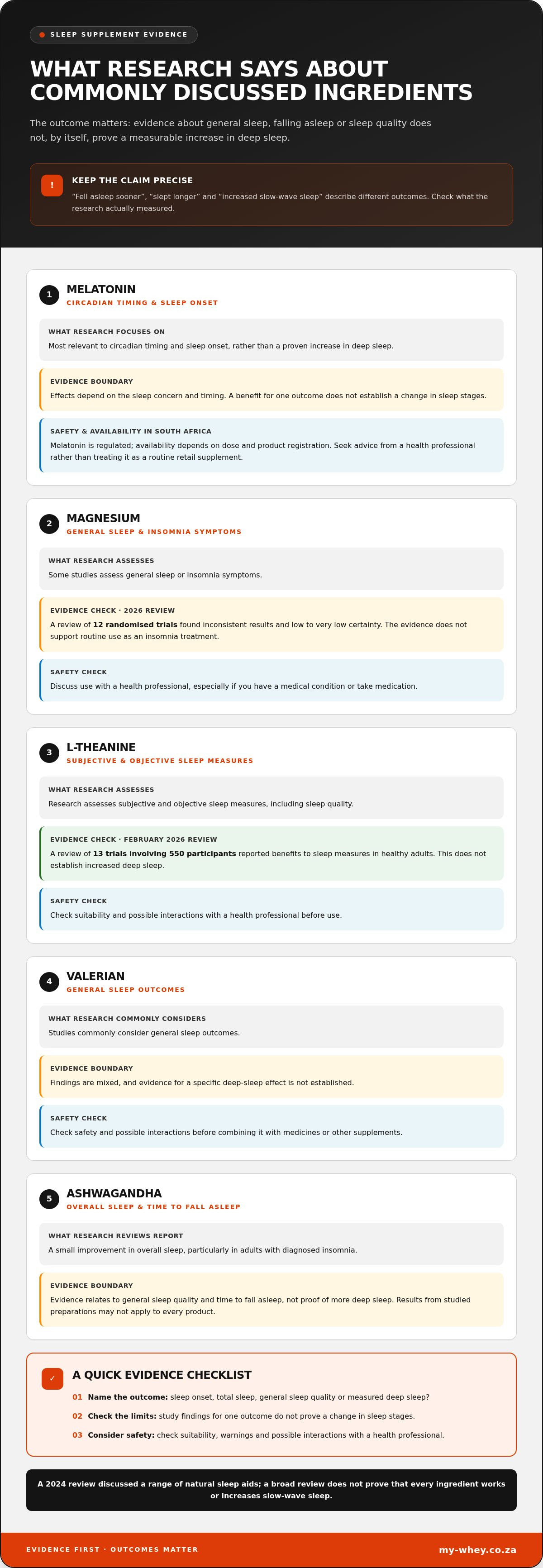
Evidence depends on the ingredient and the outcome being tested. A 2024 review discussed a range of natural sleep aids, but a broad review doesn’t prove that every ingredient works or increases slow-wave sleep. The table below distinguishes findings on general sleep from evidence specifically about deep sleep.
What research says about commonly discussed ingredients
| Ingredient | Sleep outcome studied | Evidence limitation | Key safety consideration |
|---|---|---|---|
| Melatonin | Most relevant to circadian timing and sleep onset, rather than a proven increase in deep sleep. | Effects depend on the sleep concern and timing. A benefit for one outcome doesn’t establish a change in sleep stages. | In South Africa, melatonin is regulated and availability depends on dose and product registration. Seek health professional advice rather than treating it as a routine retail supplement. |
| Magnesium | Some studies assess general sleep or insomnia symptoms. | A 2026 review of 12 randomised trials found inconsistent results and low to very low certainty. Evidence doesn’t support routine use as an insomnia treatment. | Discuss use with a health professional, especially if you have a medical condition or take medication. |
| L-theanine | Research assesses subjective and objective sleep measures, including sleep quality. | A February 2026 review of 13 trials involving 550 participants reported benefits to sleep measures in healthy adults, but this doesn’t establish increased deep sleep. | Check suitability and possible interactions with a health professional before use. |
| Valerian | Studies commonly consider general sleep outcomes. | Findings are mixed, and evidence for a specific deep-sleep effect isn’t established. | Check safety and possible interactions before combining it with medicines or other supplements. |
| Ashwagandha | Research reviews report a small improvement in overall sleep, particularly in adults with diagnosed insomnia. | Evidence relates to general sleep quality and time to fall asleep, not proof of more deep sleep. Results from studied preparations may not apply to every product. | Ask a health professional whether it is appropriate for you, particularly if you have a medical condition or take medication. |
Evidence for sleep support doesn’t establish a deep-sleep benefit. Keep that distinction in mind when reading a label or research headline. For a balanced overview of two commonly discussed ingredients, see Harvard Health on melatonin and magnesium for sleep.
Why study quality and ingredient form matter
Check who took part, how many people were studied, how long the trial lasted and what researchers measured. Findings from a small or short study may not apply to everyone. Self-reported sleep quality also differs from a measured change in sleep stages. Formulations matter too: extracts, serving amounts and other product ingredients can vary, so a result for one studied preparation shouldn’t be assumed to apply to every retail supplement.
My Whey offers curated supplement ingredients, including Ashwagandha Powder, and states that its products are third-party laboratory tested for purity. This product information isn’t evidence of a sleep outcome. You can explore supplement ingredient options whilst keeping the research and safety distinctions in mind.
Always consult your health care provider before taking any supplements. Pregnant or lactating women, people with existing medical conditions, or people taking medications should consult their health care provider/s before taking any dietary supplement. Keep out of reach of children.
These statements have not been evaluated by the Food and Drug Administration. This product is not intended to diagnose, treat, cure or prevent any disease.
Do sleep supplements work better than sleep habits? Compare the evidence
No supplement guarantees more deep sleep. An ingredient might help with a particular aspect of sleep for some people, but that doesn’t mean it will increase slow-wave sleep, resolve the cause of disrupted nights or work safely for everyone. Weigh possible benefits against uncertain evidence, side effects and interactions.
Sleep habits and clinical support have different roles. Habits shape your routine and environment, whilst a health professional can help investigate persistent problems and discuss appropriate care. Neither should be treated as a promise of a specific sleep-stage result.
When supplements may be an adjunct, not the starting point
Consider a supplement only as an optional addition, taking into account your sleep concern, the evidence for that outcome and your individual health circumstances. First, make the basics easier to sustain: keep a consistent sleep and wake schedule where possible, and make your bedroom comfortable, dark and quiet. A relaxing wind-down routine may also help you prepare for bed. These steps aren’t guaranteed solutions, and the right approach varies between people.
Compare the trade-offs. A supplement may seem convenient, but evidence can be limited, and a product may cause unwanted effects or interact with medication. A routine change avoids supplement-related interactions, but it may take time and may not address an underlying health issue. If you do consider a product, define what you want to improve, such as difficulty falling asleep or frequent waking. Don’t assume a general “sleep support” claim means more deep sleep.
Avoid adding several ingredients at once. If you make multiple changes together, it becomes harder to tell what may have helped or caused a problem. Don’t increase a serving or combine products simply because an initial effect isn’t obvious.
When to seek professional advice about poor sleep
Speak with a health professional if sleep problems persist, worsen or interfere with daily functioning. Ongoing difficulty can have different causes, and choosing a new ingredient alone may delay attention to the issue. Symptoms such as loud snoring, breathing pauses noticed by someone else, or marked daytime sleepiness are reasons to discuss your sleep with a professional, not grounds to diagnose yourself. A clinician can assess your circumstances and advise whether further evaluation is appropriate.
Seek advice before taking supplements if you use medication, have an existing medical condition, or are pregnant or lactating. This is particularly important if you’re considering a product with several active ingredients or already use other supplements. Share the product label and your current medicines with your health care provider so they can consider possible risks.
Always consult your health care provider before taking any supplements. Pregnant or lactating women, people with existing medical conditions, or people taking medications should consult their health care provider/s before taking any dietary supplement. Keep out of reach of children.
How to assess a sleep supplement safely before trying it
Use this checklist to assess supplements for improving deep sleep quality without assuming that a sleep-related claim proves a deep-sleep benefit. Start by defining what you want to change, then review the evidence, label and safety information before deciding whether to try a product.
- Define the sleep concern. Note whether the issue is taking a long time to fall asleep, waking during the night, an inconsistent schedule or feeling unrefreshed. These are different outcomes, and a product aimed at one may not address another.
- Review the evidence. Look for studies on the ingredient and the outcome you’re concerned about. If research measures general sleep quality or time to fall asleep, don’t treat it as proof of more deep sleep.
- Read the full label. Check every ingredient, the amount per serving, serving information, warnings and product-specific directions. Compare the ingredient and formulation with the research cited. A larger serving or a longer ingredient list doesn’t automatically mean better results.
- Check safety first. Consider possible interactions with medicines or other supplements, as well as any health conditions or circumstances that could affect suitability. Ask a qualified health professional before starting if you’re unsure.
- Reassess carefully. If you decide to try a supplement, follow its directions and monitor how you feel. Don’t keep increasing the amount or add other products just because you haven’t noticed a change.
Questions to ask before choosing an ingredient
Ask yourself: what exact outcome am I seeking, and does the research measure that same outcome? Is the studied ingredient in a comparable formulation, and do the product’s serving instructions align with the evidence? These checks help separate a relevant finding from a broad claim. Avoid stacking multiple products without guidance from a qualified health professional, since combinations can make effects and unwanted reactions harder to assess.
How to monitor use without overinterpreting results
Keep a simple record of bedtime, wake time, night waking and daytime effects, alongside your own observations of sleep. Look for patterns over time rather than reading too much into one better or worse night. A short-term change doesn’t prove the supplement caused it; routine, stress and other factors may also affect sleep. Stop taking it and seek professional advice if concerning effects occur.
My Whey states that its products are third-party laboratory tested for purity. This can inform your assessment of product information, but it doesn’t establish that an ingredient improves deep sleep or is suitable for every person. Explore My Whey’s supplement ingredients as part of an evidence-led decision.
These statements have not been evaluated by the Food and Drug Administration. This product is not intended to diagnose, treat, cure or prevent any disease.
Choosing sleep-related supplements with My Whey: a transparent next step
Choosing a supplement starts with understanding what the product is, what evidence supports its intended use and whether it’s suitable for you. My Whey offers curated supplements, including Ashwagandha Powder. Its inclusion in the range makes it an ingredient option, not a promise that it will improve deep sleep or treat a sleep condition.
That distinction matters when considering supplements for improving deep sleep quality. Research about an ingredient’s general effects on sleep doesn’t establish that a particular product increases deep sleep. Sourcing and purity information can help you understand product quality, but cannot demonstrate clinical effectiveness.
What to look for in product information
Before choosing a product, review its full ingredient list, serving information, directions and warnings. Check the product details and note whether the ingredient and formulation match the evidence you’re relying on. A familiar ingredient name alone isn’t enough: the form, amount and preparation used in research may differ from a retail product.
My Whey states that its products are third-party laboratory tested for purity. The product information for Ashwagandha Powder lists it as organic, vegan and gluten-free. Treat these as product attributes, not medical claims. A purity test doesn’t show that an ingredient improves sleep, and attributes such as vegan or gluten-free don’t guarantee that a supplement is appropriate for every person.
Use the label as a practical source of product-specific instructions. Don’t assume that a serving used in a study applies to a product with a different formulation, or that taking more will improve the outcome. If you’re unsure about suitability, discuss it with a health care provider, especially if you take medication or have an existing condition.
A low-pressure next step for informed shoppers
Once you’ve considered the evidence, your specific sleep concern and personal suitability, you can explore My Whey’s supplement range as a source of ingredient options. Read the product information and compare it with the research rather than relying on a broad sleep-related claim. If sleep difficulties persist or affect your daily life, prioritise advice from a health care provider over adding a supplement.
Make your next sleep decision a considered one
Before changing your routine or trying a new ingredient, choose one clear question to guide your next step. Are you hoping to fall asleep more easily, wake less often or feel more alert during the day? Being specific helps you judge whether the information you find relates to your concern, rather than relying on a broad promise about sleep.
If you’re considering supplements for improving deep sleep quality, keep your expectations grounded and your personal circumstances in view. Choose a product only after considering the evidence and your suitability, and don’t let it replace professional advice when sleep problems persist or affect daily life. Informed decisions are more useful than chasing a perfect sleep score.
To explore ingredient options, browse My Whey supplements and review the product information. Choose thoughtfully and seek guidance when you need it.
Frequently Asked Questions
Is there a supplement proven to increase deep sleep?
No supplement has been established as a reliable way to increase deep sleep for everyone. Before trusting a claim, look for the study’s actual outcome: feeling more rested is different from a measured increase in slow-wave sleep. If a product claim about supplements for improving deep sleep quality is supported only by research on falling asleep faster, that distinction matters. Discuss suitability with a health care provider before taking a supplement.
Can magnesium improve deep sleep quality?
Magnesium hasn’t been shown definitively to improve deep sleep. Its possible relevance may differ according to a person’s magnesium status, the form studied and the outcome measured. If you’re considering it because of diet or a suspected deficiency, don’t self-diagnose or use it instead of addressing ongoing sleep problems. A health care provider can help assess whether magnesium is appropriate alongside your diet, medicines and health history.
Does melatonin help you get more deep sleep?
Melatonin is associated with sleep timing, but that doesn’t establish that it increases deep-sleep duration. In South Africa, it’s regulated, and availability depends on the dose and product registration. Don’t assume that a product sold elsewhere, or a particular dose mentioned online, is suitable for you. Ask a health care provider whether it fits your circumstances, especially if you take medicines, are pregnant or have a health condition.
Is ashwagandha a sleep supplement?
Ashwagandha is used as a supplement ingredient, but that alone doesn’t prove it improves deep sleep. My Whey lists its Ashwagandha Powder as organic, vegan and gluten-free; these are product attributes, not evidence of a sleep effect. Check the product directions and warnings, and seek professional advice about suitability before use.
Can sleep supplements interact with medication?
Yes, a supplement can interact with a medicine or be unsuitable alongside a health condition. Check the exact ingredient and product label with a health care provider or pharmacist before use.
How long should you try a supplement to improve sleep?
There isn’t one trial period that suits every ingredient or person. Follow the product’s directions and any guidance from your health care provider, and don’t extend use or raise the serving just because you haven’t noticed a change. Before starting, decide what you’ll monitor, such as bedtime or next-day alertness. If the problem persists or worsens, seek advice rather than adding another product.
What should you do if poor sleep continues despite supplements?
Arrange a discussion with a health care provider rather than continuing to add ingredients. Before the appointment, note when the sleep difficulty began, how it affects your day and any medicines or supplements you use. This information can help guide a review of possible causes and appropriate next steps. Seek advice promptly if poor sleep is affecting concentration, mood, safety or your ability to manage everyday activities.