

Third-Party Tested Supplements South Africa: The 2026 Purity and Safety Guide
Did you know that as many as one in ten supplements may be contaminated with prohibited ingredients or hidden compounds? For dedicated athletes and health-conscious South Africans, this isn't just a minor frustration; it's a genuine risk to your long-term wellness and professional standing. You shouldn't have to choose between your budget and your safety when trying to reach your fitness goals.
We understand the anxiety that comes with decoding confusing labels and the irritation of paying inflated prices for so-called premium brands. You deserve a reliable way to verify the purity of what you're putting into your body. This guide empowers you to source high-quality, third-party tested supplements south africa without the unnecessary retail markup. You will learn exactly how to read a Certificate of Analysis and how to navigate the 2026 SAHPRA regulatory landscape with confidence.
By the time you finish reading, you will know how to conduct a five-step purity audit and where to find lab-tested essentials like whey protein and creatine at wholesale rates. We are stripping away the marketing hype to give you a clear, results-oriented path to cleaner nutrition.
Key Takeaways
- Identify common local market risks, including amino spiking and heavy metal contamination, to safeguard your long-term wellness.
- Master a practical 5-step purity audit to verify batch numbers and match them to official lab reports before you commit to a purchase.
- Understand the difference between global certifications and independent lab testing so you don't pay a retail premium for a logo you don't need.
- Learn how to source third-party tested supplements south africa by choosing raw, bulk ingredients that eliminate the cost of unnecessary packaging.
- Navigate the 2026 SAHPRA guidelines with professional clarity, ensuring every product you use meets stringent safety and quality standards.
The State of Supplement Safety in South Africa
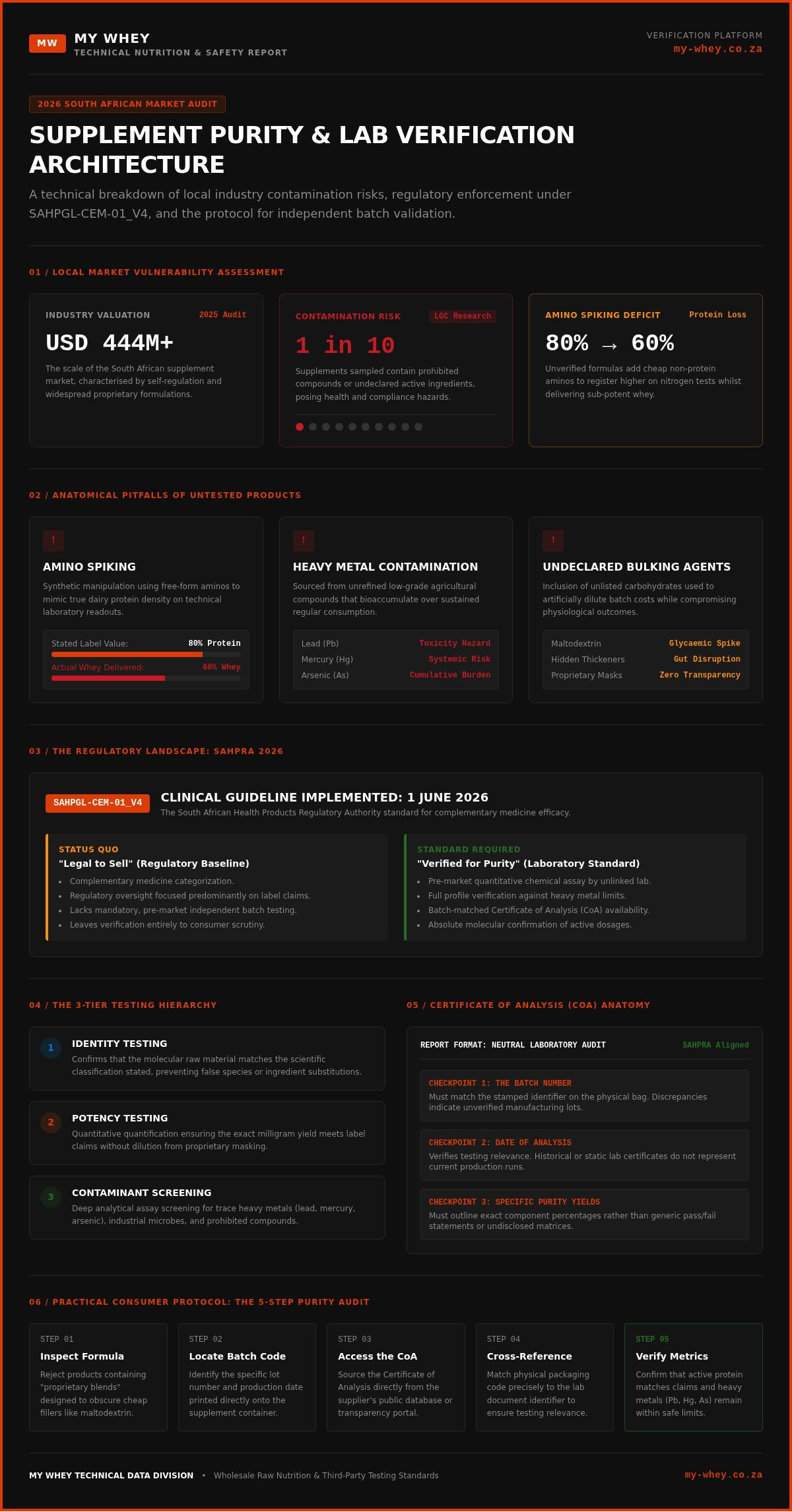
The South African supplement market is currently at a crossroads. While the industry was valued at over USD 444 million in 2025, the daily reality for consumers remains a bit like the "Wild West". You see shelves lined with shiny tubs and bold promises, yet research by LGC suggests that one in ten products may contain prohibited ingredients. Self-regulation is the current norm, often leaving you to guess what's actually inside your shake. Many brands rely on "proprietary blends" to obscure their formulas, hiding cheap fillers behind a marketing facade. By 2026, however, savvy consumers are demanding transparency. They want proof of quality, not just a glossy label.
Why Regulation Lags Behind Innovation
The South African Health Products Regulatory Authority (SAHPRA) has recently intensified its oversight. The implementation of the new clinical guideline, SAHPGL-CEM-01_V4, on 1 June 2026, marked a significant shift in how clinical evidence is assessed for health supplements. Despite these updates, a Dietary supplement is often classified as a complementary medicine, which creates a complex regulatory environment. There is a massive difference between a product being "legal to sell" and being "verified for purity". Current frameworks often focus on label claims rather than rigorous, pre-market batch testing. This gap is precisely why finding third-party tested supplements south africa is no longer a luxury for elite athletes; it's a necessity for anyone serious about their health.
The Hidden Cost of Untested Supplements
Choosing the cheapest option or the one with the loudest marketing often comes with a hidden price tag. Untested products are frequently plagued by heavy metal contamination, including lead and mercury, which pose serious long-term health risks. Then there's the issue of fillers. Ingredients like maltodextrin are often added to bulk out a product, potentially impacting your blood sugar levels and gut health without you even knowing it. Beyond health, the economic loss is equally frustrating. Consider these common industry pitfalls:
- Amino Spiking: Manufacturers add cheap amino acids to artificially inflate protein readings. You might think you're paying for a product that is 80% protein, but you could be receiving as little as 60% actual whey protein.
- Heavy Metal Exposure: Long-term consumption of lead or arsenic found in low-grade raw materials can lead to systemic toxicity.
- Undeclared Fillers: Hidden sugars and thickeners can sabotage your dietary goals and gut microbiome.
We believe you shouldn't have to pay a "health tax" for basic safety. By prioritising third-party tested supplements south africa, you ensure your money buys the exact nutrition promised on the label, not undeclared fillers or harmful contaminants.
Defining Third-Party Tested Supplements: What It Actually Means
Third-party testing is an independent laboratory analysis that is neither funded nor influenced by the supplement manufacturer. It acts as a neutral audit, ensuring that a brand's claims are grounded in chemical reality rather than marketing ambition. While many local brands claim to be "lab-tested", true third-party verification involves a rigorous hierarchy of screening. It begins with identity testing to confirm the ingredient is exactly what it claims to be, then moves to potency testing to ensure you're getting the full dosage. Finally, full contaminant screening checks for heavy metals, microbes, and banned substances. Third-party testing stands as the definitive gold standard for consumer protection in 2026, acting as the final barrier between industrial manufacturing and your personal health.
The Certificate of Analysis (CoA) Explained
A Certificate of Analysis (CoA) is essentially the "birth certificate" of a supplement batch. It provides the documented proof that a product aligns with SAHPRA's official guidelines regarding safety and efficacy. When you review a CoA, focus on three critical areas: the batch number, the date of analysis, and the specific purity percentages. A reputable brand will make these documents easily accessible. To verify your purchase, simply cross-reference the batch number printed on your supplement bag with the corresponding report on the manufacturer's website. If a brand cannot provide a batch-specific CoA, they aren't offering true transparency. You can view our commitment to purity by exploring how we document our own raw ingredients.
Batch Testing vs. Skip-Lot Testing
Consistency is the hallmark of safety. Many companies employ "skip-lot" testing, where they might only analyse every 10th or 20th batch to save on costs. While this is legal, it leaves a significant margin for error. Batch testing, where every single production run is analysed, is vastly superior. This is particularly vital for high-volume staples like whey protein. Because raw materials can vary between shipments, batch testing ensures that the nutritional profile remains identical every time you restock. It guarantees that the last scoop in your bag is as safe and effective as the very first. When sourcing third-party tested supplements south africa, always ask if the testing is batch-specific to ensure you aren't falling victim to the inconsistencies of skip-lot protocols.
Informed Sport vs. Independent Lab Testing: Choosing Your Level of Security
Choosing the right level of security often comes down to your specific goals. Global logos like Informed Sport, Informed Choice, and NSF International are frequent sights on premium tubs. These programs provide an incredible service, but they come with what we call the "Athlete Tax". Manufacturers pay significant fees to use these trademarks, and those costs are inevitably passed on to you. For the average gym-goer, paying a retail premium for a logo might not be necessary if you can access the same purity data through independent lab reports. Finding third-party tested supplements south africa doesn't always require a global certification sticker if the brand prioritises transparency over branding.
When Informed Sport is Non-Negotiable
For professional athletes, the stakes are much higher. Under WADA (World Anti-Doping Agency) rules, you're strictly liable for any substance found in your system. Even accidental cross-contamination in a factory can lead to a career-ending doping violation. This is where an Informed Sport certification becomes essential. It guarantees that every single batch has been screened for over 250 banned substances. Certain products, like branched chain amino acids, require this level of scrutiny for competitors because they are often processed in facilities that handle other, more complex formulas.
The 'Independent Lab' Alternative for General Wellness
If you aren't worried about a random drug test at your next event, you can save money without sacrificing safety. Independent labs, such as SANAS-accredited facilities in South Africa, provide identical purity data regarding heavy metals and ingredient identity. It's often easier to verify raw, single-ingredient products like Creatine Monohydrate than complex, multi-ingredient pre-workouts. For those focusing on gut health supplements, the priority is usually microbial safety and the absence of fillers rather than anti-doping status. By choosing brands that use local independent testing for their third-party tested supplements south africa, you get the same peace of mind regarding purity while keeping your costs manageable. You're paying for the science, not the marketing logo.
How to Verify Supplement Purity: A 5-Step Audit for Consumers
Verification is where marketing claims meet clinical reality. You don't need to be a scientist to vet your nutrition; you just need a methodical approach to your purchase. By following a structured audit, you can separate high-quality third-party tested supplements south africa from those that rely on flashy tubs to hide mediocre ingredients. Use this five-step checklist before you checkout:
- Step 1: Scrutinise the label for "Proprietary Blends". If a brand won't disclose exact dosages, they're likely hiding cheap fillers or under-dosed actives.
- Step 2: Check for a physical batch number and expiry date. These should be ink-jet printed on the packaging, not part of the label design itself.
- Step 3: Request the Certificate of Analysis (CoA). A transparent brand will provide this via customer service if it isn't already on their website.
- Step 4: Research the lab. Ensure the laboratory listed on the CoA is an accredited third party and not an in-house facility owned by the manufacturer.
- Step 5: Evaluate the price. If a product is significantly cheaper than the global market rate for raw materials, it's a major red flag for amino spiking or low-grade sourcing.
Reading Between the Lines of a Supplement Label
Look past the front-of-pack claims and head straight for the "Other Ingredients" list. This is where you'll spot unnecessary silicon dioxide, artificial colours, or thickeners that add no nutritional value. Be particularly cautious with terms like "Natural". In the context of omega 3 sourcing, "natural" doesn't guarantee the absence of heavy metals or oxidation. Also, watch out for "label dressing", where a brand adds a tiny, ineffective amount of a popular ingredient just to list it on the front of the tub. True purity means every ingredient serves a purpose.
Red Flags in South African Supplement Brands
The biggest warning sign is a brand that refuses to provide lab results when asked. In a market where third-party tested supplements south africa are becoming the standard, secrecy is a choice. Avoid products that rely on aggressive marketing hype or "miracle" claims that sound too good to be true. Transparency regarding the origin of raw ingredients is non-negotiable. If a brand can't tell you where their whey or creatine comes from, they likely haven't done the heavy lifting of vetting their own supply chain. Take control of your health by choosing to buy lab-tested bulk ingredients that prioritise substance over style.
My Whey: Premium Lab-Tested Nutrition Without the Brand Tax
Finding third-party tested supplements south africa shouldn't feel like a luxury reserved only for those with deep pockets. At My Whey, we've built our philosophy on a simple, transparent premise: deliver pure, high-quality nutrition without the unnecessary fluff. We don't invest in flashy tubs, designer labels, or expensive athlete sponsorships that drive up retail prices. Instead, we prioritise what actually goes into your body. By eliminating the "Retail Markup", we act as a bridge between industrial purity standards and your personal wellness goals. We organise our supply chain to ensure every batch of raw material is verified, giving you the confidence of a professional-grade product at a wholesale rate.
Purity Over Packaging
Switching to bulk sourcing offers both environmental and financial benefits that most retail brands ignore. Traditional supplement packaging is often one of the most expensive components of the final product. We've stripped that away to focus on the core essentials that drive real results. Our range includes high-purity staples like Whey Protein Concentrate 80%, Creatine Monohydrate, and high-potency Omega 3 softgels. We maintain the integrity of these products from the lab to your door, ensuring that our moisture-proof, light-resistant bulk bags protect the raw ingredients just as effectively as a plastic jar, but at a fraction of the cost. This efficient approach allows us to offer premium third-party tested supplements south africa without the premium price tag.
Your Partner in Evidence-Based Wellness
We want to empower you to take full control of your nutrition. Rather than buying pre-mixed formulas that hide their exact dosages behind proprietary blends, you can build your own customised stacks using pure, verified ingredients. Whether you are looking for specific Amino Acids to support recovery or Superfoods to boost your daily micronutrient intake, we provide the raw materials you need. It's a pragmatic, no-nonsense approach that we believe is the future of the South African supplement market. You deserve to know exactly what you're consuming and exactly why you're paying for it. Our commitment to transparency ensures that lab-tested wellness is accessible to everyone, from the weekend hiker to the dedicated powerlifter. Explore our range of lab-tested bulk supplements today and stop paying the brand tax on your health.
Take Control of Your Nutritional Purity
Securing high-quality nutrition shouldn't involve guesswork or inflated retail prices. You now have the tools to look past flashy marketing and verify the science behind your supplements. By mastering the 5-step purity audit and understanding the difference between global certifications and independent lab reports, you can make informed decisions that protect both your health and your budget. Purity is a baseline requirement, not a premium feature.
We've done the heavy lifting of vetting and quality control so you don't have to. We provide wholesale bulk rates on lab-tested ingredients, ensuring that premium third-party tested supplements south africa are accessible to everyone. With independent purity verification on all core products and reliable national delivery across South Africa, we're here to support your performance goals with integrity and efficiency.
Source Your Pure, Lab-Tested Supplements at My Whey and experience the difference of no-nonsense, evidence-based wellness. You've got the knowledge; now it's time to fuel your body with the transparency you deserve.
Frequently Asked Questions
Are all supplements in South Africa third-party tested?
No, third-party testing is not a legal requirement for all products sold in the local market. While SAHPRA implemented new clinical guidelines on 1 June 2026 to improve oversight, many brands still rely on self-regulation. This is why you must actively seek out third-party tested supplements south africa. Without independent verification, you risk consuming products that haven't been screened for heavy metals or microbial safety by a neutral laboratory.
How can I tell if a supplement has been batch-tested?
You can verify batch testing by locating the unique lot or batch number printed on your packaging. A truly transparent brand will provide a Certificate of Analysis (CoA) that matches this specific number. This document confirms that the exact production run you purchased was analysed for purity and potency. If a company only offers a generic, one-off report from years ago, they aren't performing consistent batch-specific verification.
What is the difference between a 'tested' supplement and a 'certified' one?
"Tested" typically means a product has undergone independent laboratory analysis to verify its ingredients and purity. "Certified" usually refers to global programmes like Informed Sport, which involve rigorous audits and screening for over 250 substances banned by WADA. While certifications offer the highest security for professional athletes, independent lab testing is often sufficient for general wellness enthusiasts who want to ensure they aren't consuming heavy metals or fillers.
Do I really need third-party tested protein if I'm not a pro athlete?
You definitely need purity verification even if you aren't a professional competitor. Third-party testing isn't just about anti-doping; it's about ensuring your Whey Protein Concentrate 80% isn't contaminated with lead, arsenic, or hidden sugars. Research suggests one in ten supplements could be contaminated. Choosing verified products protects your long-term health and ensures you aren't wasting money on "amino-spiked" powders that lack the promised protein content.
Why are third-party tested supplements usually more expensive?
The cost difference usually stems from laboratory fees and the "Athlete Tax" associated with global certification logos. However, you can source third-party tested supplements south africa without a retail premium by choosing bulk suppliers. By eliminating expensive plastic tubs and athlete sponsorships, we provide high-purity raw ingredients at wholesale rates. You're paying for the laboratory-verified quality of the actual supplement rather than the marketing costs of a retail brand.
Can I ask a supplement company for their lab results?
You absolutely can and should request lab results from any supplement manufacturer. A reputable company will either have a public section on their website for Certificates of Analysis or provide them via customer service upon request. If a brand refuses to share their testing data or claims it is "proprietary information", it is a significant red flag. Transparency is the hallmark of safety in the modern nutritional market.
What are the most common contaminants found in untested supplements?
The most frequent issues include heavy metal contamination, such as lead or mercury, and microbial growth like salmonella or E. coli. Additionally, many untested products suffer from "amino spiking", where cheap amino acids are added to inflate protein readings. You might also find undeclared fillers like maltodextrin, which can negatively impact blood sugar levels and gut health. Batch testing is the only way to confirm these contaminants are absent.
Is bulk buying supplements safe if they are lab-tested?
Bulk buying is perfectly safe provided the raw ingredients have been independently verified for purity. In fact, purchasing in bulk is often the most efficient way to access high-quality nutrition without the retail markup. As long as you store your supplements in a cool, dry place and the batch has a valid Certificate of Analysis, the safety profile is identical to smaller, more expensive retail tubs.