

Turmeric and Black Pepper for Joint Pain: What the Evidence Says in 2026
What if the evidence for turmeric and black pepper for joint pain is less straightforward than the headlines suggest? Curcumin, a compound in turmeric, has been studied for joint symptoms. But turmeric in food, concentrated supplements and the turmeric and pepper combination are different exposures, so findings about one do not automatically apply to the others.
It’s understandable to feel unsure: claims about arthritis benefits can be compelling, yet research varies in what it tests and what it can show. Black pepper contains piperine, which may affect curcumin absorption. However, better absorption alone does not prove better pain relief or mean a supplement is suitable for everyone.
This article explains what research can and can’t tell us, clarifies the difference between turmeric, curcumin and piperine, and compares food use with the concentrated extracts used in studies. You’ll also learn about possible side effects and medicine interactions, so you can discuss the options with a healthcare professional and make a more informed decision.
Key Takeaways
- Turmeric, curcumin and black pepper are not interchangeable. Knowing what a study tested helps you judge how relevant its findings are.
- Research on turmeric and black pepper for joint pain is promising in places, but does not establish the combination as a dependable treatment.
- Piperine may change how much curcumin the body absorbs. That alone does not show that it reduces pain or improves joint function.
- Before considering a concentrated supplement, discuss possible side effects and medicine interactions with a healthcare professional.
- Use supplements as a discussion point, not as a substitute for finding out what is causing joint discomfort or following prescribed treatment.
Turmeric and black pepper for joint pain: what are people actually taking?
A sore or stiff joint can make a familiar kitchen spice seem like a straightforward option. Turmeric is easy to recognise, black pepper is a pantry staple, and both appear in discussions of joint discomfort. But “turmeric and black pepper for joint pain” can mean anything from seasoning in a meal to a concentrated supplement. These are not interchangeable: they can contain different amounts and forms of the relevant compounds.
In brief: the turmeric and pepper combination means taking turmeric or a curcumin-containing preparation alongside black pepper, whose piperine may affect curcumin absorption. It describes an ingredient pairing, not a proven treatment or a standardised dose.
Turmeric, curcumin and piperine: how are they different?
Turmeric is a spice made from the rhizome of the turmeric plant. Curcumin is one of its compounds and is often the focus of supplement research. Curcumin, the active compound in turmeric, is not the whole spice. A turmeric capsule and a curcumin extract may therefore have different compositions.
Piperine is a compound found in black pepper. Some supplements combine it with curcumin because it may influence absorption. A pinch of pepper does not necessarily provide the same amount of piperine as a studied supplement, and adding pepper to turmeric does not guarantee a particular effect. The amounts in food vary, while supplements may use concentrated or standardised ingredients.
Does joint pain mean arthritis?
No. Joint pain is a symptom, not a diagnosis. Osteoarthritis and rheumatoid arthritis are distinct conditions, and discomfort can have other causes too. The location, duration and pattern of symptoms, along with a person’s health history, all matter when working out what may be behind the pain.
This distinction matters before trying a supplement: evidence about one condition or a specific extract may not apply to every kind of joint discomfort. A familiar spice cannot identify the cause or replace an assessment. Seek advice from a healthcare professional if pain persists, is severe or is getting worse, particularly if it limits everyday movement. They can help assess the symptoms and discuss appropriate next steps.
Food use and supplement use also deserve separate consideration. Adding turmeric and black pepper to a meal is a culinary choice; taking a concentrated extract means using a supplement with a different level and form of exposure. Research on a supplement formulation should not automatically be treated as evidence for ordinary cooking amounts, or vice versa. Understanding exactly what was tested is essential before drawing conclusions about possible joint-pain benefits.
How might black pepper change curcumin absorption?
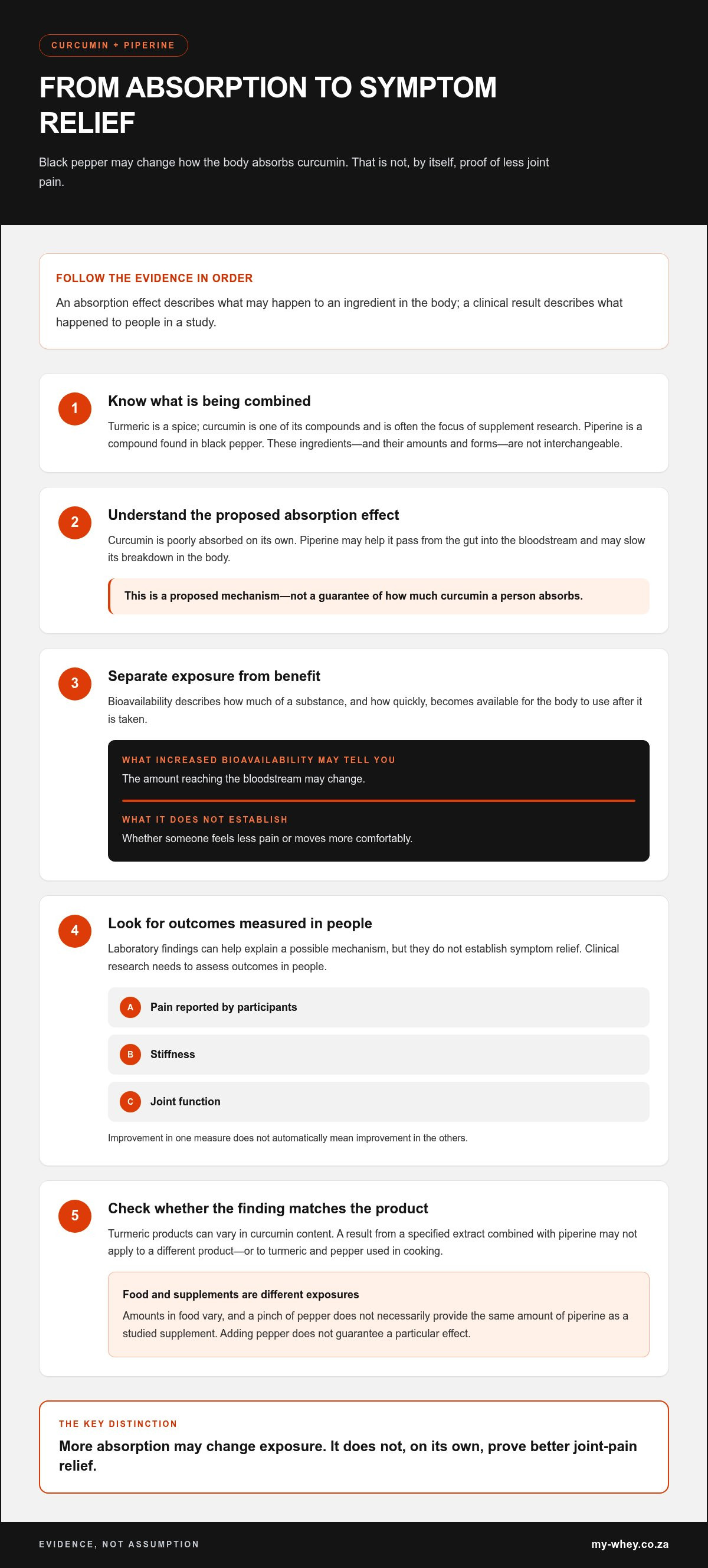
Curcumin is poorly absorbed when taken on its own, which is one reason researchers study ways to increase its bioavailability. Piperine, a compound in black pepper, may help curcumin pass from the gut into the bloodstream and may slow its breakdown in the body. This is the proposed reason for combining them. It does not mean that adding black pepper to a meal reproduces a supplement formulation or guarantees how much curcumin will be absorbed.
What does bioavailability mean?
Bioavailability describes how much of a substance, and how quickly, becomes available for the body to use after it is taken. A formulation that increases curcumin’s bioavailability may change the amount reaching the bloodstream. That measures exposure, not whether someone feels less pain or moves more comfortably.
The National Institutes of Health (NIH) information on turmeric discusses piperine’s role in curcumin bioavailability and notes that turmeric products can vary in curcumin content. That variation matters when comparing research. A finding from a specified extract combined with piperine may not apply to a different product or to turmeric and pepper used in cooking.
Why a proposed mechanism is not proof of relief
Curcumin is studied for possible anti-inflammatory activity. Researchers may investigate how it interacts with biological processes in laboratory settings, but those findings help explain a possible mechanism. They do not establish that a supplement relieves joint symptoms in people.
A plausible mechanism can explain why a treatment is worth studying, but it cannot prove that it improves symptoms. To assess clinical benefit, researchers need to measure outcomes in people, not just changes in absorption or laboratory markers.
Those outcomes should be considered separately. A study might ask whether participants report less pain, experience less stiffness or have better joint function. Improvement in one measure does not automatically mean improvement in the others. The turmeric and black pepper for joint pain question therefore has two parts: does piperine alter curcumin absorption, and does the tested combination lead to meaningful changes in people’s symptoms? Evidence for the first does not answer the second.
For readers, the practical distinction is simple: an absorption claim describes what may happen to an ingredient in the body; a clinical result describes what happened to participants in a study. When considering a supplement, look for the specific formulation and the outcomes researchers measured. Product quality information can also help you understand what you’re choosing, although testing for purity is not evidence of a joint-pain benefit. My Whey shares information about its supplement sourcing and quality as part of a straightforward approach to supplement selection.
What does research say about turmeric and joint pain?
There is research interest in turmeric and curcumin for joint symptoms, but the evidence does not establish turmeric with black pepper as a dependable treatment. Studies use different ingredients, formulations and outcomes, so a result for one preparation cannot automatically be applied to turmeric in food or every supplement. The key is to distinguish what a study actually measured from what people may assume it proves.
What can the 2026 pain-rating trial tell us?
A summary of a January 2026 cross-over trial reports that participants took culinary amounts of turmeric, 300 mg, 1 g or 3 g, with or without black pepper, over three weeks. It reports reductions in self-reported chronic pain, but adding pepper did not produce a statistically significant difference in that study. The summary does not provide enough detail about participants, comparisons or the authors’ limitations to assess the result fully, so it should not be treated as proof of joint-pain relief.
Self-reported pain is a meaningful measure of how people feel, but it is not an objective measure of joint repair. Nor does a finding about chronic pain necessarily apply specifically to osteoarthritis, rheumatoid arthritis or another joint condition. The trial raises a question worth investigating; it does not settle it.
How should different evidence be read?
Human symptom studies: These measure outcomes such as pain or function in participants. They are more directly relevant to how people feel, but results depend on the study design and the preparation tested.
Mechanistic research: This examines how curcumin might interact with biological processes. It can suggest reasons for further study, but cannot show by itself that symptoms improve.
Expert summaries: These help explain the research landscape, but are not themselves trials. Check which studies and formulations they rely on before applying their conclusions.
The main caveat is that findings for a particular preparation or group of participants may not apply to other products, people or causes of joint pain. Even a statistically significant result does not, on its own, show how large or meaningful the change was for participants.
Turmeric in food versus curcumin supplements
Food and extracts are different exposures. Turmeric contains a variable mix of compounds, while a curcumin supplement may use a concentrated or standardised extract. Products may also differ in whether they include piperine. A trial using one specific formulation therefore cannot establish the effect of a spoonful of spice, another supplement or turmeric and black pepper for joint pain generally.
Read research findings as evidence about the tested intervention, not as a personal dosing guide. The amounts used in a study are part of its design and do not automatically indicate what you should take. For a clearer picture, consider the participant group, duration, comparison and outcomes together, and keep any claimed benefit in proportion to those details.
Is turmeric with black pepper safe to try for joint discomfort?
Adding turmeric and black pepper to food is different from taking a concentrated curcumin supplement, particularly one combined with piperine. Food use and supplements involve different amounts and formulations, so do not assume their effects or risks are the same. Concentrated products deserve extra care, especially if you take medicines or have a health condition.
Turmeric and curcumin supplements are often described as well tolerated, but side effects can occur. These are commonly digestive, such as nausea, diarrhoea or stomach upset, particularly with high doses. Piperine may also affect how the body handles substances, which is one reason a supplement containing it can raise interaction concerns. Possible interactions include those involving blood-thinning medicines or diabetes medicines. That does not mean an interaction will happen, but it does make individual advice important.
Who should speak to a healthcare professional first?
Speak to your healthcare provider before taking a supplement if you’re pregnant or lactating, have an existing medical condition or take any medication. Share the product label, including its full ingredient list, and mention any other supplements you use. Do not stop, replace or change prescribed medicines to try turmeric or curcumin without clinical advice.
Always consult your health care provider before taking any supplements. Pregnant or lactating women, people with existing medical conditions, or people taking medications should consult their health care provider/s before taking any dietary supplement.
Make that conversation the next step before starting a concentrated product. Your provider can consider your health circumstances and medicines alongside the proposed supplement, rather than relying on general claims about turmeric and black pepper for joint pain.
A practical safety check before taking a supplement
Before your appointment, note the product’s name, ingredients and serving information, and make a list of your current medicines and supplements. This gives your healthcare provider specific information to review, including whether the product contains piperine or other active ingredients. If you’ve already started taking it, say when and describe any effects you’ve noticed.
Keep the purpose clear. Supplement research does not establish that a product is suitable for you, and a quality or purity check does not show that it will ease joint discomfort. My Whey states that its products undergo third-party laboratory testing for purity. That is a quality consideration, distinct from evidence of joint-pain benefits. Explore supplement information with ingredient transparency in mind, and discuss any product you’re considering with your healthcare provider.
Do not use a supplement decision to delay assessment of joint symptoms. Seek prompt advice for pain that is persistent, severe or worsening, or that concerns you. The cause matters, and supplements do not replace diagnosis or prescribed care.
How to make an informed decision about turmeric and black pepper
Use a clear sequence before considering a supplement: identify the joint concern, review what research actually tested, then discuss possible risks with your healthcare professional. This keeps a familiar ingredient in perspective. Studies of particular turmeric or curcumin preparations cannot establish that every product, food use or combination will help your symptoms.
- Identify the concern. Note which joint is affected, what the discomfort feels like and how long it has been present. If symptoms are persistent, severe or worsening, seek assessment rather than trying to manage them with a supplement alone.
- Review the evidence. Check whether research involved turmeric, a concentrated curcumin extract or a formulation with piperine. Look at the participants and outcomes measured, such as pain or function, and remember that one study may not apply to your situation.
- Discuss risks before starting. Share the product label and your current medicines and supplements with your healthcare provider. Ask whether the ingredients could be unsuitable given your health history or interact with your medicines.
Questions to take to a healthcare professional
A focused conversation can help you make a safer decision. Consider asking:
- Does this joint symptom need assessment before I consider a supplement?
- Could the ingredients interact with my current medicines or be a concern with an existing condition?
- Given the uncertain benefits, what risks should I weigh before deciding?
Do not stop or change prescribed treatment to try a supplement without clinical advice. Supplements do not replace a diagnosis or prescribed care, and the cause of joint pain matters when deciding what to do next.
Always consult your health care provider before taking any supplements. Pregnant or lactating women, people with existing medical conditions, or people taking medications should consult their health care provider/s before taking any dietary supplement.
What supplement quality information can, and cannot, tell you
Clear ingredient information and testing can help you understand what a supplement contains and assess aspects of product quality. They do not establish that it is effective for joint pain, suitable for you or supported by clinical evidence for your particular concern. Keep those questions separate.
My Whey states that its products undergo third-party laboratory testing for purity and focuses on curated ingredients and straightforward product information. That quality approach is not evidence that a supplement treats joint pain. For broader nutrition context, the Omega 3 evidence and selection guide discusses a different supplement topic; it should not be read as a recommendation for joint symptoms.
For general supplement information, explore My Whey’s supplement range. Make any decision about turmeric and black pepper for joint pain with a healthcare professional, using the product details and your health circumstances rather than relying on a broad claim alone.
Make your next step an informed one
Joint discomfort is a reason to seek clarity, not to rely on a supplement promise. If you’re considering turmeric and black pepper for joint pain, take your questions and the product details to a healthcare professional, especially if you have a diagnosis, take medicines or have symptoms that persist or worsen. Keep prescribed care in place unless your provider advises otherwise.
For supplements more broadly, look for clear ingredient information and quality practices you can understand. My Whey focuses on curated ingredients and straightforward product information, and states that its products undergo third-party laboratory testing for purity. These are product-quality considerations, not evidence that a supplement will relieve joint pain.
Explore My Whey’s curated supplement range and make your choices with care. A considered decision, guided by sound information and professional advice, is a strong next step.
Frequently Asked Questions
Can turmeric and black pepper reduce joint pain?
It is not established that the combination reliably relieves joint pain or treats arthritis. A 2026 trial measured self-reported pain after participants used turmeric preparations, with or without black pepper, but its findings do not prove that every product works for joint symptoms. Results depend on who took part, what preparation was tested and which outcomes were measured. If pain persists, discuss the cause and supplement options with a healthcare professional.
Does black pepper make turmeric work better for joint pain?
Black pepper contains piperine, which may affect how much curcumin is absorbed. That change does not show that someone will experience less pain, move more easily or treat arthritis. Evidence that an ingredient reaches the bloodstream differently does not predict how a particular person will feel. A peppered meal is also not necessarily comparable with a supplement formulation used in research.
Is turmeric in food as effective as a curcumin supplement?
They should not be assumed to have the same effects. A meal seasoned with turmeric and a concentrated curcumin product can differ in composition and amount, and research on one formulation does not establish the effect of another. Enjoy turmeric in food if it suits you, but do not use it as a substitute for assessing ongoing joint symptoms or following recommended care.
Can turmeric supplements interact with medication?
They may interact with some medicines, and the risk depends on the product and your health circumstances. If you take medication, have an existing condition, are pregnant or are lactating, speak with your healthcare provider before using a supplement. Mention all medicines and supplements you take, including non-prescription products. Do not stop or change prescribed treatment based on supplement claims or an article.
How long does turmeric take to help joint pain?
There is no established timeline that applies to everyone, and current evidence does not support promising that turmeric and black pepper will relieve joint pain. Studies differ in their products, participants and measured outcomes, so a timeframe reported for one trial may not apply to you. Do not increase an amount or continue taking a product despite unwanted effects to chase a result. Seek advice about persistent pain.
Can turmeric replace arthritis medication?
No. Do not replace prescribed arthritis treatment with turmeric or curcumin unless the clinician responsible for your care advises you to change your plan. Research into these ingredients does not establish them as substitutes for diagnosis or recommended treatment. If you’re worried about side effects or feel your current plan is not working, arrange a discussion with your healthcare professional before making changes.
Is turmeric safe for everyone to take as a supplement?
No supplement is suitable for everyone. Concentrated turmeric or curcumin products may cause side effects or interact with medicines, so review the ingredient information and discuss your circumstances before use. This is especially important if you’re pregnant or lactating, have a medical condition or take medication. Always consult your health care provider before taking any supplements. Pregnant or lactating women, people with existing medical conditions, or people taking medications should consult their health care provider/s before taking any dietary supplement.