

What to Look for in Supplement Lab Reports: 2026 Guide
If you could see through the opaque plastic of your supplement tub, would you actually recognise the ingredients inside? Most of us rely on flashy marketing and bold labels, yet the fear of heavy metal contamination or "amino spiking" in protein powders is a valid concern. It's frustrating to pay for premium nutrition only to end up with cheap fillers or outdated batches. You shouldn't have to guess whether your supplements are safe or effective.
You deserve to know exactly what you're putting into your body. This guide explains exactly what to look for in a supplement lab report, so you can verify the purity and potency of your supplements before you buy. With the FDA now using AI-driven predictive modelling to identify high-risk manufacturers in 2026, being able to read a Certificate of Analysis (CoA) is your best line of defence. We'll show you how to spot a fake or outdated report, understand which heavy metal limits are actually safe, and gain the confidence to buy pure, unflavoured ingredients in bulk. By the end of this article, you'll have the technical clarity to bypass the hype and focus on your wellness results.
Key Takeaways
- Understand why a Certificate of Analysis (CoA) is your essential tool for bypassing marketing hype and verifying the actual purity of your wellness products.
- Master the technical details of what to look for in a supplement lab report, including how to match batch numbers and verify the laboratory's credentials.
- Learn to interpret assay percentages and moisture content to ensure your protein or creatine isn't being degraded by high water levels or hidden fillers.
- Identify safe limits for heavy metals and microbial contaminants, giving you the confidence to avoid harmful substances like lead, mercury, and E. coli.
- Gain a strategic advantage by calculating the cost per gram of active ingredients, allowing you to choose high-purity bulk supplements that offer better value.
Why Independent Lab Reports are Essential for Supplement Safety
A supplement lab report, officially known as a Certificate of Analysis (CoA), is a technical document issued by a laboratory that confirms a specific batch of a product meets its defined specifications. In South Africa, a significant regulatory gap exists because supplements are not treated with the same level of scrutiny as pharmaceutical drugs. Whilst medicines must undergo rigorous clinical trials and strict government oversight before reaching the market, supplements often fall into a "grey area" where the burden of proof rests on the manufacturer. This makes understanding what to look for in a supplement lab report a critical skill for any health-conscious consumer.
A Certificate of Analysis serves as the only objective proof of a supplement’s chemical identity and safety profile. While many brands rely on in-house testing, third-party verification remains the gold standard for trust. In-house labs can be biased or use less stringent methods to save costs; however, an independent laboratory has no financial stake in the product's success. This separation ensures that the results are accurate and untainted by marketing agendas.
The Risk of Proprietary Blends and Hidden Fillers
Many retail brands use "label dressing" to hide the actual dose of active ingredients. They list a long string of impressive-sounding extracts under a "proprietary blend" without revealing the specific quantities of each. This lack of transparency often masks the presence of cheap fillers. Lab reports are particularly vital for exposing "amino spiking" in whey protein powders. This practice involves adding cheap amino acids like taurine or glycine to artificially inflate the nitrogen content, making the protein level appear higher than it actually is. Choosing bulk, unflavoured ingredients often provides more transparency because there are no complex formulas to hide behind.
Third-Party Verification vs. Marketing Claims
A "money-back guarantee" is a marketing tactic, not a safety protocol. It doesn't tell you if a product contains heavy metals or if the potency matches the label. When reviewing a report, look for ISO/IEC 17025 accreditation. This certification proves the laboratory is technically competent and produces valid results. By prioritising transparency over flashy packaging, you reduce the long-term cost of your wellness stack. You stop paying for marketing fluff and start investing in pure, effective nutrition that delivers real results.
The Anatomy of a Certificate of Analysis (CoA)
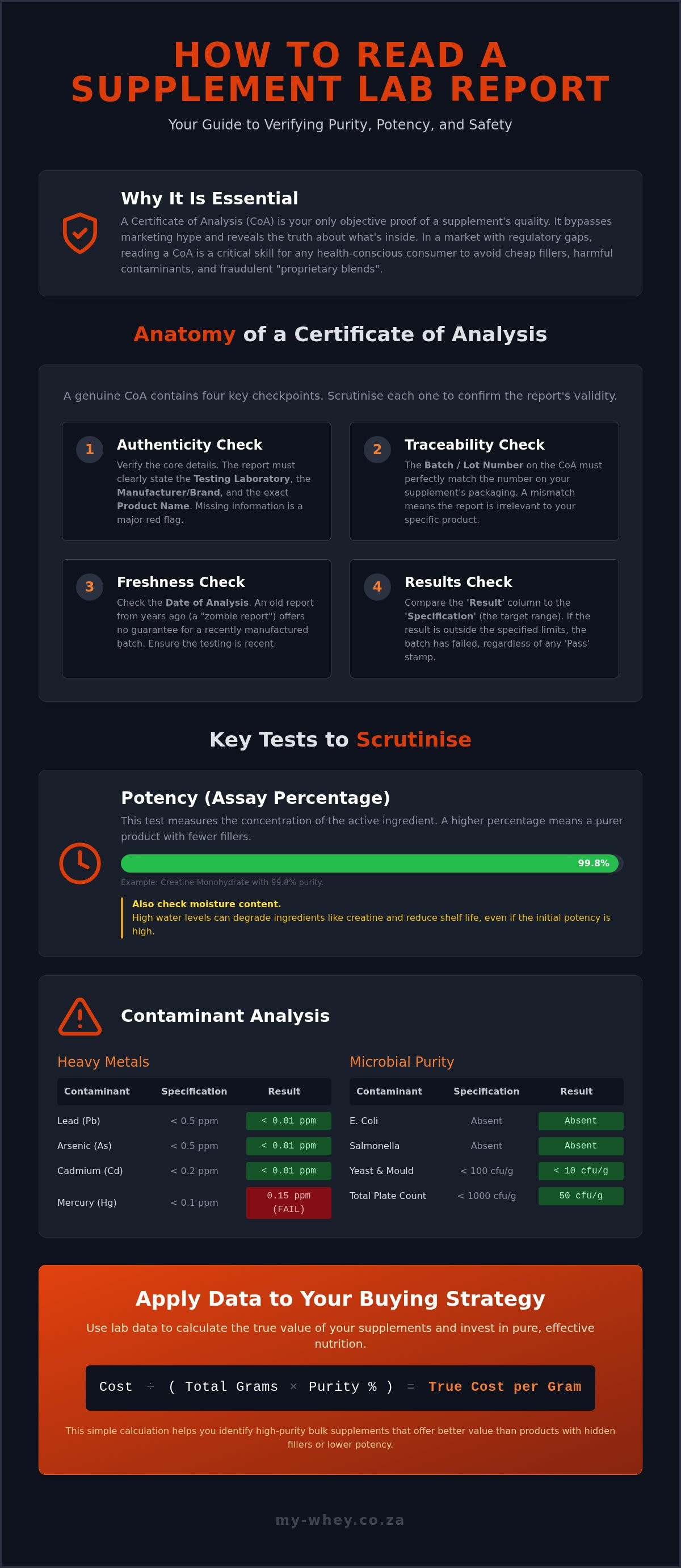
Deciphering the layout of a raw technical document is simpler once you know the structure. The header is your first checkpoint. It must clearly identify the manufacturer, the testing laboratory, and the exact product name. A professional report displays the lab’s contact information and accreditation credentials. If these details are obscured or missing, the document's validity is compromised. This header ensures accountability between the brand and the facility conducting the analysis. Understanding what to look for in a supplement lab report begins with verifying these foundational details.
Traceability is the backbone of supplement safety. Every CoA must feature a Batch or Lot Number that corresponds directly to the physical packaging of your supplement. This link is vital for vetting your supplements effectively. Without a matching batch number, a lab report is merely a marketing flyer for a different product. It doesn't prove the safety of the specific powder you're about to consume. Always ensure the number on your bag matches the one on the screen.
Check the Date of Analysis to avoid "zombie reports". These are outdated documents from years ago that brands reuse to save money on testing. A report from 2022 tells you nothing about a batch manufactured in 2026. Look closely at the "Specification" and "Result" columns. The specification is the lab's target range; the result is what they actually found. If the result falls outside the specification, the batch has failed, regardless of any "pass" stamp the brand might have added.
Matching the Batch to the Bottle
You'll typically find the lot number printed near the expiry date on your bulk supplement bag. A batch-specific report is far more valuable than a generic "typical analysis" sheet because it reflects the exact purity of your current purchase. If a supplier refuses to provide a batch-specific CoA, it's a significant red flag. Transparency isn't optional for high-quality ingredients like Creatine Monohydrate. High-integrity suppliers keep these records organised and accessible for every customer.
Reading the Methodology Column
The methodology column reveals how the lab reached its conclusions. High-Performance Liquid Chromatography (HPLC) is the standard for verifying the potency of active ingredients. For heavy metal detection, Inductively Coupled Plasma Mass Spectrometry (ICP-MS) provides the necessary precision to measure parts per billion. The choice of method matters. Less sensitive tests might miss contaminants that a more rigorous approach would easily flag. Always favour reports that utilise these modern, high-precision techniques.
Verifying Potency: How to Read Active Ingredient Results
Assay percentages represent the actual concentration of the active ingredient within your supplement. If you purchase whey protein concentrate 80%, the lab report should confirm a result of at least 80% protein content. Anything lower indicates that the product has been diluted with fillers or secondary ingredients. A result of 99% purity for creatine monohydrate is the industry standard for high-quality bulk sourcing. When you know what to look for in a supplement lab report, you can verify these numbers against the label claims to ensure you aren't being overcharged for inferior material.
Moisture content is another critical metric that often goes ignored. High moisture levels, typically anything above 5%, can cause powders to clump and degrade prematurely. Excess water creates an environment where bacteria can thrive, compromising the shelf life of your investment. Identity testing is equally vital; it uses infrared spectroscopy to prove that the branched chain amino acids in your bag are chemically identical to what the supplier promised. Without this verification, you have no way of knowing if the powder is actually the amino acid you paid for or a cheap lookalike.
Understanding Protein Concentration
Laboratories often report protein results in two ways: "as-is" or "dry basis". The dry basis result removes all moisture from the calculation, which always yields a higher percentage. To find the actual grams of protein per serving, you must look at the "as-is" result, as this reflects the powder in your tub. Use the lab's nitrogen-to-protein conversion factor to double-check the maths. If the amino acid profile shows unusually high levels of taurine or glycine without being listed on the label, the batch may be spiked.
Potency Decay and Shelf Life
Environmental factors like heat and light can rapidly diminish the potency of sensitive ingredients. This is particularly true for Omega 3 softgels, which can oxidise and turn rancid if handled poorly. Always prioritise the "Date of Manufacture" over the "Best Before" date on a CoA. A report generated recently ensures the active compounds in cognitive support supplements are still stable and effective. Freshness is a non-negotiable component of potency, especially when buying in bulk to fuel a long-term wellness journey.
Identifying Contaminants: Heavy Metals and Microbial Limits
Potency is only half the story; safety is the other. When investigating what to look for in a supplement lab report, the contaminant section is where you find the most critical health data. A comprehensive screen includes heavy metals, microbial activity, and, for herbal extracts, pesticide residues. You will often see the result "ND" or "None Detected" on these reports. This doesn't always mean the substance is entirely absent. Instead, it indicates the level is below the lab’s Limit of Quantification (LOQ). It’s a sign of high-level purity, provided the LOQ itself is sufficiently low to be meaningful.
Microbial testing ensures your supplements aren't carrying harmful pathogens. Labs look for E. coli and Salmonella, which must be completely absent in any safe product. They also measure the Total Plate Count (TPC), which quantifies the total number of bacteria, yeast, and mould present. High TPC or yeast counts suggest poor manufacturing hygiene or inadequate storage conditions. This is particularly vital for gut health supplements; you don't want to introduce opportunistic pathogens into a sensitive digestive system.
Heavy Metals: How Much is Too Much?
Heavy metal results are usually expressed in Parts Per Million (PPM) or Parts Per Billion (PPB). To put this in perspective, 1 PPM is equivalent to one milligram per kilogram. Whilst some metal presence is inevitable in natural ingredients, the limits must be strictly controlled. Lead, Arsenic, Cadmium, and Mercury are the "big four" to watch. Many high-quality manufacturers aim for Lead levels below 0.5 PPM and Mercury below 0.1 PPM. Plant-based proteins often have different metal profiles than whey because plants naturally absorb minerals from the soil. This makes rigorous batch-specific testing even more essential for vegan options.
Pesticides and Solvent Residues
For herbal supplements, the risk of pesticide residue is a genuine concern. Since many herbs are concentrated into extracts, any chemicals used during farming are also concentrated. Similarly, labs test for residual solvents like ethanol or hexane used during the extraction process. Ensuring these are within safe limits prevents long-term toxic accumulation in your body. If you value transparency, you should view our lab-tested supplements to see how we prioritise these safety benchmarks. Comparing supplement results to common food safety standards helps ground the data. For instance, the amount of lead in a serving of lab-tested whey is often lower than what you would find in a typical serving of root vegetables.
Applying Lab Data to Your Supplement Buying Strategy
Ask for the CoA before you commit to a purchase. A reputable supplier should have these documents ready for immediate review. If a brand hides behind trade secrets or promises to send a report only after you've paid, it's a signal to look elsewhere. When you've mastered what to look for in a supplement lab report, you gain the power to audit your own health stack. This proactive approach shifts the power from the marketer back to the consumer, ensuring you aren't just buying a promise, but a verified chemical profile.
Stop comparing the total price of the tub. Instead, use the lab data to calculate the cost per gram of the actual active ingredient. For example, if a report confirms a batch of Whey Protein Concentrate 80% is exactly on target, you can determine your cost per 25g of pure protein. This objective metric exposes the hidden costs of retail brands that pad their products with cheap sweeteners and thickeners. Buying bulk from a transparent supplier like My Whey allows you to control your own dosage and purity, ensuring you only pay for the nutrition that drives your results.
The Bulk Advantage: Purity Over Packaging
Retail brands often allocate a significant portion of their budget to complex flavour systems and influencer endorsements. This leaves less room for sourcing the highest-quality raw materials. Bulk ingredients are inherently easier to verify via lab reports because the analysis isn't obscured by a list of twenty additives. Choosing unflavoured powders simplifies your wellness programme; fewer ingredients mean fewer variables and a cleaner safety profile on the CoA. You can build a stack based on hard data rather than social media hype.
Making the Final Decision
Before you click buy, run through a final checklist. Ensure the batch number matches the current stock, verify the date of analysis is recent, and confirm the contaminant results are well within safe limits. Walk away if you spot red flags like generic "typical analysis" sheets or reports with redacted laboratory names. Transparency is a commitment to quality that cannot be faked. If you're ready to upgrade your standards, discover the power of transparency with My Whey’s lab-tested bulk range and take the guesswork out of your nutrition.
Empower Your Wellness Journey with Data
Transparency is more than just a brand promise; it's a standard you can now verify with technical precision. By mastering the ability to match batch numbers and interpret assay results, you eliminate the guesswork that often plagues the supplement market. You now have the tools to spot outdated "zombie reports" and understand the safety thresholds for heavy metals. This ensures your wellness stack is built on a foundation of pure, active ingredients rather than marketing fluff or cheap additives.
Knowing exactly what to look for in a supplement lab report gives you the confidence to prioritise substance over style. This data-driven approach is at the heart of our philosophy. We focus on delivering high-purity nutrition without the unnecessary costs of flashy retail packaging. If you're ready to invest in your health with total clarity, Shop Lab-Tested Bulk Supplements at My Whey. Our range is batch-tested for purity and features transparent sourcing for all bulk ingredients, with absolutely no hidden fillers or proprietary blends. Take the lead in your fitness journey by choosing supplements that prove their value on paper before they ever reach your shelf.
Frequently Asked Questions
What is a Certificate of Analysis (CoA) in supplements?
A Certificate of Analysis is a technical document issued by an independent laboratory that verifies a product's purity and potency. It confirms the batch meets specific standards for active ingredients and safety benchmarks. For instance, it proves a batch of Creatine Monohydrate is 99% pure as claimed. It acts as the final quality checkpoint before a product reaches the consumer, providing objective evidence over marketing claims.
How do I know if a supplement lab report is fake?
Check for inconsistent fonts, blurred logos, or missing contact information for the testing laboratory. A genuine report always includes a batch number that matches your physical packaging and a recent date of analysis. You can also contact the lab directly to verify the report number. If a supplier redacts the lab's name or accreditation details, it's a major red flag for the document's authenticity.
Does a lab report guarantee that a supplement is safe for everyone?
No, it only confirms the product contains what's on the label and is free from specific contaminants. Individual reactions, allergies, or interactions with medications aren't covered by a lab report. Whilst a CoA ensures you're getting pure Whey Protein Concentrate 80%, you should still consult a medical professional. Safety is about both the product's purity and your personal health history and specific nutritional requirements.
Why do some supplements not have lab reports available?
High-quality testing is expensive and time-consuming, so some companies skip it to increase profit margins. Others may use proprietary blends that they don't want to expose through detailed chemical analysis. If a company doesn't provide a report, they're often hiding low potency or the presence of fillers. Transparent suppliers prioritise these tests to empower customers who know what to look for in a supplement lab report.
What are the most important heavy metals to look for in a report?
You must check for Lead, Arsenic, Cadmium, and Mercury. These are the "big four" toxins that can accumulate in the body over time. Safe limits are typically measured in parts per million (PPM). For example, Lead should ideally be below 0.5 PPM. These metals often enter the supply chain through the soil where herbal ingredients are grown, making rigorous screening essential for your long-term health.
Can I request a lab report from any supplement company in South Africa?
Yes, you can request one, but not every company is legally required to provide it to the public. Reputable South African suppliers will share their CoAs to prove their commitment to integrity. If a brand refuses your request, it usually suggests they aren't testing every batch or have failed results they wish to hide. Always choose companies that offer this transparency as a standard part of their service.
How often should a supplement company test their products?
A responsible company should test every single batch or lot produced. Testing once a year or only for the first production run isn't enough to ensure ongoing safety. Since raw ingredient quality can vary between harvests or shipments, batch-specific testing is the only way to guarantee consistency. This methodical approach ensures that every tub of Creatine Monohydrate you buy meets the same high-purity standards as the last one.
What is the difference between a lab report and a supplement facts label?
The label is a marketing claim of what should be in the tub, whilst the lab report is the scientific proof of what is actually inside. Labels often list "proprietary blends" to obscure exact dosages, but a CoA provides the raw data on potency and contaminants. Understanding what to look for in a supplement lab report allows you to see past the label and verify the actual quality of your bulk ingredients.