

When to Buy Supplements for the Best Deals in 2026
The biggest discount isn’t always the best supplement deal. If you’re wondering when to buy supplements for the best deals, the answer isn’t simply to wait for a major sale. An offer only saves you money if the product suits your needs, the quantity is practical and the product information is clear.
A large percentage off can hide a smaller pack, while waiting for a promotion may leave you short of a supplement you use regularly. Plan repeat purchases around your actual use, then compare the cost per serving, pack size, delivery charges and expiry information before deciding.
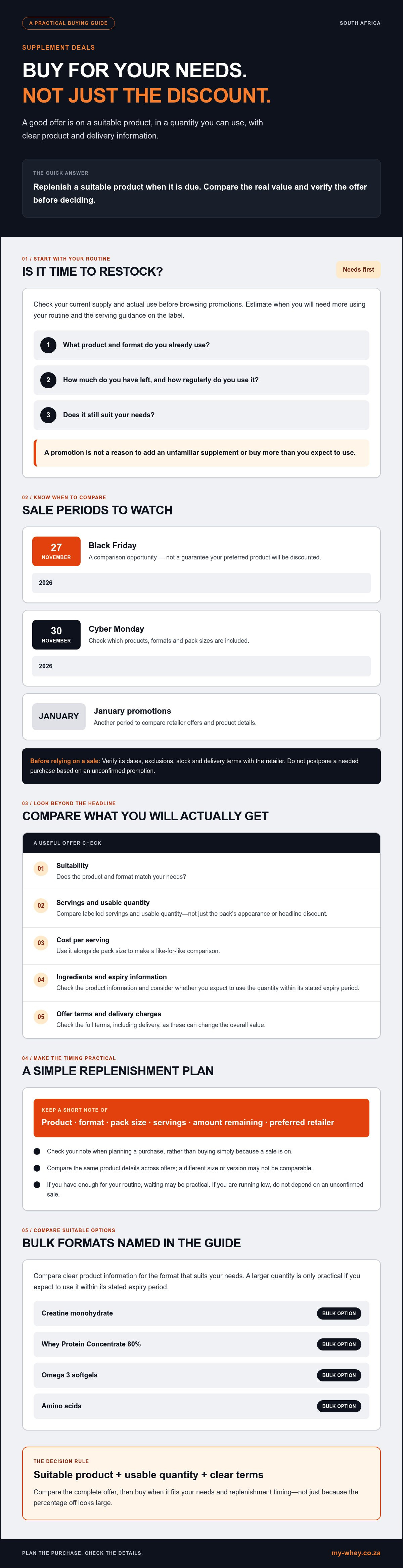
This guide explains which retail periods are worth watching in South Africa, including Black Friday on 27 November and Cyber Monday on 30 November 2026, as well as January promotions. These dates are opportunities to compare, not a guarantee of a deal. You’ll also learn how to assess product suitability and quality, and when bulk formats may offer practical value. My Whey’s range includes bulk supplement options, so use the same checks to compare its product information with any offer you’re considering.
Key Takeaways
- Decide when to buy supplements for the best deals by checking your routine and remaining supply, not just the sale calendar.
- Treat retail promotions as opportunities to compare, and verify dates, exclusions and stock before you buy.
- Look beyond the headline discount: assess servings, ingredients, expiry information and offer terms to judge what you’ll actually use.
- Use a simple replenishment note to track the product and format you need, how much you have left and where you prefer to shop.
- Compare suitable bulk options, including My Whey’s creatine monohydrate, Whey Protein Concentrate 80%, Omega 3 softgels and amino acids, using clear product information.
When to buy supplements for the best deals: start with your needs
A promotion is useful only if the supplement suits you and you’ll use the quantity you buy. To decide when to buy supplements for the best deals, start with your routine and current supply, then compare offers on products you already consider suitable. A discount alone is not a reason to add an unfamiliar supplement to your basket.
If you need a refresher on what dietary supplements are, begin with a neutral overview, then assess each product using its own information and suitability. Don’t assume every supplement is necessary or appropriate for every shopper.
Quick answer: Buy when a suitable product is due for replenishment and a verified offer gives fair value for a quantity you can use. Retail promotions can be worth monitoring, but your needs, remaining supply and the product details should guide the timing.
How to tell whether a supplement purchase is due
Check what you have before browsing deals. Is the product open? How regularly do you use it? Does it still fit your needs? Estimate when you’ll need more from your actual use and the serving guidance on the product label, rather than assuming a pack will last for a set period.
This check helps separate planned replenishment from impulse buying. If you have plenty left, a promotion may not justify buying another pack, particularly if you’re unsure you’ll use it. If a familiar, suitable product is running low, comparing offers before you run out gives you more time to make a considered choice.
Why a discount is not automatically the best deal
Look past the front-of-pack promotion. Compare the serving count and usable quantity, since pack size alone doesn’t tell you how much product you’ll get per labelled serving. Check the ingredients and format too. An offer isn’t good value if the product doesn’t match what you want or can comfortably use.
Review expiry information and delivery terms before placing an order. A larger quantity may appear better value, but only if it’s suitable and you expect to use it within its stated expiry period. Delivery charges or offer conditions can also change the overall value, so check the details at checkout.
- Confirm the product and format match your needs.
- Compare labelled servings and usable quantity, not just pack appearance.
- Check ingredients, expiry information and delivery terms.
Promotions vary by retailer, and dates, exclusions and stock can change. Verify the offer at the time of purchase. A planned top-up of a product you’ll use is a better basis for buying than an unfamiliar product chosen simply because its discount looks compelling.
Which sale periods are worth watching for supplement deals?
Major retail events, including Black Friday, can be useful times to compare supplement offers. Treat them as opportunities, not a promise that your preferred product will be discounted. Retailers set their own campaign dates, eligible products and quantities, and offers may be limited by stock. Check the terms on the retailer’s product page before relying on a promotion.
To make comparisons useful, note the product you normally buy before a campaign begins: its format, pack size, serving count and ingredient information. This gives you a baseline for checking whether an offer is comparable or features a different size or version. A US consumer resource from the National Institutes of Health, What You Need to Know, offers guidance on supplement safety and informed choices. Its regulatory information relates to the United States, so don’t treat it as a guide to South African requirements.
Should you wait for Black Friday or another major sale?
Waiting may suit you if you have enough product for your usual routine and can comfortably hold off while checking offers. But a campaign might exclude your preferred product, format or pack size, or the relevant offer may not be available when you look. Don’t postpone a purchase you need based on an unconfirmed sale. Use your remaining supply and actual replenishment needs to decide whether waiting is practical.
Think of an event as a comparison point, not a buying deadline. If a deal changes the quantity or format, check that it still suits your needs before ordering.
How to monitor promotions between major retail events
Retail offers can appear outside headline events, so check retailer newsletters and current product pages when planning a purchase. Confirm the promotion’s dates, exclusions, stock and delivery terms directly with the retailer. Don’t assume an offer will recur or remain available.
Compare like with like. Keep a short note of the usual product and pack details, then use it to assess a promotion against the same format and quantity. For example, don’t compare a larger powder pack with a smaller softgel pack based only on their headline discounts. If you’re considering a bulk supplement option, you can review supplement options and compare the available product information with your notes.
How to compare supplement deals beyond the headline discount
A lower advertised price doesn’t tell you whether two offers are comparable. Check the product details first, then assess value using the amount you can actually use. This helps you decide when to buy supplements for the best deals without letting a bold promotion override suitability or quality information.
Compare quantity, servings and product format
Use the serving size on each label to compare the number of servings in a pack. A larger format may provide more servings, but it only makes sense if you use the product regularly and can store it appropriately. Compare like with like: a powder and softgels, for example, aren’t interchangeable simply because both are supplements.
To compare cost per serving, divide the total amount payable for the offer by the labelled number of servings. Include delivery charges and any conditions required to access the promotion. Don’t rely on a discount percentage alone.
| What to compare | What to check |
|---|---|
| Product and format | Is it the product type and format you intend to use? |
| Quantity and servings | How much is included, and how many labelled servings does it provide? |
| Ingredients | Do the ingredients match your requirements? |
| Expiry information | Can you use the quantity within the stated expiry period? |
| Offer terms | Are there exclusions, minimum purchase conditions or delivery charges? |
Buying more isn’t automatically better value. If your routine may change or you’re unsure you’ll use the product, a larger pack could leave you with unused stock. Consider the product’s suitability and your likely use before treating a higher serving count as a saving.
Check quality details and promotion conditions
Read the product label and ingredient information rather than relying on promotional wording. Check expiry details and review any testing documentation the seller makes available. Verify that it relates to the product you’re considering. For a broader perspective on evaluating supplements, Harvard Health Publishing discusses whether supplements help or hurt, including potential risks.
Before buying, confirm the promotion’s end date, exclusions, stock status and any minimum purchase requirement on the retailer’s current product page. These terms can affect whether an advertised offer applies to the format or quantity you want.
A supplement deal is useful only when the product, quantity and terms suit the buyer. Use that test alongside the comparison table to assess an offer on its actual value.
A practical plan for timing your next supplement purchase
A simple routine can help you avoid last-minute orders and unnecessary stockpiling. Use these four steps to plan around your actual use, then check current retailer information before deciding.
- Review your needs. Confirm the product still suits your intended use and that you understand its label directions.
- Check your stock. Note what’s open and how much remains, including any unopened packs.
- Compare verified offers. Check current product details, promotion terms, availability and delivery information.
- Choose a suitable quantity. Consider how much you’ll use and whether you can store it as directed before selecting a pack size.
Build a replenishment calendar around actual use
Estimate when a product may run low based on your personal consumption and the serving directions on its label. Treat that estimate as a reminder to review your options, not a fixed order date. Your routine or the product’s suitability may change, so adjust the plan when needed.
Keep a brief replenishment note with the product, format, remaining supply and preferred retailer. Set a reminder to check current offers and terms before you need to reorder. Don’t assume a previous promotion will return or that the same product will be included next time.
Use a checklist before placing an order
Before checkout, confirm the product matches your intended use and that you’ve reviewed its label. Check the pack quantity, expiry information and storage instructions. A larger format is only practical if you can store it appropriately and expect to use it within the stated expiry period. Also confirm stock and delivery terms with the retailer.
If you’re weighing up pack formats, the guide to bulk supplements can help you consider what buying in bulk involves. Use it alongside the product’s own details and your expected use.
Once you’ve established what you need and how much you can use, review My Whey’s supplement range as one option for comparing product information and bulk formats. Check the relevant product details and current terms before deciding.
Where My Whey fits into a value-focused supplement purchase
Once you’ve identified what you need, how much you’re likely to use and which offer terms to check, compare suppliers on the same basis. My Whey is a South African supplier of bulk nutritional supplements, with a range that includes creatine monohydrate, Whey Protein Concentrate 80%, Omega 3 softgels and amino acids. Its stated approach includes bulk pricing and reducing unnecessary packaging costs. These are useful points to consider, but they don’t replace checking whether a particular product and quantity suit your routine.
Deciding when to buy supplements for the best deals still comes down to product information and verified terms, not an assumption that a particular supplier or sale will always offer the lowest price. Compare like-for-like formats, labelled quantities and serving information, and check what’s currently available before deciding.
What to review when considering My Whey
Check the current product description, pack quantity, label details and availability directly before ordering. My Whey describes its products as lab-tested, but don’t assume a particular certification or test result. Look for any available product-specific testing documentation and confirm that it relates to the item you’re considering.
Then apply the checklist from earlier in this guide: does the product fit your needs, can you use the quantity, and do the expiry, storage and delivery details work for you? Bulk pricing may be relevant if you already use a product regularly, but a larger format isn’t automatically the right choice. Suitability comes first.
Choose the next step that fits your supplement routine
If you’re comparing protein products, My Whey’s whey protein guide offers further context on whey protein and selection. For shoppers assessing Omega 3 softgels, the Omega 3 guide is another resource to consult alongside the product label.
Deal timing is only one part of a sound purchase. Review My Whey’s current supplement range, check the product information and verify any offer terms that apply before ordering. This gives you a clear basis for comparing what’s available with your needs, without relying on an unconfirmed promotion or buying more than you can use.
Make your next supplement purchase count
The best time to buy isn’t necessarily the day a promotion starts. Use your routine and remaining supply to plan ahead, then compare like-for-like servings, ingredients, expiry information and offer terms. A deal is worthwhile when the product suits you and the quantity is practical, not simply because the advertised discount looks large.
That’s a reliable way to decide when to buy supplements for the best deals without waiting for an unconfirmed sale or buying more than you can use. Keep a simple note of what you take and when you may need to replenish it, then check current product details before ordering.
My Whey is a South African supplier serving customers nationwide, with a range that includes creatine monohydrate, Whey Protein Concentrate 80%, Omega 3 softgels and amino acids. The business describes its products as lab-tested; review available product-specific information before drawing conclusions about testing.
Explore My Whey’s supplement range and compare the current product information with your needs. A considered purchase can support your routine and your budget. You’re in control of the timing.
Frequently Asked Questions
When is the best time of year to buy supplements?
There’s no guaranteed best period because retailers set their own campaign dates, exclusions and terms. If you’re deciding when to buy supplements for the best deals, major events such as Black Friday may be worth monitoring, but assess the actual product, quantity and offer conditions rather than assuming every promotion is worthwhile. If you need a product sooner, don’t rely on a future sale that hasn’t been confirmed.
Are supplements cheaper on Black Friday in South Africa?
Some retailers may run supplement promotions around Black Friday, but offers and availability vary by seller and product. Check the current terms, eligible formats, stock and delivery conditions before deciding. Compare like-for-like quantities and product details, and remember that an advertised discount doesn’t make an unsuitable product good value. No particular saving or promotion is guaranteed, so base your decision on the offer you can verify at the time.
Should I wait for a sale before buying supplements?
Waiting may make sense if you have enough supply for your usual routine and the product remains suitable for you. It’s less practical if delaying would interrupt a routine you’ve chosen with suitable guidance, or if the possible promotion is unconfirmed. Check how much usable product remains, compare offers once their terms are available, and avoid buying extra solely because a discount is advertised.
How can I tell whether a supplement deal is good value?
Compare the same product type using its labelled serving size, usable quantity and product details. Review the ingredients, expiry information and storage requirements, then check promotion exclusions and delivery terms. A lower headline price alone doesn’t establish value, and a larger pack may not suit your usage. To compare cost per serving, divide the current total payable by the labelled number of servings, including applicable delivery charges.
Is it better to buy supplements in bulk during a sale?
Bulk formats may suit you if you already use the product consistently and can store it according to its instructions. Before buying, check the quantity, expiry information and storage requirements, then consider how much you’re realistically likely to use. A larger pack isn’t automatically cheaper or better value. Compare its label and current offer terms with the format you normally buy, and choose a quantity that fits your routine.
How far in advance should I buy supplements?
Plan replenishment around your actual rate of use, rather than relying on a fixed number of weeks that may not suit your routine. Check how much usable product remains and follow the label directions. Allow for the delivery window stated by the retailer, and verify any promotion’s terms and stock before relying on it. Avoid buying far ahead if the expiry information or storage instructions make that impractical.
Should I choose a supplement based on its discount?
No. First decide whether the product suits your needs, then assess its label, ingredients, quantity and available quality information. A promotion can’t make an unsuitable product appropriate, and a discount doesn’t verify quality. If you have health concerns, take medicines or aren’t sure whether a supplement is suitable for you, seek advice from a qualified health professional before buying. Make suitability the first check, not the final one.