

Whey Protein Concentrate vs Isolate: The 2026 South African Purity Guide
Spending more on your protein powder doesn't guarantee better results; it often just means you're paying for a flashier tub and a bloated marketing budget. With global whey prices climbing by over 50% since 2024, understanding the nuances of whey protein concentrate vs isolate south africa is a necessity for anyone serious about their performance and their pocket. You've likely felt the frustration of rising costs or the physical discomfort of digestive bloat caused by low-quality fillers. It's easy to get lost in technical jargon like ion exchange or microfiltration, but your nutrition shouldn't feel like a chemistry exam.
This guide provides the definitive scientific and financial breakdown to help you optimise your recovery and your budget in 2026. We'll strip away the retail hype to show you exactly how to get the maximum protein grams for every Rand spent while avoiding unnecessary additives. You'll gain a clear framework to choose the right protein for your gut health and muscle goals. We'll examine the processing differences, the impact of the 15% VAT on imports, and why pure, unflavoured options are the smartest way to customise your nutrition without the retail tax.
Key Takeaways
- Learn how low-temperature filtration preserves essential protein fractions to ensure you receive maximum nutritional value from every serving.
- Master the financial trade-offs of whey protein concentrate vs isolate south africa to ensure your budget is spent on high-quality protein instead of expensive retail marketing.
- Utilise our 2026 decision matrix to optimise your protein selection based on your digestive tolerance and specific recovery requirements.
- Discover how a direct-to-consumer model eliminates the "retail tax" and hidden costs associated with traditional supplement shops.
- Gain the confidence to customise your own nutrition by choosing lab-tested, unflavoured ingredients that prioritise purity over marketing hype.
Understanding the Whey Spectrum in the South African Market
Whey protein isn't just a laboratory creation; it's a high-quality complete protein naturally derived from the cheese-making process. When milk is coagulated to produce cheese, the liquid that remains is whey. Understanding the science of whey protein helps you see it for what it is: a nutrient-dense source of all nine essential amino acids required for muscle repair and growth. For South African athletes, the market presents a dizzying array of tubs and bags, making the choice of whey protein concentrate vs isolate south africa the most frequent dilemma in local gyms.
The primary differentiator between these two forms is protein density. This term refers to the actual percentage of protein per gram of powder versus other components like fats, minerals, and carbohydrates. While both options facilitate recovery, your choice depends on how much you value that extra level of refinement. In 2026, the South African Health Products Regulatory Authority (SAHPRA) continues to enforce strict labelling standards. This ensures that the purity claims on your supplement bag are backed by actual contents, protecting you from the "amino spiking" practices that once plagued the industry.
What is Whey Protein Concentrate (WPC 80%)?
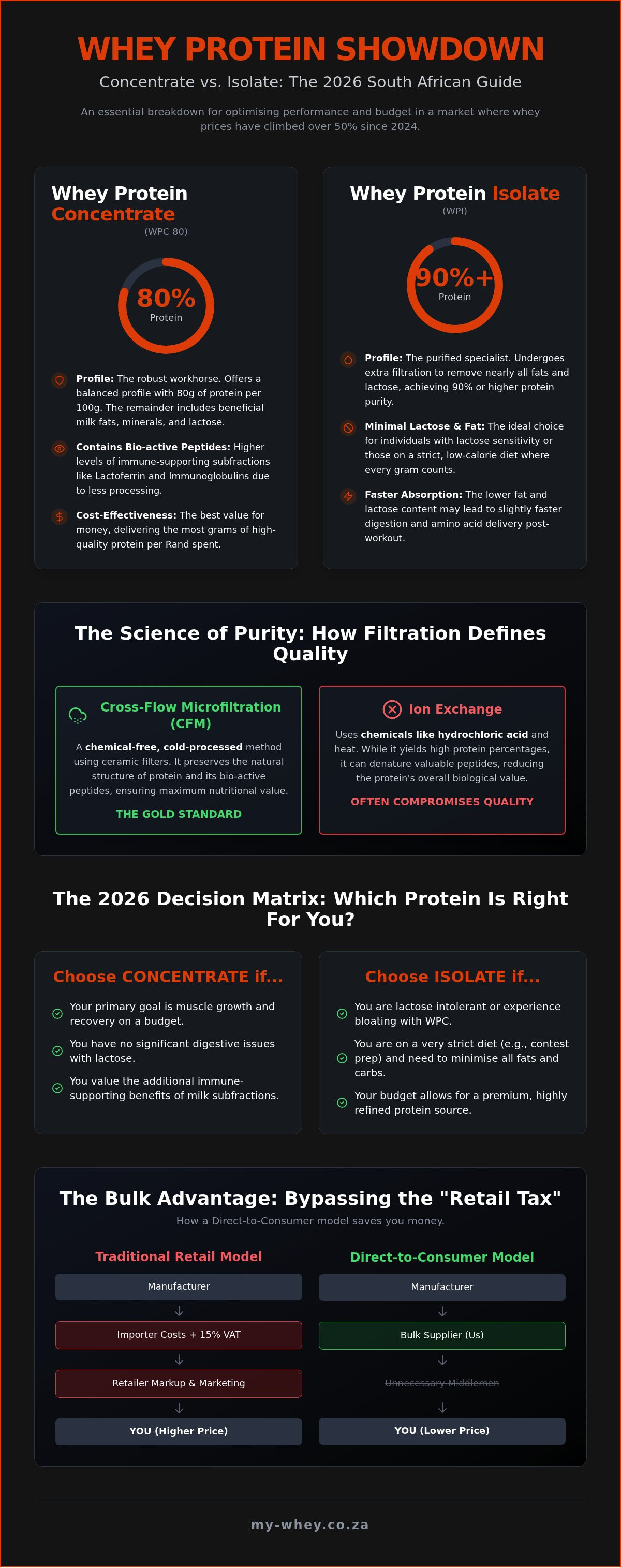
WPC 80% is the workhorse of the supplement world. It contains exactly 80g of protein for every 100g of powder, providing a robust nutritional profile. The remaining 20% consists of naturally occurring milk fats, minerals, and lactose. These aren't just fillers; they contain beneficial subfractions that support immune health. It's the most cost-effective form of high-quality protein available. If you don't have severe digestive sensitivities, WPC 80% offers the best balance of performance and value for your daily requirements.
What is Whey Protein Isolate (WPI)?
Isolate is the result of taking the filtration process one step further. Through advanced microfiltration, almost all the remaining fats and lactose are stripped away, resulting in a powder that reaches 90% purity or higher. This makes WPI the preferred tool for specific scenarios. It's designed for those with strict calorie counts who can't afford the extra few grams of fat, or for individuals with significant lactose sensitivity who experience bloating with standard concentrates. You're paying for the intensive processing required to achieve this surgical precision in your macronutrients.
The Science of Purity: How Filtration Defines Your Gains
The way your protein is processed determines how your body utilises it for recovery. High-quality filtration isn't just about stripping away unwanted extras; it's about safeguarding the delicate protein fractions that trigger muscle growth. When comparing whey protein concentrate vs isolate south africa, the most critical factor is often the temperature used during manufacturing. Heat destroys value. Excessive temperatures denature protein, effectively breaking the structures your body needs for efficient Muscle Protein Synthesis (MPS).
Purity on a label can be a deceptive metric. A product might claim a high protein percentage, but if the processing was aggressive, the biological value of that protein could be compromised. Understanding the nutritional differences between whey isolate and concentrate requires a look at the filtration method itself. Cold-processed methods ensure that the amino acid profile remains intact and bioavailable. When you evaluate whey protein concentrate vs isolate south africa, look beyond the flashy packaging and focus on the method of extraction.
Cross-Flow Microfiltration (CFM) vs Ion Exchange
CFM is a chemical-free, cold-pressed filtration method. It uses ceramic membranes to separate protein from fats and lactose physically. This process preserves the natural shape of the protein molecules. In contrast, Ion Exchange relies on chemical reagents like hydrochloric acid to adjust pH levels. While Ion Exchange yields a high protein percentage, it often denatures sensitive peptides. For athletes seeking the highest quality, CFM remains the gold standard for preserving nutritional integrity and ensuring your body can actually use what you swallow.
Preserving Bio-active Peptides
Whey is more than just a collection of amino acids. It contains bio-active peptides such as Alpha-lactalbumin, Lactoferrin, and Immunoglobulins. These components play vital roles in immune support and gut health. Because whey concentrate undergoes less intensive processing than isolate, it naturally retains a higher concentration of these health-boosting fractions. This makes a high-quality Whey Protein Concentrate 80% an excellent choice for those prioritising overall wellness alongside muscle gains. Choosing a product that respects these delicate structures ensures you aren't just hitting your macros, but supporting your body's foundational health through superior sourcing.
Performance vs Price: Navigating the South African Retail Tax
Walk into any South African fitness shop and you'll see walls of neon-coloured tubs featuring professional athletes. These brands aren't just selling you protein; they're charging you for the prime shelf space in the shopping centre, the celebrity endorsement fees, and the expensive plastic packaging. This is what we call the "Retail Tax." When you look at the debate of whey protein concentrate vs isolate south africa, you must consider whether you're paying for nutritional science or a marketing machine. By stripping away the branding and focusing on the raw ingredient list, you can calculate the effective protein cost. This metric determines how many Rand you spend per gram of actual protein, rather than the total weight of the tub.
The global market saw whey prices surge by 50 to 110% between 2024 and 2025. In South Africa, this cost is compounded by a 15% VAT rate on imported supplements, even though customs duties remain at 0% for most whey products. These external factors mean that every Rand counts. Healthline explains the difference between whey isolate and concentrate by highlighting that isolate undergoes more processing to remove fats and carbohydrates. However, for the average gym-goer, the question is whether that extra refinement translates into better results or just a lighter wallet.
Macro Breakdown: Protein Density and Calories
The calorie difference between a scoop of WPC 80 and WPI is usually less than 15 calories. While isolate offers slightly more protein per serving, the gap is often only 2 to 3 grams. You should ask yourself if such a minor increase justifies a price tag that can be 40% to 50% higher than concentrate. If you aren't preparing for a professional bodybuilding stage where every single gram of fat is tracked, the additional cost of isolate might not provide a proportional return on your investment. For most South Africans, WPC 80 provides the most efficient way to hit daily protein targets without overspending.
The Digestive Reality: Lactose and Bloating
Digestive comfort is the only area where the price gap is easily justified. Whey concentrate contains lactose, which can cause significant bloating, gas, or discomfort for those with sensitivities. Because isolate is filtered to remove almost all milk sugars, it's the superior choice for anyone with lactose intolerance. If you're unsure of your tolerance, it's wise to test a smaller batch of high-quality concentrate first. If your gut handles it well, you've just saved yourself a significant amount of money on your monthly supplement stack while still reaching your recovery goals.
The 2026 Decision Matrix: Which Protein Suits Your Lifestyle?
Selecting the right supplement requires a clear understanding of your daily routine and physiological needs. It's a common misconception that isolate is reserved solely for professional athletes or those with elite-level aspirations. In reality, the choice between whey protein concentrate vs isolate south africa comes down to personal tolerance and specific dietary constraints. Whilst the processing methods differ, your progress depends more on your total daily protein intake and consistency than on the specific filtration level of your powder. To further enhance your recovery and support lean muscle retention, you might also consider integrating branched chain amino acids into your intra-workout routine to prevent muscle breakdown during intense sessions.
When to Choose Whey Protein Concentrate
Whey concentrate is the ideal choice for budget-conscious athletes who want high-quality nutrition without the premium price tag. Because it retains more bio-active peptides, it offers additional support for immune health that highly processed isolates often lack. It's particularly effective for "hard gainers" who benefit from the small amount of healthy fats and carbohydrates that remain in the powder. If your goal is general muscle building and you don't suffer from lactose sensitivity, WPC 80% provides the best return on investment. For a deeper look at how these proteins function in the body, read The Definitive Guide to Whey Protein to understand the full spectrum of benefits and selection criteria.
When to Invest in Whey Protein Isolate
Isolate acts as a surgical tool for your nutrition. It's the preferred option for individuals undergoing strict contest preparation or those following a ketogenic diet where every gram of carbohydrate must be accounted for. Its primary advantage is the removal of almost all lactose, making it the only viable choice for those with severe digestive issues. Whilst it does have a slightly faster absorption rate, this is generally only a priority during the immediate post-workout window or for athletes training multiple times per day. If you need a protein that leaves no room for extra calories or digestive discomfort, isolate is worth the additional spend. You can view our pure, lab-tested range to find the exact filtration level that matches your current training phase.
Sourcing Pure Protein: The Bulk Advantage in South Africa
The choice between whey protein concentrate vs isolate south africa often ends at the checkout counter, but the true value is determined long before you tap your card. Retail brands often hide behind complex labels and heavy marketing. Sourcing your supplements through a bulk model acts as an antidote to these inflated prices. It ensures you receive a product that hasn't been sitting in a warehouse for months. Direct-to-consumer sourcing provides access to fresher, lab-tested batches that prioritise nutritional integrity over shelf-life stability. We position ourselves as your partner in this process, handling the complexities of sourcing so you can focus on your performance.
You must learn to spot "amino spiking" to protect your gains. This is a deceptive practice where manufacturers add cheap amino acids like glycine or taurine to artificially inflate the protein count on the label. Whilst these are technically amino acids, they don't contribute to muscle repair in the same way complete whey does. Always look for a clear breakdown of the amino acid profile. If a brand isn't transparent about their lab results or third-party testing in 2026, they're likely compromising on the quality of the raw material.
Eliminating Fillers and Artificial Additives
Many retail products rely on maltodextrin or unnecessary thickeners like xanthan gum to improve texture and mouthfeel. These additives dilute the actual protein content and frequently cause digestive distress or unwanted insulin spikes. If you've ever felt bloated or sluggish after a shake, these hidden fillers are often the primary culprits. For a deeper understanding of how these additives affect your digestion and how to choose better, consult our guide on gut health supplements South Africa. Choosing unflavoured, pure ingredients allows you to avoid these irritants entirely and ensures every gram you consume serves a purpose.
The Direct-to-Consumer Advantage
Whether you've settled the debate of whey protein concentrate vs isolate south africa for your own goals, the direct-to-consumer model offers a significant advantage. Skipping the middleman isn't just about saving money; it's about quality control. You eliminate the "Retail Tax" and gain the freedom to use custom flavour systems. This allows you to customise the exact level of sweetness in your shakes and avoid the artificial colours found in standard tubs. It puts the power back in your hands. You aren't just buying a supplement; you're taking control of a nutritional strategy that prioritises substance over style. Take the next step in your journey by choosing transparency and efficiency for your recovery. Explore our range of pure, bulk supplements today and fuel your progress without the retail markup.
Master Your Nutritional Strategy for 2026
Choosing between whey protein concentrate vs isolate south africa shouldn't be a gamble based on neon packaging or celebrity hype. You now have the framework to distinguish between the surgical precision of isolate and the cost-effective, peptide-rich profile of concentrate. Your results depend on consistency and the avoidance of hidden fillers. By opting for cold-processed, lab-tested ingredients, you ensure every gram you consume supports muscle protein synthesis without the digestive bloat.
Take control of your recovery by eliminating the unnecessary retail markups that inflate local shop prices. Focus on high-purity ingredients that fit your lifestyle and your budget. With transparent, lab-tested purity and national delivery across South Africa, we've handled the complexities of quality control so you can focus on your training. It's time to prioritise substance over style and invest in what actually drives performance.
Optimise your gains with pure Whey Protein Concentrate 80% from My Whey and experience the bulk pricing advantage today. Your journey to better performance is built on the foundation of clean, reliable nutrition.
Frequently Asked Questions
Is whey protein isolate better for weight loss than concentrate?
Isolate contains slightly fewer calories and almost no fat or carbohydrates, making it a precise tool for strict calorie deficits. However, the difference is usually only 10 to 15 calories per scoop. For most individuals, the choice of whey protein concentrate vs isolate south africa for weight loss depends on total daily protein intake and budget rather than the specific filtration type. Consistency remains the most vital factor for your results.
Can I use whey protein concentrate if I am lactose sensitive?
It depends on the severity of your sensitivity. Whey concentrate contains roughly 4% to 8% lactose, which many people with mild sensitivity tolerate without issues. If you experience significant bloating or gas, isolate is the safer choice because the intensive filtration process removes nearly all milk sugars. Always test your tolerance with a smaller batch of concentrate before committing to a larger bulk purchase for your gut health.
How much more expensive is whey isolate in South Africa?
Isolate is typically 40% to 60% more expensive than concentrate in the local market. This price gap reflects the advanced microfiltration required to reach 90% purity or higher. When evaluating whey protein concentrate vs isolate south africa, you should consider if the extra 2 to 3 grams of protein per serving justifies the increased cost for your specific goals. For many, high-purity concentrate offers a more efficient balance of performance and price.
What are the signs of low-quality protein fillers to look out for?
Look for "amino spiking" ingredients like glycine, taurine, or added creatine listed within the protein blend. These are often used to artificially inflate the protein count on the label. Other red flags include excessive thickeners like maltodextrin or xanthan gum, which are used to mask a thin texture in low-protein powders. High-quality products should always provide a clear amino acid profile and transparent lab results to verify their actual potency.
Should I mix my protein with milk or water for better absorption?
Water is the superior choice for rapid absorption, particularly during the immediate post-workout window. Milk contains fats and casein that slow down the digestion process, which might delay muscle recovery. Whilst milk can improve the taste and add extra calories for those struggling to gain weight, water ensures the amino acids reach your bloodstream as quickly as possible. Base your choice on your specific macronutrient targets and digestive comfort.
Is it better to buy flavoured or unflavoured bulk protein?
Unflavoured bulk protein offers the highest level of purity and versatility. It contains no artificial sweeteners, colours, or unnecessary additives, allowing you to customise your nutrition completely. This approach avoids the "retail tax" often found in pre-mixed tubs. You can use separate flavour systems to control the sweetness of your shakes, ensuring you only consume what your body needs for recovery without the baggage of hidden chemicals.
How does SAHPRA regulate protein powders in South Africa?
SAHPRA regulates protein powders primarily as foodstuffs under strict labelling and advertising standards. In 2026, the focus remains on ensuring that product labels accurately reflect their contents and that manufacturers don't make unsubstantiated medicinal claims. Importers must also comply with Department of Agriculture standards to ensure the raw materials are safe. This regulatory framework protects you from deceptive marketing and ensures the purity of the supplements available on the national market.
Can I bake with whey concentrate and isolate?
You can bake with both, but concentrate is generally the better option for maintaining texture. Its natural fat and lactose content help keep protein pancakes or muffins moist during the cooking process. Isolate tends to become dry or rubbery when exposed to high heat due to its lack of fat. If you're experimenting with high-protein recipes, concentrate provides a more palatable result whilst still delivering the essential amino acids your body requires.