

Citrulline malate or L-citrulline for a better pump?
Citrulline malate isn’t automatically better for a bigger training pump: both forms supply L-citrulline, which the body converts into L-arginine to help produce nitric oxide. Choosing citrulline malate for better pumps means weighing its added malic acid against the more direct dose control of pure L-citrulline. A commonly used pre-workout amount of citrulline malate is 6-8 g, but the amount of L-citrulline it provides depends on the product’s ratio.
It makes sense to look for a supplement that supports blood flow during lifting, but the two forms are not identical. L-citrulline is the amino acid linked to nitric oxide production. Citrulline malate also contains malic acid, which has a proposed role in energy production. That does not make either form a guaranteed way to get a more noticeable pump.
This guide explains what L-citrulline is, how it relates to nitric oxide and blood flow, and what the evidence says about short-term muscle-pump effects. You’ll also find a side-by-side comparison and practical criteria for choosing based on ingredient content, serving size and training priorities.
Key Takeaways
- Understand how L-citrulline supports nitric oxide production and why that may affect blood flow during training.
- Learn how to compare pre-workout options by checking the amount of L-citrulline supplied, not just the total powder dose.
- See how citrulline malate’s added malic acid differs from pure L-citrulline, and what that means for training goals.
- Use the evidence on acute pump effects to set realistic expectations and choose an option that suits your routine.
Does citrulline increase nitric oxide?
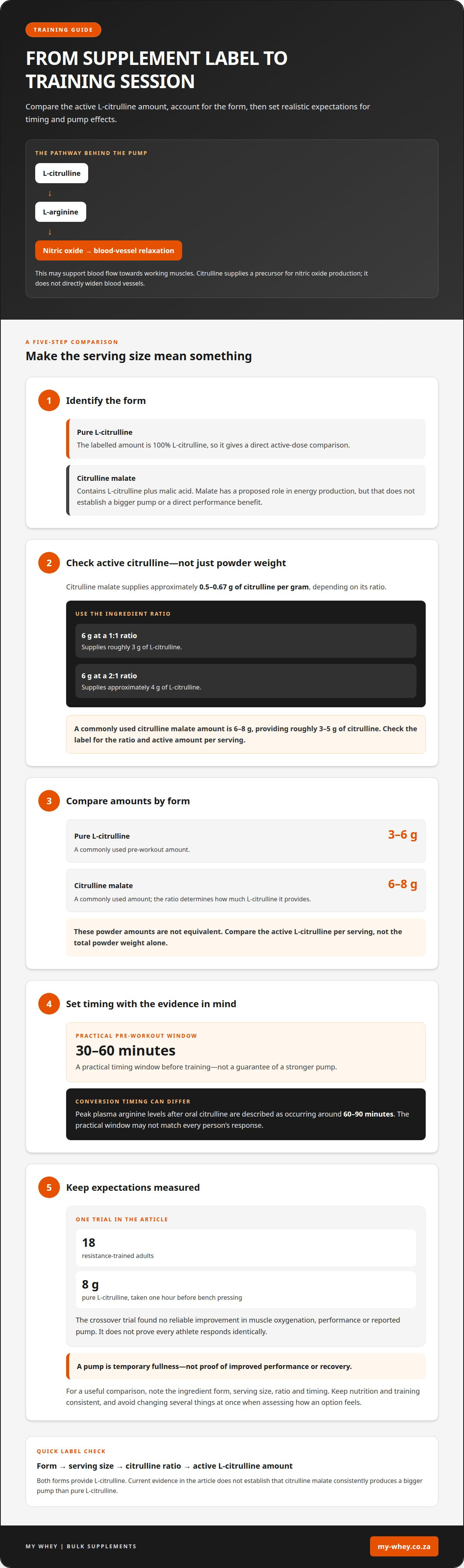
L-citrulline supports nitric oxide production by converting into L-arginine, a precursor the body uses to make nitric oxide.
L-citrulline and nitric oxide production
L-citrulline is a naturally occurring amino acid also found in watermelon. After you consume it, the body converts it into L-arginine, which is needed to produce nitric oxide. L-citrulline is considered a more efficient route to increasing nitric oxide than taking L-arginine directly. It is one of three amino acids in the urea cycle, alongside L-arginine and L-ornithine.
Nitric oxide and blood-vessel relaxation
Nitric oxide acts as a vasodilator, helping widen blood vessels. This can allow more blood to flow, including towards working muscles during training. That is the main link between citrulline and blood-vessel relaxation: citrulline supplies a precursor for nitric oxide production, but does not directly widen vessels in the same way nitric oxide does.
Citrulline, blood flow and muscle pumps
During lifting, greater blood flow to working muscles may contribute to the temporary fullness athletes call a pump. Citrulline’s proposed role is upstream: it supports L-arginine availability, which helps the body produce nitric oxide. The effect depends on this biological pathway, not simply on the total amount of powder in a nutrition product. A pump is an acute sensation, not proof of improved training performance.
Citrulline dose for nitric oxide support
Pure L-citrulline is 100% L-citrulline, so its labelled amount reflects the amino acid itself. Citrulline malate includes malic acid, meaning the total dose supplies less citrulline. A common pump dose of citrulline malate is 6-8 g, providing roughly 3-5 g of citrulline. For a 2:1 product, 6 g supplies approximately 4 g of L-citrulline.
| Option | What the dose represents | Practical distinction |
|---|---|---|
| L-citrulline | 100% L-citrulline | Direct dose comparison |
| Citrulline malate | 6-8 g supplies roughly 3-5 g citrulline | Check the ratio and active amount |
Compare the amount of L-citrulline per serving, not just the total powder weight.
Does citrulline malate increase blood flow during lifting?
Citrulline may support blood flow by supplying a precursor for nitric oxide production, but responses vary. When comparing pure L-citrulline with citrulline malate in South Africa, check the label for the ingredient form, serving size and amount of active citrulline per serving. Powder weight alone does not tell you how much L-citrulline you will get.
L-citrulline and citrulline malate pre-workout doses
A practical pre-workout timing window is 30-60 minutes before training. A commonly used dose is 3-6 g of pure L-citrulline, while citrulline malate is often taken at 6-8 g. The amounts aren’t equivalent: malate contributes to the total powder weight, so the ratio determines how much L-citrulline each serving provides.
For example, 6 g of citrulline malate at a 1:1 ratio supplies roughly 3 g of citrulline. A 2:1 ratio supplies a greater proportion of citrulline. Read the ingredient panel before comparing servings, and use the stated ratio to understand the active dose. Timing supports a consistent routine, but it doesn’t guarantee a stronger pump.
Workout pump comparisons
Both forms provide L-citrulline, which the body converts into arginine and uses in the pathway for nitric oxide production. This may help blood vessels relax and support blood flow during intense exercise. Citrulline malate also contains malic acid, which has a proposed role in energy production. Studies have not established that it consistently produces a bigger pump than pure L-citrulline.
Absorption and the time required for conversion also matter. Peak plasma arginine levels after oral citrulline ingestion are described as occurring around 60-90 minutes, so the practical 30-60-minute timing window may not match every person’s response. A workout pump is temporary fullness, not a direct measure of performance or recovery.
For a useful comparison, note the ingredient form, serving size, ratio and timing, then pay attention to how your training session feels. Keep your nutrition and workout routine consistent rather than changing several things at once. This makes it easier to assess whether either option suits your training.
For a wider view of supplement choices, explore supplement options.
Citrulline Malate vs L-Citrulline - Which Gives Better Pump?
Pure L-citrulline and citrulline malate differ in composition, so compare the active ingredient rather than powder weight alone. Pure L-citrulline is 100% L-citrulline, while citrulline malate supplies approximately 0.5-0.67 g of citrulline per gram, depending on its ratio. This distinction matters when assessing citrulline malate for better pumps: a larger serving doesn’t necessarily deliver more active citrulline.
Malate has a proposed role in aerobic energy production and lactate clearance, which could potentially delay fatigue. This gives citrulline malate a theoretical endurance rationale beyond L-citrulline alone. However, evidence for a direct performance benefit from malate is less robust than evidence for L-citrulline’s nitric oxide effects. A proposed mechanism does not prove that it improves training volume.
Performance findings also call for measured expectations. A crossover trial gave 18 resistance-trained adults 8 g of pure L-citrulline one hour before bench pressing. It found no reliable improvement in muscle oxygenation, performance or reported pump. The result doesn’t prove every athlete responds identically, but it shows that a larger dose doesn’t automatically mean better sports performance.
| Option | Composition | What it may suit |
|---|---|---|
| L-citrulline | 100% L-citrulline | Those prioritising a direct, measurable citrulline dose |
| Citrulline malate | L-citrulline with malic acid | Those interested in malate’s proposed endurance role |
Creatine is a separate supplement, not another form of citrulline, so consider their intended roles separately. For citrulline malate for better pumps, compare the amount of L-citrulline per serving. If endurance is your focus, consider malate’s proposed role separately. The available findings do not identify a clear winner for pump or training volume.
Acute citrulline malate and muscle pump effects
An acute dose means taking citrulline malate before a single workout, rather than assessing long-term use. The question is whether it changes muscle fullness, blood flow or performance during that session. These outcomes are not interchangeable: a visible pump does not establish reduced fatigue or improved lifting capacity.
Citrulline malate combines L-citrulline, an amino acid in the urea cycle, with malic acid. Malic acid is an intermediate in the Krebs cycle, the body’s energy-producing process. A 6 g serving at a 2:1 ratio provides 2 g of malic acid. This gives the formula a proposed energy-production role, but the evidence for a direct performance benefit from malate is less robust than for L-citrulline’s nitric oxide effects.
Acute results have not consistently shown a larger pump. In a trial involving 30 young male resistance-trained athletes, 8 g of citrulline malate combined with 3 g of arginine was taken once before a standardised arm workout. The combination didn’t reliably improve muscle perfusion, arm size or reported pump. It’s a useful reminder that adding ingredients doesn’t necessarily maximise the effect.
Amount matters for tolerance, too. Both L-citrulline and citrulline malate are described as well tolerated up to 10 g daily. Higher citrulline malate doses can cause mild digestive discomfort, and gastrointestinal discomfort may occur above 8-10 g. More powder isn’t a reliable way to increase fullness or delay fatigue. Stay within recommended dosages, maintain adequate hydration and pay attention to how the serving sits before training.
For a wider supplement routine, explore amino acid supplements alongside your training and nutrition priorities.
My Whey
My Whey helps South African supplement buyers explore options that fit their wider nutrition and training routine. Citrulline research can help you understand the difference between a proposed pump effect and reliable training foundations; your overall supplement choices should reflect your individual goals and diet. My Whey offers Creatine Monohydrate, Whey Protein Concentrate 80%, Omega 3 Softgels and Amino Acids, giving you several categories to consider as part of a broader approach. These products are not substitutes for understanding a citrulline label or its active dose. Turn to My Whey when you’re reviewing your supplement priorities beyond a single pre-workout ingredient. Contact My Whey to discuss your supplement needs.
Make your next supplement choice with purpose
If you’re considering citrulline malate for better pumps, assess it over a training block rather than chasing a dramatic change in one session. Keep your training, nutrition and supplement routine consistent enough to understand what you’re responding to. Then decide whether a pump-focused product fits alongside the foundations you already prioritise.
Supplement decisions also sit within a wider routine. My Whey offers options including Creatine Monohydrate, Whey Protein Concentrate 80% and Omega 3 Softgels, for people considering different parts of their nutrition and training needs. The right choice depends on what you’re trying to support, not on adding products for their own sake.
For clear, practical guidance on your supplement choices, contact My Whey for supplement advice. Take the next step with a plan that feels considered and suited to your goals.
Frequently Asked Questions
What Is L-Citrulline?
L-citrulline is a naturally occurring amino acid found in foods such as watermelon. In the body, it participates in the urea cycle alongside L-arginine and L-ornithine. For supplement users, its relevance is that it can be converted into L-arginine, a building block used in nitric oxide production. A supplement provides a way to consume this amino acid without relying on food sources alone.
Does pure L-citrulline improve muscle oxygenation?
One trial did not find a reliable improvement in muscle oxygenation after pure L-citrulline. It gave 8 g one hour before bench pressing to 18 resistance-trained adults, including 11 men and 7 women. The result means that the tested dose and session didn’t demonstrate a consistent oxygenation benefit. It doesn’t establish that every training context or individual response will be identical.
Does the ‘malate’ part matter for performance?
Malate gives citrulline malate a proposed role in energy metabolism, but that possibility is not the same as a demonstrated performance effect. Malic acid is involved in the Krebs cycle, a process that helps produce energy. When comparing products, separate this proposed endurance rationale from the amount of L-citrulline in each serving. The added ingredient alone does not prove better lifting results.
How can the nitric-oxide mechanism be real if the pump did not improve?
A biological pathway and a noticeable workout outcome are different measures. Citrulline can support the body’s nitric oxide production pathway, but that does not guarantee a measurable change in muscle fullness in every session. Training conditions, serving size and the outcome measured all matter. A plausible mechanism explains how an effect could occur; it does not establish that you will notice it in a particular workout.
How does Citrulline Malate enhance the Performance?
Citrulline malate combines L-citrulline with malic acid, so its proposed benefits relate to both nitric oxide production and energy metabolism. However, “enhance” should not be read as a guaranteed improvement in strength, repetitions or recovery. Assess the product by its active citrulline content and your training goal. A pump-focused aim, for example, differs from seeking better endurance across a session.
How good is the evidence?
The evidence is limited and doesn’t establish a dependable pump or performance benefit for everyone. Two randomised crossover trials reviewed included 48 participants in total, while individual trial findings did not consistently show improvements in measured outcomes. That’s enough to assess the proposed mechanism, but not to promise a predictable training result. Treat citrulline as an optional supplement, not a replacement for a sound training and nutrition routine.