

Creatine cognitive benefits and what the science says
Creatine may offer cognitive benefits, but the evidence is still limited and inconsistent. Some research points to possible support for memory, concentration and fatigue during sleep loss, rather than a dependable boost for everyone. That distinction matters when weighing the cognitive benefits of creatine supplementation.
It’s understandable to look beyond exercise performance when considering creatine. The key is to distinguish promising findings from established effects: results may vary by situation, and researchers have not established the best approach for cognitive outcomes.
This article explains what studies say about memory and vigilance, why creatine may be relevant for vegetarians and vegans, and what to consider before supplementing. It also sets out the limits of the evidence, so you can make a measured decision rather than rely on broad claims.
Key Takeaways
- Creatine may support aspects of thinking under stress or sleep loss, but current findings don’t establish a reliable cognitive boost for everyone.
- Learn why memory and vigilance results can differ between studies, and what those findings mean in practical terms.
- Explore why people following vegetarian or vegan diets may have different dietary creatine intake, and how that could relate to cognitive effects.
- Consider the evidence and your health needs before supplementing; My Whey offers Creatine Monohydrate as an option to explore.
What is driving creatine’s popularity, and what does the science say?
Creatine is attracting interest beyond exercise because it may support brain energy. Researchers are investigating whether this could matter during sleep loss, hypoxia or neurological disease.
Memory and concentration under stress
Memory and concentration under stress describe how well someone retains information and focuses when tired or under pressure. This can matter during demanding work or study, when sleep deprivation may make clear thinking harder. Some findings suggest creatine may support memory and concentration in these conditions. They do not establish a reliable effect in everyday situations, so the context of each study matters.
Human evidence for cognitive benefits
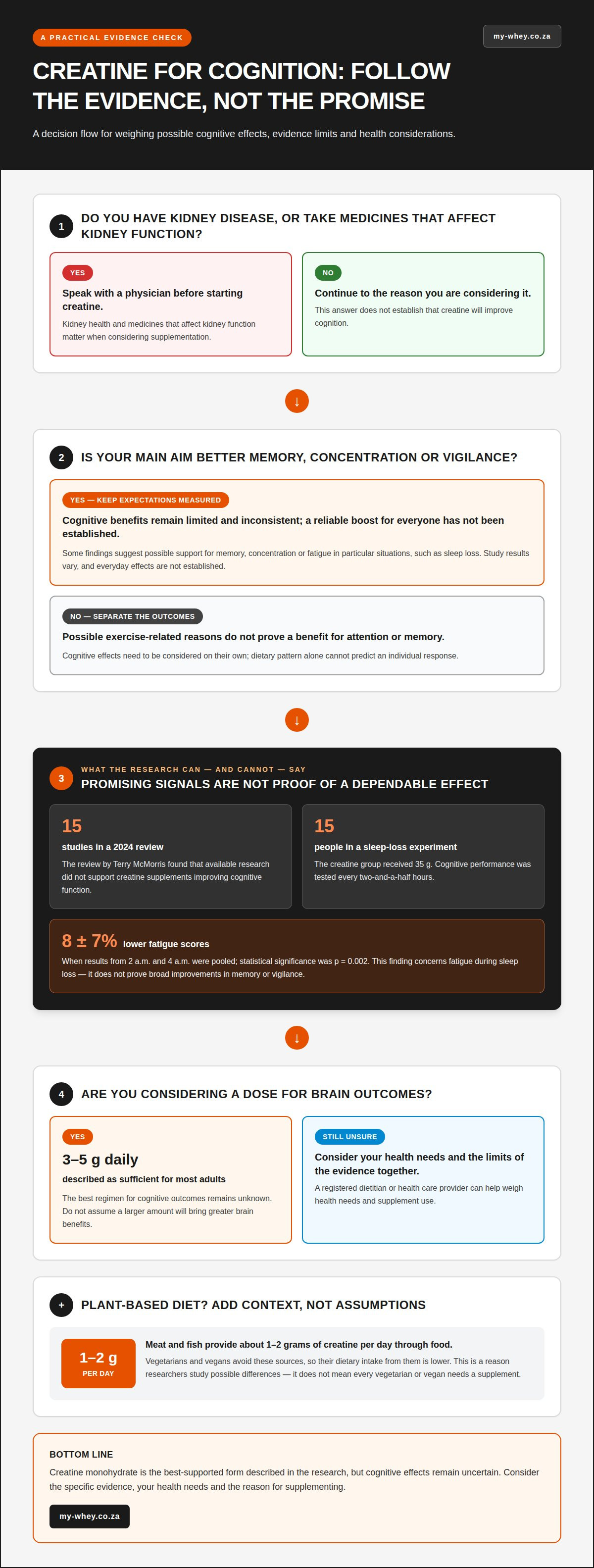
Human evidence includes possible benefits for memory, concentration and fatigue in specific situations, rather than a consistent improvement across cognitive tasks. Creatine monohydrate is the best-supported form: it is the most studied and effective form described in the research. However, a 2024 review by Terry McMorris examined 15 studies and found that available research did not support creatine supplements improving cognitive function. That contrast calls for a measured interpretation.
One sleep-deprivation experiment recruited 15 people and gave the creatine group 35 g. Researchers tested cognitive performance every two-and-a-half hours. When results from 2 a.m. and 4 a.m. were pooled, fatigue scores fell by 8 ± 7%, with statistical significance at p = 0.002. This finding concerns fatigue during sleep loss; it doesn’t prove broad improvements in memory or vigilance.
Creatine may increase brain creatine and support brain energetics, which helps explain interest in its use during hypoxia or neurological disease. However, study methods vary, including participants, supplementation regimens and cognitive assessments. Brain creatine measurements are also often absent, limiting comparisons. Overall, the cognitive benefits of creatine supplementation remain uncertain, despite promising findings in particular conditions.
Any final advice for those considering creatine supplements?
Creatine’s role in brain health centres on energy metabolism: brain cells use energy to maintain normal function. Supplementation can raise brain creatine, but evidence for cognitive effects remains limited and inconsistent. Researchers also don’t yet know the optimal amount or regimen for brain outcomes.
A pilot study at the University of Kansas Medical Center followed 19 people with Alzheimer’s disease, aged 60-90 years. Participants took 20 grams of creatine monohydrate daily for eight weeks, with blood samples collected at baseline, four weeks and eight weeks. Brain creatine increased by 11%, measured using magnetic resonance spectroscopy at baseline and eight weeks. However, the study had no control group, so it cannot establish that creatine caused cognitive improvement.
Measurement matters, too. After a high single oral dose, researchers detected increased total creatine relative to N-acetylaspartate in the left medial parietal region for up to 5.5 hours. This is a regional signal, not a direct measure of brain-wide energy use or better memory. Differences in brain regions and measurement methods can affect how results are interpreted.
A 2023 long Covid study monitored 19 patients for six months; half received 4 g of creatine. The creatine group reported improved symptoms, including less brain fog and fewer concentration difficulties. This is an encouraging finding, but a small study cannot show that the same effect applies to everyone with long Covid.
For most adults, 3-5 grams daily is sufficient. The best regimen for cognitive outcomes remains unknown, so don’t assume a larger amount will bring greater brain benefits. People with kidney disease, or those taking medicines that affect kidney function, should speak with a physician before starting. A registered dietitian or health care provider can also help weigh health needs and supplement use.
For a practical next step, explore creatine supplement options with these evidence limits in mind.
Creatine and cognitive function in vegetarians and vegans
Meat and fish provide about 1-2 grams of creatine per day through food. Vegetarians and vegans avoid these sources, so their dietary intake from them is lower. That difference gives researchers a reason to study whether supplementation affects cognition differently across dietary patterns. It does not, by itself, show that every vegetarian or vegan needs a supplement.
Emerging data suggests creatine may support cognitive function and reduce fatigue, particularly for people experiencing sleep loss, vegetarians and older adults. For someone following a plant-based diet, memory and concentration under demanding conditions are relevant outcomes to consider. However, the evidence does not establish a dependable cognitive effect for all vegetarians or vegans. Dietary pattern alone cannot predict an individual response.
Keep cognitive outcomes distinct from exercise performance. A supplement may be considered for muscle-related reasons, but that does not prove the same benefit for attention or memory. Cognitive studies also vary in their participants, supplementation regimens and assessments. These differences make it difficult to translate a finding from one group into a precise recommendation for someone following a vegetarian or vegan diet.
Kidney health and medication use also matter before starting. Studies have found that long-term creatine use does not harm kidney function in healthy adults. People with kidney disease, or those taking medicines that affect kidney function, should speak with a physician before using supplements. This is especially relevant if a health condition or treatment affects kidney health. Discuss your diet, medicines and reason for supplementing together, rather than assuming that a plant-based diet alone determines whether creatine is appropriate.
Memory and vigilance
Memory involves taking in and recalling information; vigilance means maintaining attention to relevant signals. These functions can overlap, but recall and sustained focus are different abilities. Remembering instructions after a demanding night, for example, tests something different from noticing a change on a screen.
The cognitive benefits of creatine supplementation need to be understood in light of the task measured. A finding about recall does not automatically show better vigilance, concentration or decision-making. The assessment, study conditions and outcome all shape what the result can tell you.
Sleep deprivation adds another factor. Someone who has slept poorly may struggle to stay focused during a long task and find new information harder to remember. These experiences can occur together, but researchers need separate measures to distinguish attention, memory and fatigue.
Studies use varied cognitive assessments, participants and supplementation regimens. One may measure how well people retain information; another may test sustained alertness. This variation makes direct comparisons difficult. A result from one task is a specific finding, not a complete account of everyday thinking.
To assess claims about the cognitive benefits of creatine supplementation, consider which ability researchers measured and under what conditions. A reported change in fatigue, for instance, is not proof of improved memory. Keeping the outcome in view helps distinguish a finding in a particular setting from a broad claim about cognitive performance.
My Whey: Creatine Monohydrate
My Whey Creatine Monohydrate offers a straightforward option for readers considering supplementation. It’s a practical next step if you have weighed the evidence and want to explore creatine as part of your routine, without treating possible cognitive effects as guaranteed.
Keep your reason for taking it clear. Research on memory and focus remains mixed, so choose based on your needs and discuss personal health considerations with a healthcare professional. My Whey also offers Cognitive Support, a separate category for readers exploring products related to cognition.
For questions about the available options, contact My Whey.
Make your next step a considered one
Choose supplements with a clear purpose, not the expectation that one product will solve every challenge with focus or memory. Decide what you want to support, consider how it fits your routine, and keep your expectations grounded in the evidence. The cognitive benefits of creatine supplementation remain an area of study, so treat personal experience as one part of a broader health decision.
My Whey offers Creatine Monohydrate, alongside Whey Protein Concentrate 80% and Omega 3 Softgels. These are distinct options for different nutritional goals, not substitutes for one another. If you’re weighing creatine, take your health circumstances and reason for using it into account; people with relevant health concerns should discuss supplementation with a healthcare professional.
For help exploring your options, contact My Whey with your questions. Take an informed, steady approach to your wellness goals.
Frequently Asked Questions
How does creatine work in the body?
Creatine supports the body’s energy system by contributing to phosphocreatine, which helps regenerate ATP, a source of energy for cells. Muscles store much of the body’s creatine, and the brain also contains creatine. This role in energy production explains researchers’ interest in cognitive function, but a mechanism alone does not show that supplementation improves thinking or memory.
What are common myths or misconceptions related to creatine?
A common misconception is that creatine reliably sharpens thinking for everyone. Human evidence does not establish a consistent cognitive improvement, and changes in fatigue or performance on one task do not prove better memory in daily life. Another oversimplification is assuming every study tests the same outcome: researchers use different participants, dosing regimens and assessments, so findings need careful interpretation.
What are safe dosing and quality guidelines?
For most adults, the suggested amount is 3-5 grams daily, though the best regimen for cognitive outcomes is unknown. Creatine monohydrate is the most studied form. Speak with a health care provider before supplementing if you’re pregnant or lactating, have a medical condition, or take medication. Stop use and seek advice if an adverse reaction occurs; keep supplements out of children’s reach.
These statements have not been evaluated by the Food and Drug Administration. This product is not intended to diagnose, treat, cure or prevent any disease.
What are the benefits and drawbacks?
Creatine’s established role in the body’s energy system is one reason people consider supplementation, while possible cognitive effects remain uncertain. A practical limitation is that results from one setting may not apply to another, such as comparing a sleep-deprived participant with someone who is rested. Supplementation may also temporarily increase body weight through water shifts in muscle tissue, which could matter to someone monitoring their weight.
How does creatine affect memory, attention and processing speed?
Research has not established reliable improvements in memory, attention or processing speed for everyone. Some findings suggest potential support for memory or concentration under stress, but tests measure distinct abilities. For example, recalling information differs from responding quickly to a visual cue. Treat each result as specific to its task and conditions, rather than as evidence of a general cognitive boost.
Does creatine improve cognition in vegetarians or people with low dietary creatine intake?
People get about 1-2 grams of creatine daily from foods such as meat and fish, so vegetarians and vegans may have lower intake from these sources. Emerging data suggests possible cognitive or fatigue-related effects, but it doesn’t establish that supplementation improves cognition for every person eating a plant-based diet. Consider your overall diet and health needs, rather than using dietary pattern alone to predict an effect.