

Essential Amino Acids for Muscle Recovery and Soreness
BCAAs are only three of the nine essential amino acids the body needs from food. For essential amino acids for muscle recovery, that distinction matters: the full group supplies the building blocks for muscle protein, while BCAAs alone provide only part of the picture. They may support recovery and soreness management, but they’re not a substitute for enough protein overall.
It makes sense to look for a supplement that can ease post-workout soreness and help you recover well. This article explains what essential amino acids are, how they relate to muscle repair and delayed onset muscle soreness, and whether BCAAs may help. You’ll also see why total protein intake and a balanced diet matter when deciding whether amino acid supplements have a place in your routine.
Key Takeaways
- Learn why essential amino acids provide a fuller profile than BCAAs, which contain only three essential amino acids.
- Assess your overall protein intake and eating pattern before deciding whether amino acid supplements could add value.
- Understand when post-exercise soreness commonly peaks and what research suggests about amino acids and recovery.
- Explore how My Whey’s Amino Acids and Creatine Monohydrate fit into a considered supplement routine.
Do BCAAs help with muscle recovery?
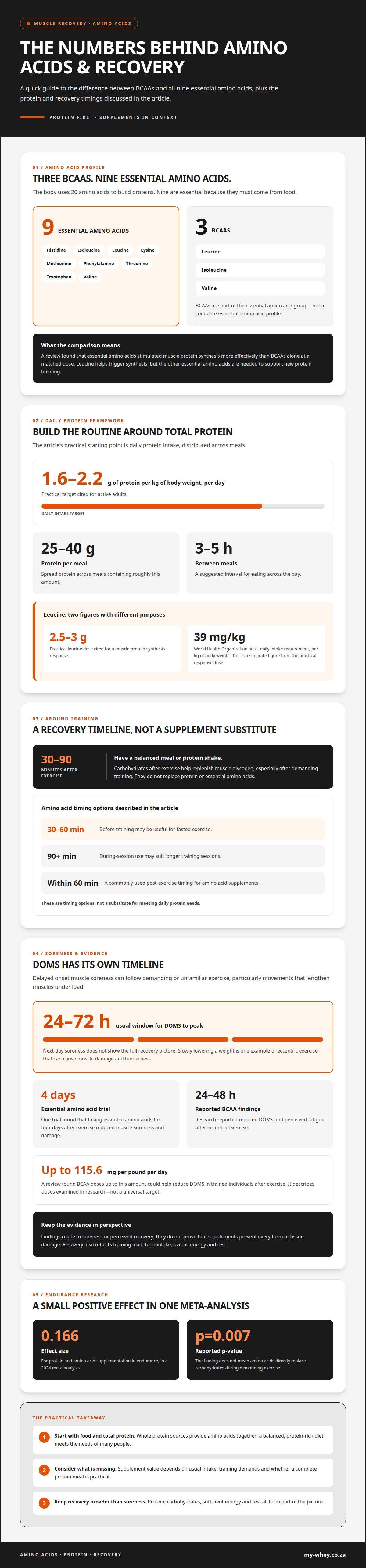
BCAAs may help with muscle soreness, but they supply only three essential amino acids: leucine, isoleucine and valine. The body uses 20 amino acids to build proteins, and nine are essential because food must supply them. Muscle protein synthesis uses amino acids to build and repair muscle proteins after training. A review found that essential amino acids stimulate synthesis more effectively than BCAAs alone at a matched dose. That makes the full amino acid profile relevant, not just leucine.
Leucine helps trigger muscle protein synthesis, but it needs the other essential amino acids to support new protein building. A practical dose cited for this response is 2.5 to 3 grams of leucine. This is separate from the World Health Organization’s adult daily intake requirement of 39 milligrams per kilogram of body weight. Whole protein, such as eggs, dairy, meat or a protein shake, provides amino acids together. EAA supplements provide all nine essential amino acids; BCAAs provide only three.
Start with your daily protein intake. For active adults, a practical target is 1.6 to 2.2 grams per kilogram of body weight per day, spread across meals containing roughly 25 to 40 grams of protein. Aim to eat every 3 to 5 hours. If a meal is not practical after training, a protein shake can be convenient. Whey protein is one example of a complete protein source, while isolated amino acid supplements may add less when daily protein is already sufficient.
After exercise, have a balanced meal or protein shake within 30 to 90 minutes. Carbohydrates immediately after exercise help replenish muscle glycogen, especially after demanding training. They don’t replace protein or essential amino acids. For endurance sessions, recovery still depends on meeting overall energy and protein needs. BCAAs may be useful in some circumstances, but soreness, muscle damage and recovery also reflect training load, food intake and rest. Consider the whole routine before adding supplements.
What Are Essential Amino Acids?
Essential amino acids are nutrients the body must get from food because it cannot make enough of them itself. The nine are histidine, isoleucine, leucine, lysine, methionine, phenylalanine, threonine, tryptophan and valine. All contribute to building proteins; leucine, isoleucine and valine are the branched-chain amino acids. Together, essential amino acids provide the building blocks for muscle repair and growth after exercise.
A balanced, protein-rich diet meets the needs of many people. Supplementation may suit athletes who train frequently, particularly during calorie restriction, when food intake is lower. It can also be a convenient option around a workout when a complete protein meal is impractical. Supplements do not replace sound nutrition, and their value depends on what is missing from your usual intake.
Timing can follow the training schedule. Amino acids may be taken before, during or after exercise. A serving 30 to 60 minutes before a workout may be useful for fasted training; during-session use may suit sessions lasting 90 minutes or more. After exercise, amino acid supplements are commonly taken within 60 minutes. These timings are options, not a substitute for meeting daily protein needs.
For endurance, a 2024 meta-analysis found a small positive effect from protein and amino acid supplementation, with an effect size of 0.166 and p=0.007. That finding doesn’t mean amino acids directly replace carbohydrates during demanding exercise. Consider your training demands and overall nutrition before adding a supplement. Digestive tolerance varies, so discontinue a product that causes discomfort. Compare ingredient information and serving details, and weigh the ongoing cost against how well it fits your diet.
To explore amino acid supplement options, consider whether they fill a practical gap in your training nutrition.
Amino acids and delayed onset muscle soreness
Delayed onset muscle soreness (DOMS) is discomfort that follows demanding or unfamiliar exercise, especially movements that lengthen muscles under load. It typically peaks 24 to 72 hours after training, so soreness the next day doesn’t show the full recovery picture. Eccentric exercise, such as lowering a weight slowly, can also cause muscle damage and tenderness.
Research has examined whether amino acids change this response. One trial found that taking essential amino acids for 4 days after exercise reduced muscle soreness and damage. Research on branched-chain amino acids reported reduced DOMS and perceived fatigue 24 to 48 hours after eccentric exercise. These findings concern soreness and perceived recovery, not proof that supplements prevent every form of tissue damage.
A review found that BCAA doses up to 115.6 milligrams per pound per day could help reduce DOMS in trained individuals after exercise. That upper amount describes doses examined in research, not a universal target. BCAA products contain leucine, isoleucine and valine, but the response can’t be separated from training demands, overall protein intake and the rest of an athlete’s nutrition.
Recovery involves more than soreness. Protein supplies amino acids for protein synthesis and supports tissue repair, while carbohydrates replenish muscle glycogen after demanding sessions. Protein also contributes to hormone production and wider health. A supplement should not replace meals that provide energy, protein and carbohydrates. The practical priority is matching your nutrition to your workload and allowing time between hard sessions.
Track soreness alongside performance and training load. If discomfort peaks within the usual 24 to 72-hour window, note which exercise preceded it and how long it affects movement. Reports of acute changes in perceived recovery and soreness commonly appear within one to two weeks of consistent supplement use around training. That timeframe describes reported perception, not a guaranteed change in muscle repair or athletic performance.
Essential amino acids and muscle recovery
A practical essential amino acid serving is 6 to 15 grams; another suggested dose is 6-10 g, with at least 2 g of leucine. These are reference points, not a reason to overlook total protein intake. The benefits of essential amino acids for muscle recovery depend on having the building blocks needed for muscle protein, while branched-chain amino acids supply only leucine, isoleucine and valine.
After resistance exercise, muscle repair relies on amino acids to build and renew proteins. Leucine helps signal this process, but the other essential amino acids matter too: they provide the remaining building blocks. That is why a complete EAA profile differs from BCAAs alone. It provides all nine essential amino acids for protein synthesis, rather than just three.
You can get these nutrients from complete protein sources such as eggs, dairy, meat and fish. A protein-rich meal may be enough if it fits your routine and daily intake. A supplement can be more practical when limited time, appetite or meal access makes eating around training difficult. Choose according to what your usual meals provide, not simply in pursuit of faster strength gains.
Adults aged 50 and above may benefit from supplemental leucine and a full essential amino acid profile. They may need to pay particular attention to protein quality and distribution across meals. For other athletes, training frequency, food intake and recovery demands help determine whether an EAA supplement adds value. Amino acids support muscle repair, but they don’t replace progressive training, adequate energy or rest.
For essential amino acids for muscle recovery, consider the serving directions and assess leucine alongside the full amino acid profile. If you want to compare options, explore amino acid supplements as one way to add essential amino acids to your routine.
My Whey: Creatine Monohydrate
My Whey offers Creatine Monohydrate for people considering supplements alongside their training and nutrition. It’s separate from essential amino acids, so choose it for a different place in your routine rather than as a replacement for protein or amino acids. My Whey also offers Amino Acids and Whey Protein Concentrate 80%, which relate more directly to adding amino acids or protein to your diet.
Start with the basics: review your meals, training and recovery needs before choosing a supplement. If you want to add a particular product category, My Whey offers a range of supplements, while your choice should still reflect your individual needs.
Contact My Whey to explore its supplement options.
Make your next recovery choice count
Use your training and eating habits to decide what to adjust. If your meals already meet your protein needs, another supplement may not be the most useful change. When considering essential amino acids for muscle recovery, assess whether your current food sources provide the amino acids your routine requires. A clear goal helps you choose deliberately instead of adding products without a reason.
My Whey’s range includes Amino Acids, Creatine Monohydrate, Whey Protein Concentrate 80% and Omega 3 Softgels. These are distinct options, so consider which one aligns with your nutrition priorities. For a conversation about amino acid options, contact My Whey for amino acid advice.
Build your recovery routine around consistent training, suitable nutrition and choices that fit your needs. Keep your approach considered, and choose supplements only when they serve a clear purpose.
Frequently Asked Questions
Do You Need Amino Acid Supplements?
Not necessarily, if your usual meals already provide enough protein and essential amino acids. Consider a typical day: eggs at breakfast, yoghurt as a snack and a protein-rich supper all contribute. A supplement may be convenient when work, travel or appetite makes a meal difficult, but it should not replace a balanced diet. Judge its value by the gap it fills in your eating routine.
But Are They Effective For Muscle Growth and Recovery?
They can support muscle protein building when they supply amino acids that your diet lacks. But not every product offers the same profile: an EAA supplement provides a broader range than BCAAs alone. Training quality, adequate food and consistent recovery habits also shape progress. If your meals already meet your protein needs, isolated amino acids may contribute less than improving another part of your routine.
Does The Timing Of When You Take EEAs Matter?
Timing can help fit EAAs around training, but regular protein intake across the day matters too. Taking them 30 to 60 minutes before exercise is one option, particularly for fasted training. Another is taking them within 60 minutes after a session. For example, choose the timing that works around your next meal, rather than disrupting your schedule to hit an exact moment.
How Do They Work?
After digestion, amino acids enter circulation and become available to tissues. Muscle cells use them to build and renew proteins, including proteins affected by resistance exercise. Leucine also acts as a signal involved in starting protein synthesis. The other essential amino acids supply material for this process, so leucine alone does not provide the full set of building blocks.
How do essential amino acids help muscle protein synthesis after exercise?
Exercise prompts the body to remodel muscle tissue, and essential amino acids provide material for making new muscle proteins. Leucine helps signal synthesis, while the other essential amino acids support the building process. For example, after a demanding session, a meal containing dairy, eggs or another complete protein supplies these nutrients together and can form part of your post-training nutrition.
When should you take essential amino acids before or after a workout?
Take them 30 to 60 minutes before training when exercising fasted, or within 60 minutes afterwards if that better fits your routine. If you can eat after exercise, a balanced meal or protein shake is another practical choice. For instance, someone finishing training near mealtime can prioritise the meal, while someone without meal access may prefer a portable supplement.