

How to Build a Supplement Stack for Beginners
What if your first supplement stack worked better because it included less? If you’re unsure how to build a supplement stack for beginners, it’s easy to get drawn towards overlapping ingredients, trend-led recommendations and products that don’t match your needs. A small, goal-led routine is easier to understand and assess.
Start with one clear priority, then decide whether a supplement category has a practical role in supporting it. Creatine Monohydrate, Whey Protein Concentrate 80% and Omega 3 Softgels are options to assess against your own goals, not a checklist everyone needs to follow. My Whey states that its products undergo third-party laboratory testing for purity, another point to weigh when comparing products.
This guide will help you choose a minimal routine, check labels for overlapping ingredients and introduce products one at a time so you can assess whether each earns its place. You’ll also learn when to seek professional advice. Always consult your health care provider before taking any supplements. Pregnant or lactating women, people with existing medical conditions, or people taking medications should consult their health care provider/s before taking any dietary supplement.
Key Takeaways
- Learn how to build a supplement stack for beginners by starting with one clear goal, not a long list of trending products.
- Compare product categories with your needs, and treat protein powder as a convenient food option rather than a must-have.
- Use a practical label checklist to review ingredients, quantities, directions, warnings and testing claims.
- Introduce one relevant product at a time, follow its label and reassess before making another change.
- Explore My Whey products as optional choices for your goals, with third-party laboratory-tested purity as one quality point to consider.
How to build a supplement stack for beginners: start with your goal
Supplement advice can feel crowded fast. One recommendation leads to another, making it difficult to tell which products answer a real need. Start by naming the outcome you want to support, then consider whether a supplement has a practical role in your plan. You don’t need a complicated routine to make a considered choice.
A supplement stack is a chosen combination of products intended to support a specific goal. A goal-led stack is the smallest useful set of products for a defined need, not a collection of whatever is trending. It’s optional, and it should sit alongside food, training and recovery, never replace them or professional healthcare. For a broad introduction to supplement types and general considerations, see Understanding Dietary Supplements.
Set one clear goal before choosing supplements
Make your goal concrete enough to guide a decision. “Get healthier” or “perform better” can mean many things. A more useful starting point might be making protein intake more convenient, supporting a training routine or planning your diet around a particular preference. Ask what you want to make easier or more consistent, and whether a supplement category is relevant to that specific task.
Before choosing anything, consider your current eating pattern, training routine, preferences and health circumstances. These details can help you spot practical constraints, but they can’t diagnose a deficiency. If you have a medical condition, take medication or are unsure whether a supplement is suitable, speak with a health care provider. Always consult your health care provider before taking any supplements. Pregnant or lactating women, people with existing medical conditions, or people taking medications should consult their health care provider/s before taking any dietary supplement.
Build the foundation before adding products
Start with the routine that supports your goal: regular, balanced meals; an appropriate training plan if training is part of that goal; and attention to sleep and recovery. Supplements are optional. Their clearest role is to address a defined gap or practical constraint, not to compensate for an inconsistent foundation or promise a particular result.
For example, someone with a busy schedule who finds it difficult to prepare a protein-containing snack might consider protein powder as a convenient food option. Someone whose meals already suit their needs may have no reason to add it. The question isn’t whether a product is popular, but whether it fits your circumstances and makes your plan more workable. That’s a useful first step in how to build a supplement stack for beginners.
What belongs in a beginner supplement stack, and what is optional?
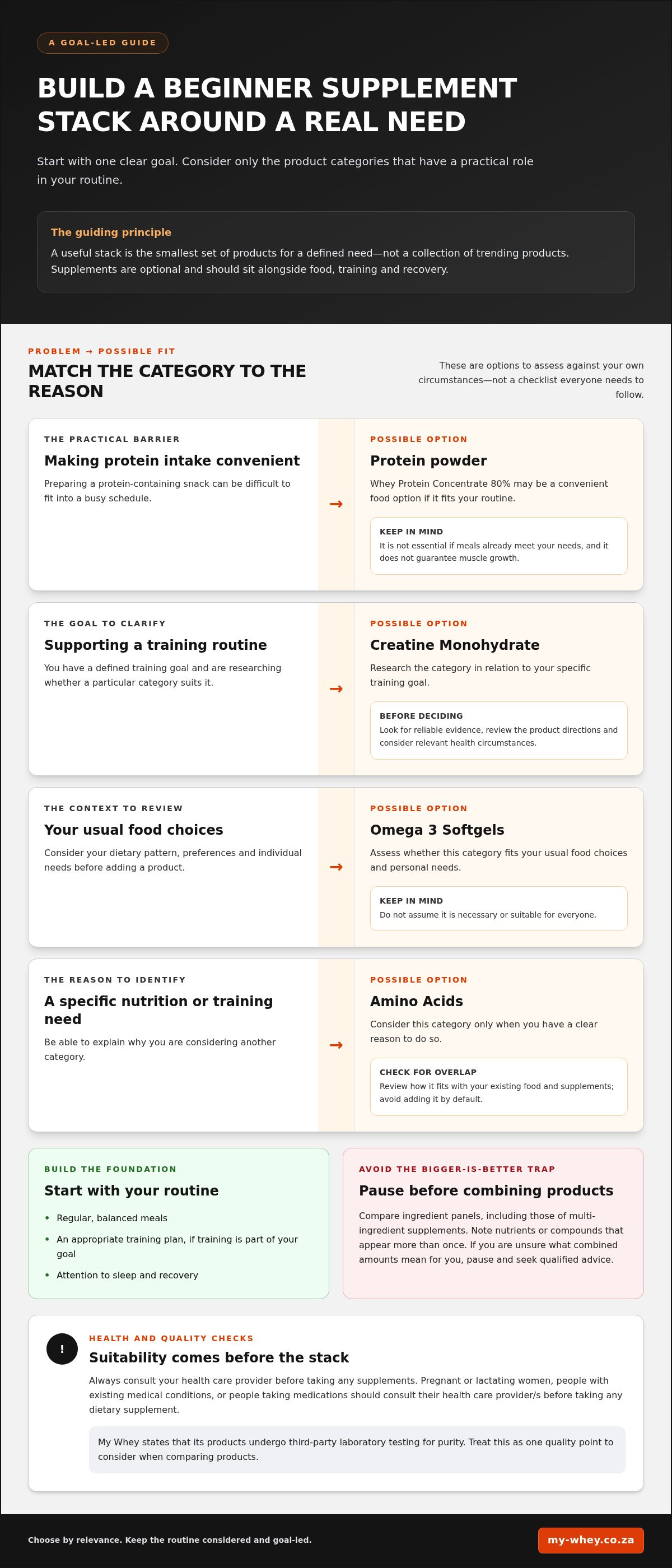
There’s no standard set of products every beginner needs. Choose by relevance: does a category address a specific need in your diet or routine, and can you explain why you’re considering it? Use the comparison below as a starting point for that decision, not as a prescription.
| Goal | Product category | When it may be relevant | Key caveat |
|---|---|---|---|
| Make protein intake more convenient | Protein powder, such as Whey Protein Concentrate 80% | You want a practical food option that fits your routine. | It isn’t essential if meals already meet your needs, and it doesn’t guarantee muscle growth. |
| Consider a training-focused option | Creatine Monohydrate | You have a defined training goal and are researching whether this category suits it. | Review reliable evidence, product directions and relevant health considerations before use. |
| Review your dietary pattern | Omega 3 Softgels | You’re considering whether this category fits your usual food choices and individual needs. | Don’t assume it’s necessary or suitable for everyone. |
| Assess a specific nutrition or training need | Amino Acids | You’ve identified a clear reason to consider this category. | Check how it fits with your existing food and supplements; avoid adding it by default. |
Match product categories to a specific reason
Whey Protein Concentrate 80% may suit someone looking for a convenient protein source, particularly if preparing food is a practical barrier. My Whey describes its Whey Protein Concentrate 80% as grass-fed and pure protein. Treat it as an optional food choice, not a requirement. Creatine Monohydrate is another category to research for a training-related goal. Before deciding, look for evidence from reliable sources and follow the current product label rather than relying on broad claims or generic advice.
Omega 3 Softgels and Amino Acids also need an individual reason. Consider your usual diet, preferences and goal before adding either. A product category appearing frequently in recommendations doesn’t show that it fills a gap in your own routine.
Spot overlap and avoid a bigger-is-better stack
Before combining products, compare the ingredient panels of everything you already take, including multi-ingredient supplements. Note any nutrients or compounds that appear in more than one product. If you’re unsure what the combined amounts mean for you, pause and seek qualified advice instead of adding another product.
More products don’t automatically mean better results or value. Each extra item makes it harder to identify what’s relevant and adds more ingredients to review. Use a simple test: can you link each product to a specific need? If not, leave it out for now. This is central to how to build a supplement stack for beginners without turning it into a trend-driven shopping list.
Once you have a clear reason, you can explore My Whey supplement options and assess them against your needs. No product is a required part of a stack.
How to compare supplement options without falling for hype
A clear label won’t prove that a supplement is right for you, but it gives you information for a more informed comparison. Look for products that explain what they contain, how the serving is described and what warnings apply. If key details are hard to find, pause rather than relying on a headline claim.
Judge a supplement by clarity, relevance to your goal and credible quality information, not by the confidence of its marketing. A product may be well presented and still be unnecessary for your routine. Keep your reason for considering it in view as you read.
Read labels for clarity, relevance and overlap
Use this checklist to assess each option and compare it with products you already take:
- Ingredient identity: Can you tell which ingredients are included, and do they relate to your stated goal?
- Quantity per serving: Is the amount of each ingredient clear, or is it hidden within a blend?
- Serving information: Are the serving size and directions easy to understand? Follow the current product label rather than assuming directions are interchangeable between products.
- Warnings: Read relevant cautions and check whether they apply to your circumstances.
- Overlap: Compare panels across your current supplements to see whether the same ingredients appear more than once.
A proprietary blend isn’t automatically a reason to reject a product, but if it obscures individual ingredients or their quantities, you have less information to assess what you’d be taking. Don’t combine products just because their names suggest complementary roles. If you spot repeated ingredients or can’t make sense of the combined information, hold off and seek qualified advice.
Separate evidence from marketing claims
Claims about benefits, performance or health outcomes need more than persuasive wording. Look for reliable evidence that addresses the specific ingredient and claim, and consider whether it applies to the product and serving you’re evaluating. Testimonials can describe someone’s experience, but they don’t establish that you’ll have the same experience. Dramatic promises are no substitute for evidence.
Quality information is another part of the comparison, not a guarantee of results. Look for transparent sourcing and specific, substantiated testing claims. My Whey states that its products undergo third-party laboratory testing for purity. That is a quality point to consider, not proof that a supplement will produce a particular outcome or suit every person.
For protein products, compare the label information with what you actually need from a convenient food option. The whey protein guide can help you explore differences between options without turning protein powder into a requirement.
Keep the process measured. For anyone learning how to build a supplement stack for beginners, a product earns consideration when its ingredients are clear, its purpose fits your goal and its quality information can be assessed. If any of those pieces are missing, leave it out while you compare alternatives.
How to introduce and review your first supplement stack
A simple review routine helps you make informed decisions without trying several new products at once. Introduce one relevant product, keep notes on what changes in your routine and reassess its purpose. This won’t prove that the supplement caused a particular result, but it can help you describe your experience and raise clearer questions with a health care provider.
- Record your goal. Write down what you want the product to support and why it may fit your routine. A specific reason gives you a basis for reviewing it later.
- Review your current intake. Note the foods, drinks and supplements you already use. Compare labels for overlapping ingredients, and make a note of relevant health circumstances or medicines to discuss with a provider.
- Choose one relevant product. Select a single option that matches the goal you recorded. Avoid starting several new products together, particularly if you haven’t compared their ingredient panels.
- Follow the current label. Use the directions and warnings on that product’s label. Don’t apply another product’s directions or improvise a serving amount.
- Reassess and make a note. At a review point that makes sense for your routine and the label directions, consider whether the product remains relevant, practical and well tolerated. Record questions or changes to discuss with a health care provider.
Start gradually and follow product directions
Keep other parts of your routine as consistent as you can while introducing a product. Changing one variable at a time makes it easier to describe what changed, though it cannot establish that the supplement caused that change. A brief log can include the product and label directions, your usual routine, training, how well you tolerate it and any questions you want to raise. If you notice a concerning reaction, stop and seek advice from a health care provider.
Review whether each product still has a purpose
Set a review point around your routine and the product directions, not a promised results timeline. Ask yourself: does this still address the goal I recorded? Is it practical to use as directed? Do I tolerate it? If the answer is unclear, keep notes and seek qualified guidance rather than adding another product to compensate. If you’re considering Creatine Monohydrate, the creatine monohydrate guide offers a focused place to explore that category.
Keep products out of reach of children. The product safety disclaimer states: “These statements have not been evaluated by the Food and Drug Administration. This product is not intended to diagnose, treat, cure or prevent any disease.” A careful, one-at-a-time approach makes it easier to assess whether a product has a clear place in your routine. Explore supplement options at My Whey and compare them with your goal before deciding.
Build a practical beginner stack with My Whey products
Use the framework from the earlier sections to assess products by purpose, label clarity and quality information. My Whey’s range includes categories to consider, not a prescribed beginner stack. You may find that one product fits a practical need, or that your current food and routine already work well without supplements. The goal is a considered choice, not a longer list.
Choose only the product category that fits your goal
If preparing protein-rich food is difficult to fit into your day, Whey Protein Concentrate 80% may be worth assessing as a convenient food option. My Whey describes it as grass-fed and pure protein. Compare the product information with your needs and existing diet; it isn’t essential for everyone and doesn’t guarantee a particular training outcome.
For a training-related goal, you could research Creatine Monohydrate as an optional category. My Whey offers it in powder and capsule forms. Consider the label information and relevant evidence before deciding whether it suits your circumstances. The format alone doesn’t determine whether it belongs in your routine.
Omega 3 Softgels or BCAA 2:1:1 powder may also be categories to assess, but only against an individual dietary pattern or clearly defined goal. Don’t add them simply because they appear alongside another product in a recommendation. For each option, ask what specific need it addresses, whether the information is clear and whether it overlaps with anything you already use.
Keep quality, value and safety in view
My Whey describes its approach as a curated range supplied in bulk, and states that its products undergo third-party laboratory testing for purity. These are useful points to weigh when comparing options, but testing for purity isn’t a promise of results or proof that a product is suitable for every person. Review the product label and directions, then decide whether its purpose justifies adding it to your routine before considering a bulk purchase.
Supplements don’t replace suitable food, training, sleep, recovery or professional healthcare advice. If you’re pregnant or lactating, have an existing medical condition or take medication, speak with a health care provider before using supplements.
Keep out of reach of children. The product warning states: These statements have not been evaluated by the Food and Drug Administration. This product is not intended to diagnose, treat, cure or prevent any disease. Choose only what makes sense for your goal and circumstances. If you’ve considered your needs and reviewed the label information, you can explore My Whey supplements as optional products to assess, not as a ready-made stack.
Make your next supplement choice with confidence
Your next step doesn’t need to be a purchase. Decide what would make a product genuinely useful in your day-to-day life, and what would tell you it’s time to reconsider. That personal measure can keep your choices grounded as your routine changes. A supplement stack isn’t a commitment to keep adding products; it can stay small, change when your needs do, or remain empty if nothing is relevant.
That’s the practical value of learning how to build a supplement stack for beginners: you can make decisions deliberately instead of reacting to every new recommendation. Keep your goal in view, take time to compare options and involve a health care provider when your circumstances call for professional guidance.
When you’re ready to consider products against your own needs, explore My Whey’s supplements. Choose thoughtfully, keep your routine proportionate and let your priorities guide what comes next.
Frequently Asked Questions
How many supplements should a beginner take in a stack?
There’s no set number; a beginner may need none or may choose one product that fits a clear purpose. If you’re learning how to build a supplement stack for beginners, judge each item individually rather than aiming for a particular count. If your meals already suit your needs and your routine is working, adding products just to make a stack larger may offer no clear advantage.
Can beginners take creatine and whey protein together?
They can be considered as separate options in the same routine, but combining them isn’t automatically necessary. Whey protein is a food option, while creatine is a different supplement category, so assess each against your own goal, diet and circumstances. Review both labels and consider any other products you use. If you have a health condition, take medication or are unsure about combining them, ask a health care provider.
Do I need supplements to build muscle?
No. Supplements aren’t a requirement for building muscle. A suitable training plan, enough food to support your needs, consistency and recovery are more fundamental. Protein powder may be convenient if preparing or carrying food is difficult, but it isn’t a guaranteed muscle-building solution. Consider whether it solves a practical problem for you. If it doesn’t, focus on making your meals and training routine workable first.
How do I know whether a supplement stack is working?
Decide what you’ll observe before you start, such as whether a product makes your routine easier to follow or fits your food preferences. Keep brief notes on use, training, tolerance and any changes in your circumstances. This record can help you describe your experience, but it can’t prove the supplement caused a change. If you notice a concerning reaction, stop using the product and seek advice from a health care provider.
Can I start taking several new supplements at once?
It’s better not to introduce several new products at once. If you change multiple things together, it becomes harder to work out what you tolerated or what may have affected your routine. Check the labels for ingredients that appear in more than one product, and consider another only after you’ve had a chance to assess the first. If you’re uncertain about combinations, pause and discuss them with a qualified health care provider.
What should I check on a supplement label before buying?
Check the ingredient names, the quantity of each ingredient per serving, serving directions and relevant warnings. See whether the label gives enough detail to compare it with products you already use, and look for clear, substantiated information about sourcing or testing. Don’t assume a bold claim is evidence of a benefit. If a blend doesn’t disclose useful ingredient details, you may have too little information to judge whether it suits your needs.
Is a supplement stack safe for everyone?
No. Suitability depends on the person, the product, medicines and health circumstances, so don’t assume a stack is safe for you based on someone else’s experience. Keep supplements out of reach of children.