

Marine or Bovine Collagen: Which Should You Choose
The obvious choice may not be the best type of collagen to take for you. Marine and bovine collagen come from different sources, but once processed into peptides, collagen is broken down into smaller protein fragments. That means the source is only part of the decision.
It’s reasonable to want a clear winner when choosing the best type of collagen to take, especially when supplements are often discussed for skin or joint support. A more useful approach is to understand what collagen peptides contain, how marine and bovine collagen differ, and whether either suits your needs and preferences.
This guide compares the two sources, explains the amino acids in collagen peptides and outlines what to consider before taking a supplement. You’ll have a practical way to choose without assuming one option is right for everyone.
Key Takeaways
- Choose between marine and bovine collagen by considering your dietary preferences and the goal you have in mind.
- Learn how collagen types relate to skin, eyes, bones and wound healing, and why they don’t target one body area when taken.
- Understand what collagen peptides contain, including their amino acid profile, before deciding whether they suit your diet.
- Use the evidence and practical considerations to decide whether a collagen supplement fits your routine.
What are collagen peptides?
Collagen peptides are smaller protein fragments made when collagen is broken down through enzymatic hydrolysis, making them absorbable through the gastrointestinal tract. In South Africa, marine and bovine collagen supplements are sold through supplement retailers and online; prices vary with the source, format and serving size.
Collagen types and their roles
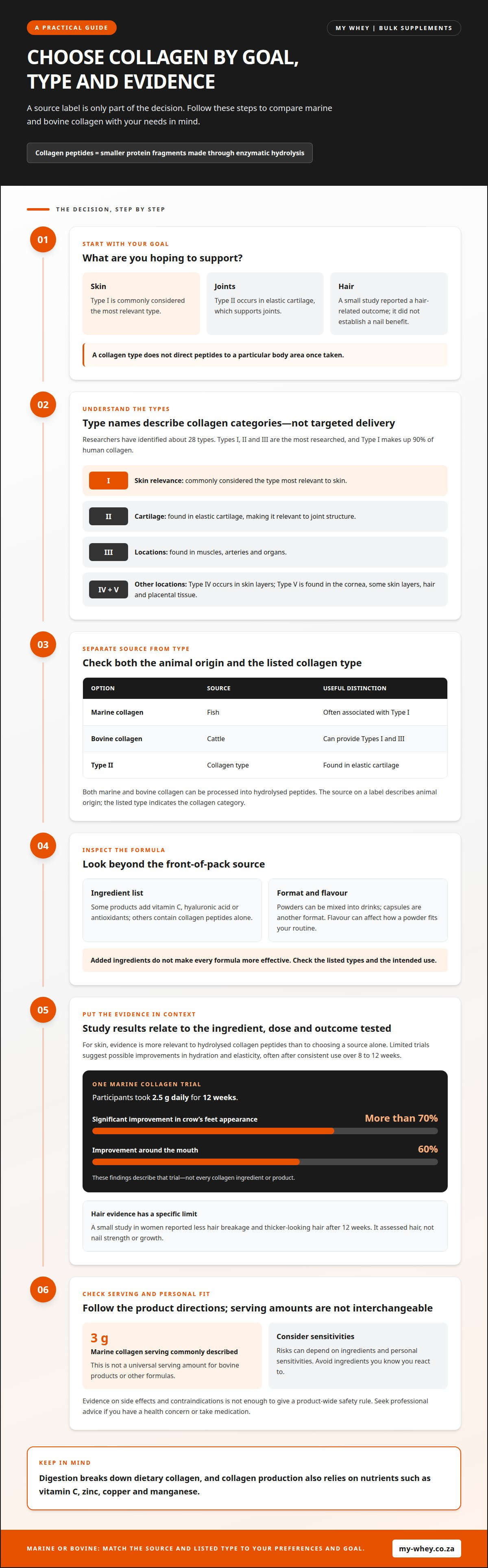
Researchers have identified about 28 collagen types, with Types I, II and III the most researched. Type I makes up 90% of human collagen and is commonly considered the type most relevant to skin; Type II occurs in elastic cartilage, which supports joints. Type III is found in muscles, arteries and organs. Types IV and V have distinct locations: IV occurs in skin layers, while V is found in the cornea, some skin layers, hair and placental tissue.
These locations help explain why collagen types are discussed in relation to skin elasticity, eyes, bones and wound healing. Type V’s presence in the cornea connects it with eye tissue, while Type II’s location in cartilage makes it relevant to joint structure. A supplement’s collagen type does not mean its peptides are directed to a particular body area.
Collagen types and sources
Marine collagen comes from fish, while bovine collagen comes from cattle. Both can be processed into hydrolysed peptides, so source and collagen type are separate considerations. Marine products are often associated with Type I, while bovine products can provide Types I and III. The source on a label describes the animal origin; the listed type indicates the collagen category.
Collagen-rich foods and supplements aren’t interchangeable with intact collagen in the body. Digestion breaks down dietary collagen, and collagen production also relies on nutrients such as vitamin C, zinc, copper and manganese.
| Option | Source | Useful distinction |
|---|---|---|
| Marine collagen | Fish | Often associated with Type I |
| Bovine collagen | Cattle | Can provide Types I and III |
| Type II collagen | Collagen type | Found in elastic cartilage |
Choose a supplement by matching its source and listed collagen type to your dietary preferences and primary goal.
Should I Take Collagen Supplements?
A supplement may be worth considering for a defined goal, but evidence varies by collagen form and outcome. Before deciding, look at the ingredient studied, the dosage and the limits of the research.
Research on wrinkles and collagen
Studies have examined hydrolysed collagen peptides for skin elasticity and wrinkles. In one trial, participants took 2.5g of hydrolysed marine collagen daily for 12 weeks. More than 70% had a significant improvement in crow’s feet appearance, while 60% showed improvement around the mouth. These results relate to that trial, not every collagen ingredient or product.
Evidence for skin health
For skin health, hydrolysed collagen peptides have more relevant evidence than choosing a source alone. Limited trials suggest possible improvements in skin hydration and elasticity, often after consistent use over 8 to 12 weeks. Type I is commonly linked with skin, but research findings don’t establish that every Type I supplement performs alike. A study in healthy older adults reported improved atherosclerosis markers with 2.5 grams daily; The study authors (not identified in the research fact) reported this finding.
Ingredients, formats and flavours
Read the full ingredient list, not just the collagen source. Some supplements add vitamin C, hyaluronic acid or antioxidants, while others contain collagen peptides alone. Powders can be mixed into drinks; capsules offer another format, and flavours affect how a powder fits your routine. Added ingredients don’t make every formula more effective. For flavour options, explore supplement flavour systems.
Dosage, risks and contraindications
Marine collagen is commonly described at a 3-gram daily serving, but follow the product directions rather than assuming doses are interchangeable. Bovine products and other formulas may use different serving amounts. Evidence on side effects and contraindications isn’t enough here to give a product-wide safety rule. Risks can depend on ingredients and personal sensitivities; avoid ingredients you know you react to, and seek professional advice if you have a health concern or take medication.
Marine or bovine collagen: which one to choose?
Choose according to your main goal and the collagen type, rather than the source alone. Evidence relating to skin, joints and hair concerns specific collagen types or studies.
Marine collagen for skin, hair and nails
Marine collagen is often chosen for skin-focused use, where Type I is usually considered the most relevant type. Research on skin and joint health most strongly supports Types I, II and III, but findings depend on the outcome measured. A small study in women reported less hair breakage and thicker-looking hair after 12 weeks of collagen supplementation.
That finding about hair doesn’t establish the same effect for nails. Use the study’s actual outcome to set expectations: it assessed hair, not nail strength or growth.
Collagen for skin and joint support
For skin, Type I is usually considered the leading choice; for joints, Type II’s location in elastic cartilage makes it a relevant type to consider. Research discussed for skin and joint health centres on Types I, II and III. Bovine collagen can provide Type II, while marine and bovine sources differ by origin as well as the collagen types they contain.
If both skin and joint support matter to you, focus on the formula’s listed types and intended use. Collagen peptides are used by the body wherever needed, rather than being directed specifically to the skin or joints.
Skin-focused collagen formulas
Assess a skin-focused formula by its collagen type and the outcome addressed by the evidence, such as skin elasticity. Type I is usually considered best for skin, but the source label alone doesn’t tell you which types a product contains. Check the ingredient information instead of choosing marine or bovine collagen by name alone.
For hair, the small 12-week study offers a specific example, while its findings don’t establish a nail benefit. Match the product’s stated focus to your goal: skin, joints, hair or nails.
Decision guide: For skin, prioritise Type I; for joint considerations, look at Type II and cartilage. If hair is your focus, note the limited study’s 12-week timeframe and hair-specific outcome. For nails, don’t treat hair findings as proof. Choose the source and formula that align with your preference and the type relevant to your goal.
Collagen peptide sources and amino acids
Marine and bovine collagen differ by animal source, but peptides are defined by processing and protein composition. Collagen peptides contain more than 90% protein, so the amino acid profile is central to understanding what the ingredient contributes. The source identifies origin; it doesn’t change the fact that collagen is a protein made from amino acids.
Collagen contains 19 different amino acids, and collagen peptides contain 8 of the 9 essential amino acids. Oral collagen supplements usually contain two or three amino acids. These statements describe different aspects of the ingredient: the broader amino acid profile of collagen and the amino acids present in a supplement. They don’t mean a collagen product supplies all the essential amino acids.
Peptides are shorter fragments than intact collagen proteins. This distinction helps when reading labels: “collagen peptides” describes the processed ingredient, while “marine” or “bovine” identifies its source. A powder may list collagen peptides as its main ingredient, but its format alone doesn’t reveal its amino acid profile or intended use.
Read the label in sequence. First, identify the source, such as fish-derived marine collagen or bovine collagen. Next, look for “collagen peptides” and review the ingredients for added components. Finally, compare the serving information and format with how you plan to use the product. For example, a flavoured powder may suit mixing into a drink, while an unflavoured option can be easier to add to food.
Dietary protein sources differ in their amino acid make-up, so collagen peptides shouldn’t automatically replace other protein foods. Consider the rest of your diet and your reason for taking a supplement. Hydration and skin elasticity are possible research outcomes, but the source name alone doesn’t establish a result.
If you’re comparing standalone amino acid options, explore amino acid supplements as a separate part of your nutrition choices.
My Whey
My Whey offers products across several nutrition categories to help you make considered supplement choices. This article compares collagen sources and evidence; use those points to decide whether collagen suits your goals before adding a supplement to your routine.
If you’re also reviewing your wider nutrition, My Whey offers Creatine Monohydrate, Whey Protein Concentrate 80%, Omega 3 Softgels and Amino Acids. These are distinct products, not substitutes for marine or bovine collagen. Their relevance depends on your own dietary priorities and the role you want a supplement to play.
Keep the decision practical: identify your goal, consider the evidence for the ingredient, and choose products that fit your routine. For questions about My Whey’s supplement range, contact My Whey.
Make your next choice with clarity
Let your goal guide your next step. Before choosing a supplement, decide what matters most, then use the product’s source, collagen type and ingredient list to judge whether it fits. The best type of collagen to take is not simply the one with the most appealing label; it’s the option that matches your preferences and the evidence relevant to your goal.
Keep your wider nutrition routine in view, too. My Whey offers a range of supplements, including Creatine Monohydrate, Whey Protein Concentrate 80% and Omega 3 Softgels. These are separate options for different nutrition priorities, not collagen substitutes.
If you’d like to discuss your collagen questions as you consider your options, contact My Whey about collagen. Take a considered approach, choose what aligns with your needs, and move forward with confidence.
Frequently Asked Questions
What is the most effective collagen to take?
There isn’t one option that is most effective for every goal. The best type of collagen to take depends on whether you’re prioritising skin or joint support, and on the collagen type and form studied. Hydrolysed peptides have been researched for skin hydration and elasticity, while research also suggests possible benefits for knee osteoarthritis symptoms. Study results don’t establish that every supplement will have the same effect.
What are the three main types of collagen?
Types I, II and III are the three most researched types. Type I is the most abundant in the body; Type II is associated with cartilage, while Type III occurs in muscles, arteries and organs. These distinctions can help you interpret a product label, but the type alone doesn’t show how a particular supplement will affect you. Consider its intended use alongside the supporting evidence.
Can I tell if my body’s collagen level is decreasing?
You can’t reliably measure collagen levels from appearance alone. Changes in skin or comfort can have different causes, so they don’t identify collagen levels by themselves. Age provides general context: Type I collagen levels begin to decline around age 25, and collagen production naturally declines after 60. These are broad patterns, not a way to determine an individual’s collagen level.
What can I do to improve skin collagen loss to slow the signs of ageing?
Help protect skin collagen from ultraviolet damage by using sunscreen with SPF 30 or higher. Collagen production also requires nutrients including vitamin C, zinc, copper and manganese, so include sources of these in a balanced diet. These steps support protection and normal production; they can’t promise to reverse visible ageing. Consider them alongside, rather than as a replacement for, your usual skin-care routine.
What happens to collagen as I age?
Collagen production changes over time. Type I collagen levels begin to decline around age 25, and production naturally declines in everyone after 60. Women also experience a significant reduction after menopause. These age-related changes vary between people; the figures describe general patterns, not a precise forecast of skin, joint or tissue changes for an individual.
Which collagen type is best supported for joint pain and osteoarthritis?
Type II collagen is most closely linked with cartilage, making it relevant to joint support. Limited randomised controlled trials suggest collagen peptides may help relieve pain and improve joint function in people with knee osteoarthritis. That evidence doesn’t show that all collagen supplements work alike. Check whether a product identifies its collagen type and consider the evidence for the specific joint outcome you’re interested in.