

Proprietary Blends in Supplements: Ingredient Order and Dosing Concerns
A proprietary blend can list its ingredients without revealing how much of each it contains. Understanding proprietary blends in supplements starts with this distinction: the label may show the blend’s total amount, while leaving individual ingredient quantities undisclosed.
That can leave you unsure whether an ingredient is present in a meaningful amount or how it fits alongside other supplements or medicines. Ingredient order may indicate relative weight, but it does not reveal any ingredient’s precise dose.
This guide explains what proprietary blends are, how ingredient order works and why undisclosed quantities can complicate comparisons and decisions about potential interactions. You’ll learn what to check on a label and when greater transparency may matter, so you can judge what the available information does, and does not, tell you.
Key Takeaways
- A proprietary blend groups ingredients under one label entry, so the total blend amount may be clearer than each ingredient’s individual dose.
- Ingredient order can offer a clue to relative amounts, but it does not reveal precise quantities.
- Compare the blend’s total weight with its ingredient list to judge how much dosing detail the label provides.
- Undisclosed amounts can make it harder to assess overlap or possible interactions with medicines and other supplements.
Ingredient order on supplement labels
Ingredient order may offer a limited clue about relative weight, but not precise doses. Read it alongside the blend’s total weight and the full label.
Ingredient order and blend weight
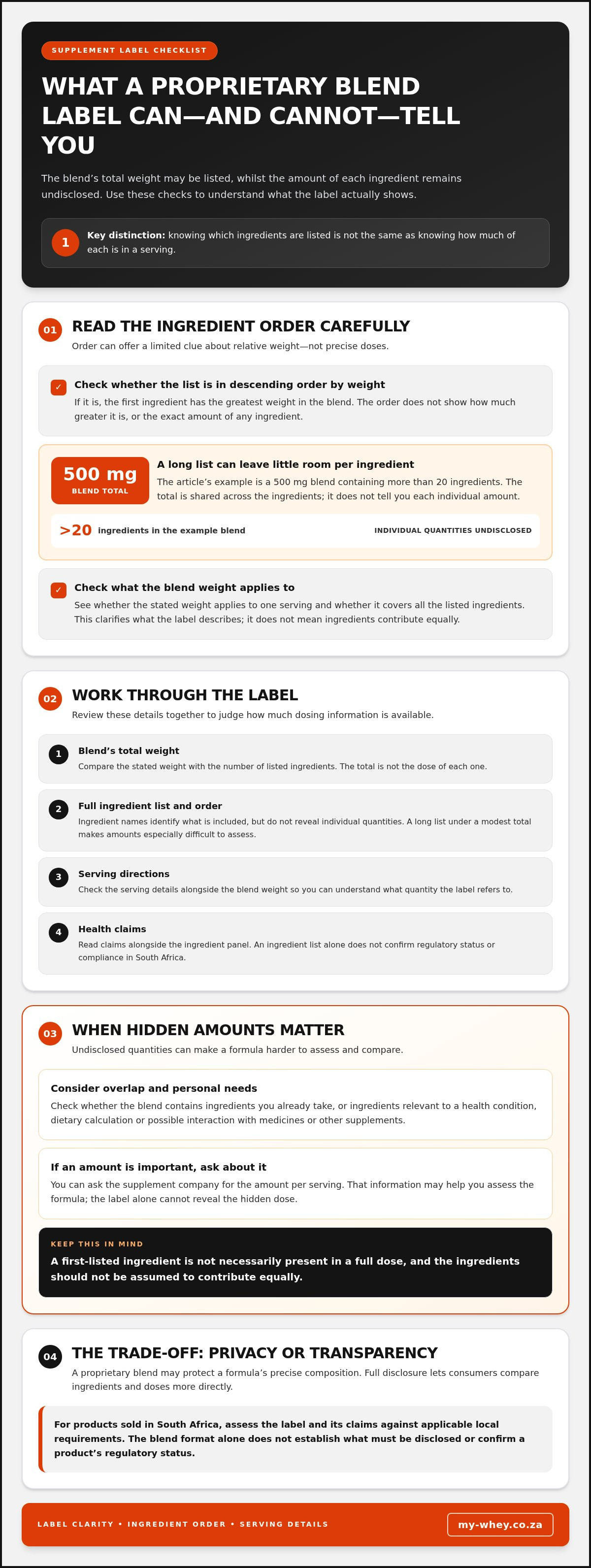
Where a label lists blend ingredients in descending order by weight, the first ingredient has the greatest weight in the blend. The sequence doesn’t reveal how much greater it is, or the exact amount of any ingredient. This matters when a blend has a long list and a small total weight. For example, a 500 mg blend containing more than 20 ingredients may leave little room for each ingredient.
In South Africa, ingredient order alone does not establish how SAHPRA regulates a product or its health claims. Assess the product and its label claims; an ingredient list by itself does not confirm regulatory status or compliance.
Before buying, read the full label for the blend’s total weight, listed ingredients, serving directions and health claims. Consider whether that information is enough to assess the product in light of your needs, medicines or health concerns.
Assessing undisclosed ingredient amounts
A blend’s total weight is shared across its ingredients; it is not the dose of each one. Compare the stated weight with the ingredient list and its order. This shows how much dosing information the label provides, but it cannot reveal individual amounts. When a long list sits under a modest total weight, it is especially difficult to tell how much of each ingredient a serving contains.
Undisclosed amounts can make it harder to assess whether a blend suits your needs. If an ingredient matters because of a health condition, dietary calculation or possible interaction, ask the supplement company for its amount per serving. That information may help you assess the formula, but the label alone cannot tell you the ingredient’s dose.
Check whether the blend weight applies to one serving and whether it covers all the listed ingredients. These details clarify what the label describes, but do not mean the ingredients contribute equally or that the first-listed ingredient is present in a full dose.
What Is Proprietary Blend?
A proprietary blend groups several supplement ingredients under one label entry without disclosing the amount of each. This format can affect how easily you compare products and assess a formula’s transparency.
How proprietary blends appear on labels
A label may give a blend a collective name, such as “herbal complex”, followed by its constituent ingredients. This identifies what the formula contains, but not each ingredient’s dose. Even a complete ingredient list may not provide enough information for a meaningful comparison between products. For products sold in South Africa, assess the label and claims against applicable local requirements; the blend format alone does not establish what must be disclosed.
Label dressing and ineffective doses
Label dressing can make a formula appear comprehensive through a long ingredient list, while individual quantities remain unclear. Ingredient names alone don’t show whether their amounts are useful for the product’s intended purpose. For example, a hypothetical blend of 15 ingredients totalling 7,000 mg could allocate 6,999 mg to its first ingredient. NSF, USP and Informed Choice certifications indicate independent testing for quality, purity and label accuracy. Testing information adds context, but doesn’t reveal a hidden ingredient amount.
Blend trade-offs and labelling rules
A proprietary blend may protect the precise composition of a formula, while full disclosure lets consumers compare ingredients and doses more directly. That is the central trade-off: formula privacy versus transparency. For South African products, read the ingredient panel and claims carefully, and don’t treat the presence of a blend as proof that its individual amounts are disclosed. Ingredient identification and quantity disclosure are separate details to consider when assessing a label.
Compare product information with the label you’re assessing by exploring supplement options and details.
What proprietary blends are
A proprietary blend is a named group of dietary ingredients presented together as one component of a supplement formula. The label may state the blend’s total amount without disclosing individual quantities. A name such as “Active Superfood Complex” describes a grouped entry, not a specific dose or guaranteed effect. The practical distinction is between knowing which ingredients are listed and knowing how much of each a serving contains.
Blend names often suggest an intended role, such as antioxidant support or digestive health. Treat that wording as a description of the formula’s positioning, not proof that the ingredients achieve a particular outcome. For example, a label example lists an Active Superfood Complex at 6.5 grams, while an Antioxidant Greens Blend is listed at 1.7 grams. Those totals describe the blends, not the amount of any single ingredient.
A separate example lists a Dairy-Free Probiotic Blend at 40 mg and 8 billion CFU. These are different kinds of information: milligrams state a mass, while CFU describes colony-forming units. The entry illustrates why consumers should read the complete label and serving details. A blend’s name alone cannot tell you whether its contents match your dietary needs or the particular ingredient amounts you intended to use.
Assess the full ingredient panel, serving directions and claims together. Note whether a blend contains ingredients you already take, then consider whether the label gives enough detail to make that comparison. A protein product and a botanical formula may both contain blends, but their ingredients serve different purposes. Understanding a formula’s intended role helps you interpret its label without assuming a longer list means a better fit.
Potential interactions and dosing concerns
A proprietary blend can make dosing harder to assess because individual ingredient amounts are hidden. This limits your ability to judge potency, efficacy and safety, particularly if a powder overlaps with a vitamin, medicine or another supplement. Ingredient order may show relative weight, but not the exact dose needed to assess that overlap.
Look for ingredients that may duplicate other sources. Caffeine is one example: check whether an energy or focus blend adds to caffeine from drinks or other products. Yohimbe and phenethylamines are also stimulants that feature in supplement safety concerns. If you take medication, have an underlying health condition, or are pregnant or breastfeeding, discuss a new supplement with a qualified healthcare professional. Individual responses vary, so another person’s routine is not a reliable guide to dosing.
There’s a practical efficacy concern, too. A creatine example contrasts 100 mg, stated not to affect athletic performance, with 2,000+ mg, stated to affect it. The point is that ingredient presence alone doesn’t establish a useful dose. Clinical evidence relates to defined ingredients and amounts; an undisclosed blend can make it difficult to compare its contents with those studied.
Whey isolate and whey concentrate are distinct ingredient descriptions, not interchangeable terms. Compare each product’s serving information and stated protein amount rather than assuming the powder’s form tells you its full nutritional contribution. The same applies to a blend containing protein alongside other ingredients: assess the full label and your dietary needs, not just the front-label claims.
For a straightforward comparison, review supplement ingredient details and consider how each label fits your needs.
My Whey: Creatine Monohydrate
My Whey offers Creatine Monohydrate for readers considering a named ingredient rather than a multi-ingredient blend. If creatine is what you’re looking for, compare the product label and serving directions with your needs before choosing.
That distinction keeps the decision focused. A product centred on a named ingredient can make it easier to understand what you’re considering, though the label remains essential for details such as serving information. My Whey also offers Whey Protein Concentrate 80%, Omega 3 Softgels and Amino Acids for different supplement interests.
Visit my-whey.co.za to explore My Whey’s supplement range.
Make your next supplement choice with confidence
Let your goals guide your next label review. Before choosing a formula, decide which ingredient or nutritional need matters most, then consider whether the product information supports that choice. Understanding proprietary blends in supplements helps you make more deliberate comparisons without treating a long ingredient list as proof of suitability.
If you’re considering Creatine Monohydrate, Whey Protein Concentrate 80% or Omega 3 Softgels, My Whey offers these options for different supplement needs. Bring a specific question about a label or ingredient to the conversation, and focus on the details that affect your decision.
Ask My Whey about supplement labels and take your next step with greater clarity.
Frequently Asked Questions
What is a proprietary blend in a dietary supplement?
A proprietary blend is a named mixture of dietary ingredients presented as one component of a formula. For example, a label might group several botanical ingredients under “herbal complex”. The name describes the mixture, not necessarily its exact proportions or the amount of every ingredient. Separate the blend’s stated purpose from the information the label provides about its composition.
How are ingredients listed in a proprietary blend on supplement labels?
Labels may show a collective blend name followed by its ingredients. Read the complete entry, including the order, serving directions and any amounts printed nearby. Unless the label explains how the sequence is arranged, do not use it to calculate ingredient quantities. For a South African product, base your interpretation on the information provided on its label.
Do supplement companies have to disclose the amount of each ingredient in a proprietary blend?
The term “proprietary blend” does not, by itself, establish that a company is exempt from South African labelling requirements. Look for a stated amount for each ingredient rather than treating the blend’s total weight as an individual dose. If a quantity matters to your dietary planning or health, rely on information that clearly identifies the ingredient and amount per serving.
How can you assess whether a proprietary blend contains effective ingredient doses?
Compare an ingredient’s stated amount with credible evidence for that ingredient and its intended use. Check that the label’s serving size matches the amount you’re assessing, and distinguish the blend’s total weight from individual quantities. If the quantities are not itemised, the label alone cannot establish whether each ingredient provides an effective dose.
What are the health risks and interactions associated with proprietary blend supplements?
Unclear ingredient quantities can make it harder to assess overlap with medicines, health conditions or other supplements. Before using a product, list the supplements and medicines you already take, including combination products, and check for repeated ingredients. A qualified healthcare professional can assess possible interactions in the context of your health and treatment.
How can you spot misleading or underdosed proprietary blends?
A long ingredient list does not prove that a blend is misleading or underdosed, but it can make the available dose information harder to assess. Look for a clear serving size, specific ingredient quantities and claims supported by the label’s details. Avoid drawing conclusions from a blend name or prominent front-label claim alone; neither establishes the amount of each ingredient.