

Protein Intake for Muscle Gain: How Much Should You Eat
More protein doesn’t automatically mean more muscle. For muscle gain, a practical daily target is 1.6-2.2 grams of protein per kilogram of body weight, alongside regular resistance training; a protein intake calculator for muscle gain can help translate that range into a personal target.
It makes sense to focus on protein: your body uses it to build and repair muscle tissue. But pushing intake higher isn’t a shortcut to bigger gains. In trials lasting 13 weeks on average, higher protein intake was associated with about 0.3 kg of additional muscle gain, making consistent training and an appropriate overall diet important parts of the picture.
Here, you’ll learn how to estimate your daily protein target, spread it across meals and account for calories while aiming to build muscle. You’ll also see what the evidence suggests about the additional muscle higher protein intake may support, so you can set a practical target without assuming that more is always better.
Key Takeaways
- Use your body weight and training goal to set a daily protein target that suits you, rather than relying on a one-size-fits-all number.
- Spread protein across meals to make your daily target easier to meet and support muscle repair throughout the day.
- Expect protein to support, not replace, consistent resistance training; higher intake alone doesn’t guarantee extra muscle growth.
- When aiming to gain muscle, consider how your overall calorie intake supports training and recovery, as well as how much protein you eat.
How does protein help you build muscle?
Protein provides amino acids that the body uses to build and repair muscle tissue. Resistance training supplies the stimulus for muscle growth, while dietary protein and sufficient energy support the body’s response.
Protein recommendations for adults and active people
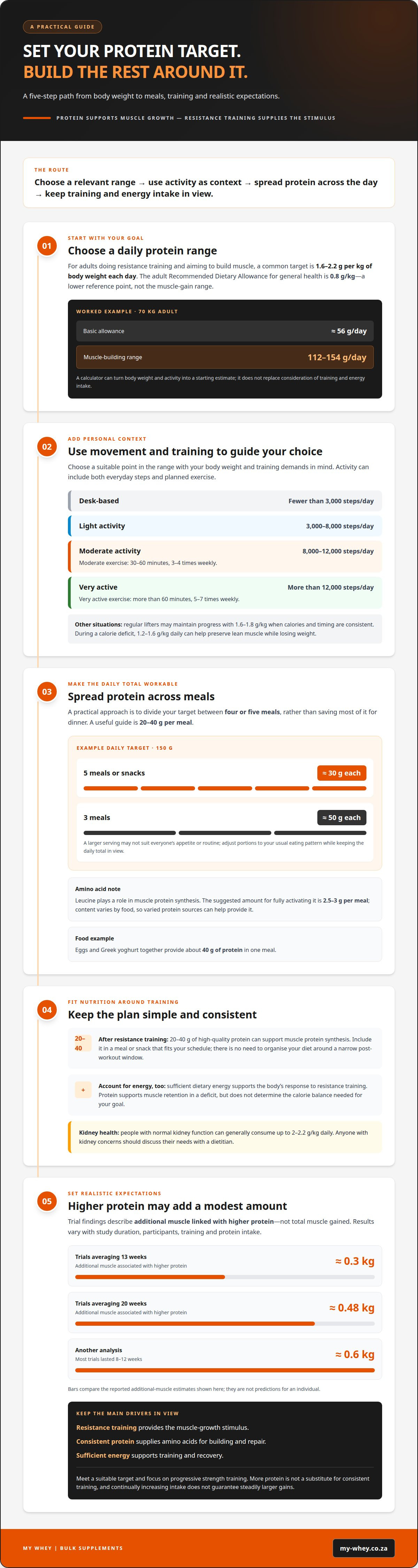
Protein recommendations describe how much daily protein adults may need for health or training goals. The adult Recommended Dietary Allowance is 0.8 grams per kilogram of body weight; muscle gain targets are higher. Adults doing resistance training commonly use 1.6-2.2 grams per kilogram daily. Choosing a suitable point in that range helps set a practical target that reflects body weight and training demands.
Assess activity level using both everyday movement and planned exercise. Desk-based activity is fewer than 3,000 steps daily; light activity is 3,000 to 8,000. Moderate activity is 8,000 to 12,000 steps, while very active means more than 12,000. Exercise frequency adds context: moderate exercise is 30-60 minutes, 3-4 times weekly, and very active exercise exceeds 60 minutes, 5-7 times weekly.
For example, a 70 kg adult’s basic allowance is around 56 grams daily. Applying the muscle-building range gives 112-154 grams daily. A protein intake calculator for muscle gain uses body weight and activity to estimate a starting point, not a substitute for considering training and energy intake.
Protein needs for different lifters and calorie deficits
Protein needs can vary with age and training experience, and adequate intake alongside resistance training may support muscle growth. Regular lifters can often maintain progress with 1.6-1.8 grams per kilogram when calories and timing are consistent. These ranges help individuals tailor protein requirements to training experience rather than assuming every lifter needs the highest target.
During a calorie deficit, a target of 1.2-1.6 grams per kilogram daily can help preserve lean muscle while losing weight. Compare this with a muscle-gain target, then account for the reduced energy intake. Protein supports muscle retention, but it doesn’t replace resistance training or determine the calorie balance needed for the goal.
Protein distribution across meals
Meeting your daily protein target is only one part of a muscle-building nutrition plan. Spreading protein across meals gives your body regular opportunities to use amino acids for muscle repair and recovery. A practical approach is to divide your target between four or five meals instead of saving most of it for dinner.
A serving of 20-40 grams of protein per meal is a useful guide for stimulating muscle protein synthesis. Leucine, an amino acid found in protein foods, plays a role in this process; the suggested amount for fully activating it is 2.5-3 grams per meal. The exact leucine content varies by food, so a balanced diet with varied protein sources can help provide it.
For a daily target of 150 grams, five meals or snacks could each provide about 30 grams. If you prefer three meals, the same total works out to approximately 50 grams per meal. That larger serving may not suit everyone’s appetite or routine, so adjust portions around your usual eating pattern while keeping the overall daily amount in view.
After resistance training, 20-40 grams of high-quality protein can support muscle protein synthesis. Include it in a meal or snack that fits your schedule; there’s no need to organise your entire diet around a narrow post-workout window. The daily total and a pattern you can maintain matter more than a complicated timetable.
For example, eggs and Greek yoghurt together provide about 40 grams of protein in one meal. Other meals can draw on different dietary sources, helping keep nutrition varied. People with normal kidney function can generally consume up to 2-2.2 grams per kilogram daily; anyone with kidney concerns should discuss their needs with a dietitian. If a convenient protein source helps you meet your meal target, explore protein options.
Expected additional muscle gain from higher protein intake
Higher protein intake can support muscle growth, but the additional gain is usually modest. Randomised controlled trials lasting 13 weeks on average associated higher protein intake with about 0.3 kg of additional muscle. Trials lasting 20 weeks on average found about 0.48 kg of additional gain. These figures describe added muscle linked with higher protein, not total muscle gained.
Another analysis found about 0.6 kg of additional muscle in trials, most of which lasted 8-12 weeks. The estimates differ because studies vary in duration, participants, training and protein intake. They are useful for setting expectations, not for predicting an individual result. A kilogram of body weight gained is also not necessarily a kilogram of new muscle.
Protein provides amino acids used to build and repair muscle tissue after strength exercise. For people under 65, consuming at least 1.6 grams per kilogram of body weight each day alongside strength training helped increase muscle mass. That finding supports adequate protein as part of a training plan; it does not show that continually increasing intake produces steadily larger gains.
When interpreting the evidence, distinguish protein’s contribution from the effect of training. A muscle-building plan needs regular resistance exercise, sufficient dietary energy and protein consistently throughout the day. If training is inconsistent, extra protein cannot replace the strength stimulus. And if your intake already meets your needs, increasing it further may add little. Sports nutrition targets offer a starting point, while training quality and recovery also shape results.
The practical takeaway is to meet a suitable daily target and focus on progressive strength training, rather than chasing the highest possible intake. Trial results suggest that higher protein intake can support a small additional amount of muscle over weeks, not transform gains overnight. Track your training and body-composition trends over time. Daily scale changes include water and other tissues, not just muscle.
Does protein intake differ for beginners, advanced lifters, or people in a calorie deficit?
Training experience, weekly workload and calorie intake all affect the protein target that suits you. Beginners can make progress with a consistent resistance-training routine and adequate daily protein. The aim is to support muscle growth, not assume that more protein automatically means faster results. Start with a target suited to your body weight and goal, then keep your training and meals consistent.
Advanced lifters, bodybuilders and athletes training five or more days weekly may benefit from higher protein intake. Regular lifters can often maintain progress around 1.6-1.8 grams per kilogram daily when calorie intake and timing are consistent. Training volume matters: demanding sessions create more recovery needs than a lighter schedule. A higher target still needs to fit the person’s overall diet and energy intake.
A calorie deficit changes the priority. The goal is to lose body fat whilst preserving lean muscle, so protein becomes especially relevant alongside strength training. A practical range is 1.2-1.6 grams per kilogram of body weight daily. For a 68 kg person, that works out at about 82-109 grams. The lower end gives a starting estimate; body weight and training routine help determine where the target sits within the range.
For example, a 75 kg lifter training regularly might use 1.6 grams per kilogram, or 120 grams daily, as a working target. Someone eating less energy to lose weight could calculate a different amount from the deficit range. Use a protein intake calculator for muscle gain to estimate grams from body weight, then consider whether the goal is building or preserving muscle. Keep resistance training in the plan; protein alone doesn’t provide the stimulus for muscle growth.
If a convenient protein source would help you meet your target, explore protein options to support your nutrition routine.
My Whey: Whey Protein Concentrate 80%
My Whey’s Whey Protein Concentrate 80% offers a convenient way to add protein when meals alone don’t fit your routine or make your daily target difficult to meet. It can complement a balanced diet, but it isn’t essential if you already get enough protein from food.
Use it to support your nutrition plan, not replace resistance training, varied meals or sufficient energy intake. First work out your daily protein goal, then consider whether a supplement would make it easier to reach. Your overall intake matters more than relying on a single product.
If you’d like to discuss whether Whey Protein Concentrate 80% fits your routine, contact My Whey.
Build a routine you can sustain
Use a protein intake calculator for muscle gain as a starting point, then make your plan practical. Choose meals you enjoy, keep a simple record of your training and eating, and notice whether your routine feels manageable over time. Consistency is more useful than an elaborate plan that is difficult to maintain. If your schedule or appetite changes, reorganise your meals while keeping your training goals in view.
Supplements can be one option within that routine. My Whey offers Whey Protein Concentrate 80%, Creatine Monohydrate and Omega 3 Softgels. Each has a different place in a broader nutrition plan, so consider what fits your needs rather than adding products without a clear purpose.
If you’d like support choosing an option that suits your routine, contact My Whey. Keep your next step simple, consistent and aligned with the training you can sustain.
Frequently Asked Questions
Can You Consume Too Much Protein?
Yes, regularly consuming far above your needs can be a concern. Intake exceeding 3-4 grams per kilogram of body weight daily may be associated with potential problems, particularly for people with pre-existing kidney issues. Very high protein intake can also displace other foods and contribute to nutrient imbalances. Focus on meeting a suitable target rather than increasing protein without a clear reason.
How much protein after exercise?
A serving of 20-40 grams of protein after resistance exercise is a practical amount to include in your recovery meal or snack. For example, if training ends before your usual lunch, make lunch protein-rich rather than adding an unnecessary extra meal. Your overall daily intake still matters, so consider how this serving fits your meals across the rest of the day.
How much protein per meal?
Aim for about 20-40 grams per meal as a useful guide. If your daily target is difficult to reach in three large servings, divide it across four or five meals and snacks instead. For instance, add a protein-rich snack between meals rather than trying to make dinner cover most of the day’s requirement. Choose portions that suit your appetite and routine.
Protein Calculator: How Much Protein Do I Need Per Day?
Multiply your body weight in kilograms by a daily target that reflects your goal. For muscle gain, 1.6-2.2 grams per kilogram gives the calculation range. A person weighing 60 kg would calculate 96-132 grams daily. Treat the result as a planning estimate, then choose a target within the range that fits training frequency and your usual food intake.
How Much Protein After Workout?
Plan for 20-40 grams of protein after a workout, using food or a convenient protein source that fits your day. A meal within an hour or two can contribute to muscle repair and growth. You don’t need to let a missed immediate snack disrupt your routine; return to your normal meal pattern and meet your overall daily target.
How Much Protein Do I Need Daily?
For muscle gain alongside regular resistance training, use 1.6-2.2 grams of protein per kilogram of body weight daily as a practical range. If your weight is 75 kg, that works out to 120-165 grams. The lower or higher end depends on your goal, activity and eating pattern. Spread the amount across meals so it’s manageable to meet consistently.