

Rhodiola rosea for mental fatigue: energy, effects and timing
Rhodiola rosea may feel energising, but it isn’t simply a herbal version of caffeine. Research on rhodiola rosea for mental fatigue suggests it may help some people manage tiredness and stress, but results vary and there’s no guarantee of an immediate lift. Its mildly stimulating effect also means timing can matter.
If mental fatigue is making work, study or daily tasks harder, it’s understandable to look for support. You want to know whether rhodiola could help you feel more alert, not just hear broad claims about energy.
This guide explains what the evidence suggests about mental fatigue and stress, how soon effects may appear, when people commonly take rhodiola, and which side effects or precautions to consider. It also explains why rhodiola is best viewed as a possible support, not a substitute for sleep or appropriate care for ongoing fatigue.
Key Takeaways
- Rhodiola may help with stress-related mental fatigue, but study results vary. Read what the evidence suggests before treating it as a reliable energy boost.
- Some research has reported changes over days or weeks, so learn what study timelines can and can’t tell you about when effects may appear.
- Because rhodiola may feel stimulating, taking it earlier in the day may suit you better than taking it near bedtime.
- Consider possible side effects and interactions before use; the National Center for Complementary and Integrative Health describes rhodiola as possibly safe for use for up to 12 weeks.
Can Rhodiola Rosea Help You Cope Better with Stress?
Research on rhodiola and stress includes both longer-term daily use and single-dose studies. The study conditions shape what the findings can tell us about stress-related fatigue.
Stress-Related Mental Fatigue
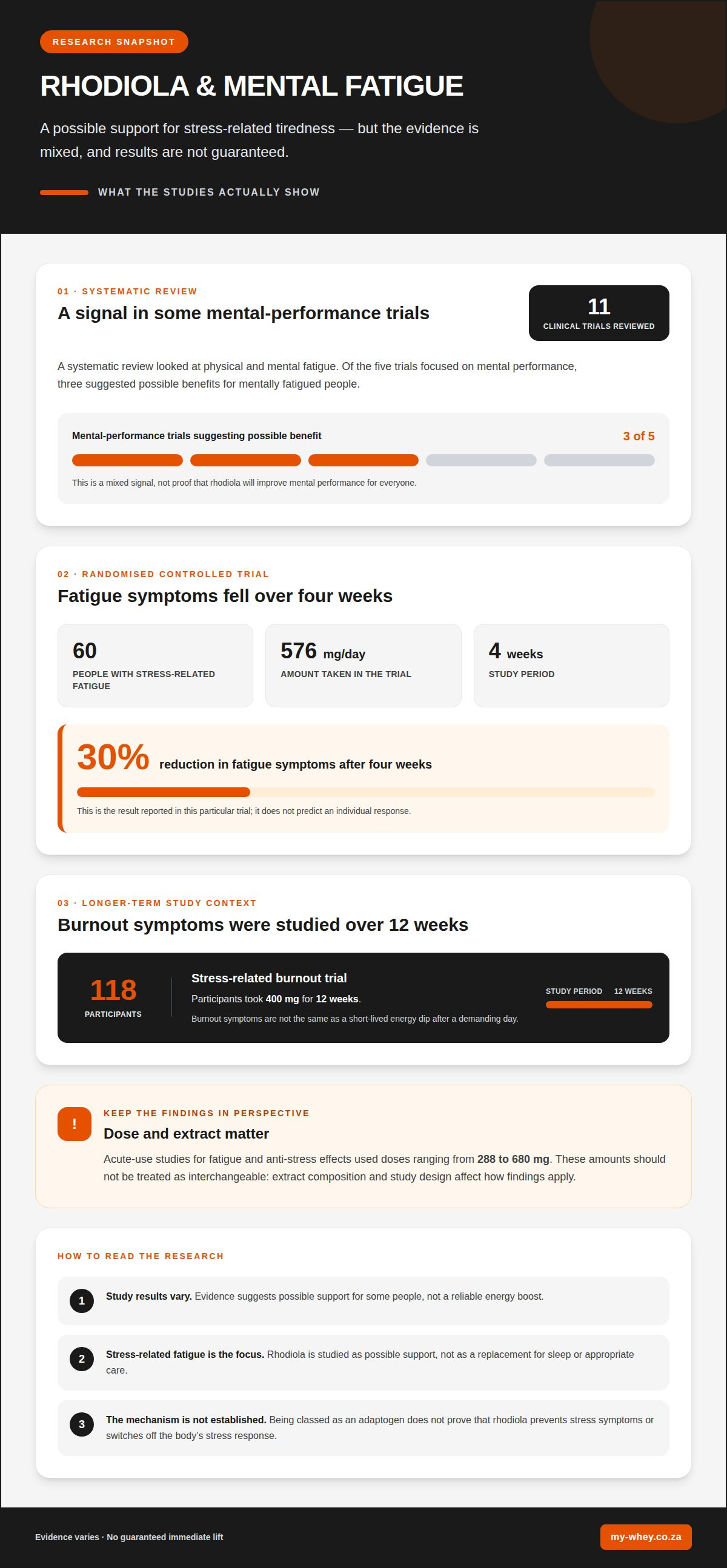
Stress-related mental fatigue is cognitive tiredness that develops alongside ongoing stress. It can make concentration, recall and everyday decisions feel harder. Rhodiola is studied as a possible support for these symptoms, not as a replacement for sleep or appropriate care. A trial assessed 118 people with stress-related burnout. Participants took 400 mg for 12 weeks. This gives useful context: burnout symptoms differ from a short-lived energy dip after a demanding day.
Evidence for Fatigue and Stress Reduction
The evidence includes studies of both longer-term use and acute doses. A systematic review examined 11 clinical trials on physical and mental fatigue. Three of five mental-performance trials suggested possible benefits for mentally fatigued people. A randomised controlled trial included 60 people with stress-related fatigue. They took 576 mg/day for four weeks, and fatigue symptoms fell 30% after four weeks. Acute use for fatigue and anti-stress effects has involved doses ranging from 288 to 680 mg. These amounts shouldn’t be treated as interchangeable: extract composition and study design affect how results apply. Rhodiola root contains more than 140 active ingredients, so the effects of one compound may not represent every extract.
Adaptogens and the Stress Response
Adaptogens are plants studied for their relationship with the body’s response to stress. Rhodiola belongs to this group, but the label describes a research category, not proof that it prevents stress symptoms. The hypothalamic-pituitary-adrenal (HPA) axis connects brain signals with adrenal hormone release during stress. This system helps coordinate the body’s response; it isn’t a switch an herb can simply turn off. Findings on fatigue don’t establish a specific HPA mechanism. Note which symptoms you want to address, and discuss supplement use with a healthcare professional if they persist or affect daily life.
Are there any side effects of taking Rhodiola?
Rhodiola’s safety depends on the extract, dosage and your health context. The National Center for Complementary and Integrative Health describes Rhodiola as possibly safe for use for up to 12 weeks. That statement doesn’t establish safety for longer use or every person.
Standardised extracts commonly contain 3% rosavins and 1% salidroside. Studies have examined 200 to 600 mg/day of standardised extract, whilst capsules or tablets commonly contain 100 to 200 mg of extract. These figures describe different things: the amount per capsule is not necessarily the full daily dosage. Check the serving instructions and the standardised content, rather than comparing capsule weights alone. A higher extract amount does not automatically mean a better match for your needs.
Standardisation identifies target levels of particular ingredients; it doesn’t show that every product has identical quality. Rhodiola is also called arctic root, but that common name doesn’t tell you its rosavin or salidroside content. People who are pregnant or breastfeeding are advised against using it because clinical safety data are limited. Speak with a healthcare professional before taking it if you use medication or manage a health condition, especially if you take medicines that affect neurotransmitters.
Is Rhodiola rosea registered or regulated as a supplement in South Africa? The information here doesn’t establish its registration status in South Africa. A standardised extract label describes ingredients, but doesn’t prove local registration.
For broader plant-based supplement options, explore herbal supplements. If you’re considering rhodiola, keep the extract, daily amount, duration and any medicines in view when discussing it with a healthcare professional.
How long does rhodiola take to work for mental fatigue?
There’s no single clinical timeline for rhodiola’s effects on fatigue. Studies measured outcomes over different periods, from a single dose to several weeks. This means an early energy shift and gradual changes in concentration aren’t the same outcome. Although some findings are encouraging, the evidence doesn’t establish a standard time to feel benefits.
For chronic fatigue symptoms, an open-label study gave 100 people 400 mg daily for eight weeks. Participants reported improvements in concentration. Because the study was open-label, it can’t show how results compare with a placebo. Its eight-week duration also describes the study period, not a promise that everyone needs that long to notice a change.
Mood research uses different groups and measures. A 12-week study involving 57 people with depression compared rhodiola with sertraline and placebo. A separate study of 89 people with mild-to-moderate depression used 340-680 mg/day for six weeks. In a 12-week combination study, participants taking two rhodiola capsules with sertraline reported the greatest mood improvement. These findings concern depression treatment, not a guaranteed timeline for stress-related mental fatigue.
Cognitive outcomes have also been tested separately. In a four-week study, healthy active men taking 600 mg/day improved one simple reaction-time measure by 9.5%. Reaction time is not the same as memory, concentration or daily mental stamina. Results from one cognitive test therefore can’t establish how quickly a person will notice broader changes.
Study design matters when judging these timelines. An open-label trial lacks a placebo comparison, while a change measured in one task may not reflect everyday functioning. Dose, extract and the outcomes researchers track also differ between studies. Track the symptom you want to change, such as concentration during work, and note how it changes over time. Persistent fatigue deserves assessment, since rhodiola studies don’t identify every cause or explain hormone-related symptoms.
Rhodiola and mental fatigue
Rhodiola research examines more than general energy: some studies assess alertness and mental performance under pressure. This distinction matters because feeling energised during exercise doesn’t necessarily mean clearer thinking through a demanding workday. Rhodiola is also called golden root, but its traditional name doesn’t establish how it affects each person.
For a practical example, 100 nursing students used Rhodiola extract during exams. They reported improved alertness, less mental fatigue and better exam performance. This suggests possible relevance when mental demands are high, though the study doesn’t prove the same effects for every student or workplace. Exam performance also reflects more than alertness alone.
A separate placebo-controlled study involved 161 military cadets experiencing sleep deprivation. Both Rhodiola dose groups improved the antifatigue index compared with placebo, with no clear advantage for the higher dose. The setting is important: sleep deprivation creates a specific strain, so these results don’t show that Rhodiola can replace adequate sleep or address every cause of ongoing tiredness.
Extracts can differ in their ingredients, including rosavins, and standardisation helps describe what a product contains. It doesn’t prove that an extract will improve mental fatigue. Rhodiola may also feel stimulating, so an energising effect isn’t always useful, particularly if it disrupts rest. Focus on the outcome that matters to you, such as staying alert during study, rather than assuming a general energy claim means better concentration.
Exercise studies add another useful distinction. In a crossover trial, 24 participants took a single 200 mg dose one hour before an endurance test; the trial reported improved exercise performance and lower perceived exertion. That finding concerns physical effort, not mental fatigue. For support focused on concentration and mental performance, explore cognitive support options alongside the evidence and your personal needs.
My Whey
My Whey offers a range of supplements to support a considered approach to energy and wellbeing. Rhodiola research can be difficult to interpret, so keep the distinction clear: study findings don’t make a supplement a substitute for addressing persistent fatigue or seeking appropriate health advice.
For broader nutrition goals, My Whey offers Creatine Monohydrate, Whey Protein Concentrate 80%, Omega 3 Softgels and Amino Acids. These are different supplement categories, not replacements for rhodiola or treatments for mental fatigue. Choose based on your wider nutrition needs rather than expecting one product to resolve every cause of low energy.
If you’d like help exploring the available supplement options, contact My Whey.
Choose your next step with confidence
If you’re considering rhodiola rosea for mental fatigue, start with a clear goal: decide what you want to support in daily life, such as staying focused through a work task or feeling less mentally drained. This makes it easier to judge whether a supplement fits your wider routine, rather than expecting it to solve every source of low energy. Consider sleep, workload and persistent symptoms alongside any supplement.
Supplement choices should match your priorities, not just a broad promise of energy. If you’re exploring options for your wider nutrition needs, discuss your supplement choices with My Whey. Take an informed, steady approach and choose the next step that makes sense for you.
Frequently Asked Questions
Does rhodiola rosea give you energy like caffeine?
No. Rhodiola is a plant extract, not caffeine, although it can feel stimulating. That doesn’t make the two interchangeable: the study findings discussed here don’t directly compare their effects. If you’re considering rhodiola for an afternoon slump, remember that feeling stimulated doesn’t prove your focus has improved or replace addressing what’s causing your tiredness.
What are Rhodiola rosea’s main benefits?
Research has examined Rhodiola for fatigue, stress symptoms, mood and mental performance. In one trial, adults taking 200 mg twice daily for four weeks reported improvements in fatigue, mood and quality of life. These are outcomes studied in particular groups, not benefits that apply equally to everyone. Consider the symptom you want to address and whether the study outcome matches it.
Can rhodiola replace sleep?
No. Rhodiola doesn’t replace sleep or remove the effects of sleep loss. A study involving 161 military cadets examined performance during sleep deprivation, but improved measures in a study setting don’t mean the supplement provides the restorative role of sleep. If tiredness continues despite adequate rest, consider other possible causes rather than relying on a stimulating supplement to push through.
What’s the difference between rhodiola and other adaptogens like ashwagandha?
Both are plants commonly described as adaptogens, but that label doesn’t mean they have identical effects. The findings discussed here concern rhodiola, so they can’t establish how ashwagandha compares for fatigue, stress or concentration. Don’t assume evidence for one applies to the other. If you take medication or manage a health condition, discuss herbal supplements with a healthcare professional.
What evidence supports Rhodiola rosea for mental fatigue?
Evidence includes a systematic review of 11 clinical trials on physical and mental fatigue. Three of five trials assessing mental performance suggested possible help for mentally fatigued participants. A separate observational study involving over 1,100 participants reported reduced stress-associated symptoms within three days. These findings offer context, but differences in study design and outcomes make them difficult to treat as one consistent result.
What dose of Rhodiola rosea has been studied for mental fatigue?
Studies have used different amounts, depending on the extract and outcome. For example, one trial examined 200 mg twice daily for four weeks, while another assessed 576 mg/day in people with stress-related fatigue. These study doses aren’t a personal recommendation. Extract standardisation, medicines and health conditions matter, so discuss a suitable approach with a healthcare professional before starting a supplement.