

Spend Less on Supplements in South Africa with Online Discounts
To learn how to save money on supplements in South Africa, compare the full checkout cost, including delivery, and use online discounts or coupons when they lower the total. If a healthy, balanced diet covers your nutritional needs, one multivitamin a day rather than two may also help a bottle last longer.
Supplement costs can add up, so it makes sense to look beyond the product’s displayed price. This guide explains how to compare online offers, use coupons, assess free-shipping deals and think carefully about whether a multivitamin fits your routine. You’ll come away with practical ways to manage your spending without buying more than you need.
Key Takeaways
- Compare the final checkout total, not just the advertised price, and weigh coupon savings against delivery costs.
- Use the same product size and serving basis when comparing pharmacies, supermarkets and online stores.
- Buying in bulk can make sense when you’ll use the product; a multivitamin taken once daily could make a bottle last up to four months.
- If creatine is part of your supplement routine, My Whey offers Creatine Monohydrate as an option to consider.
Finding online discounts, coupons and free shipping
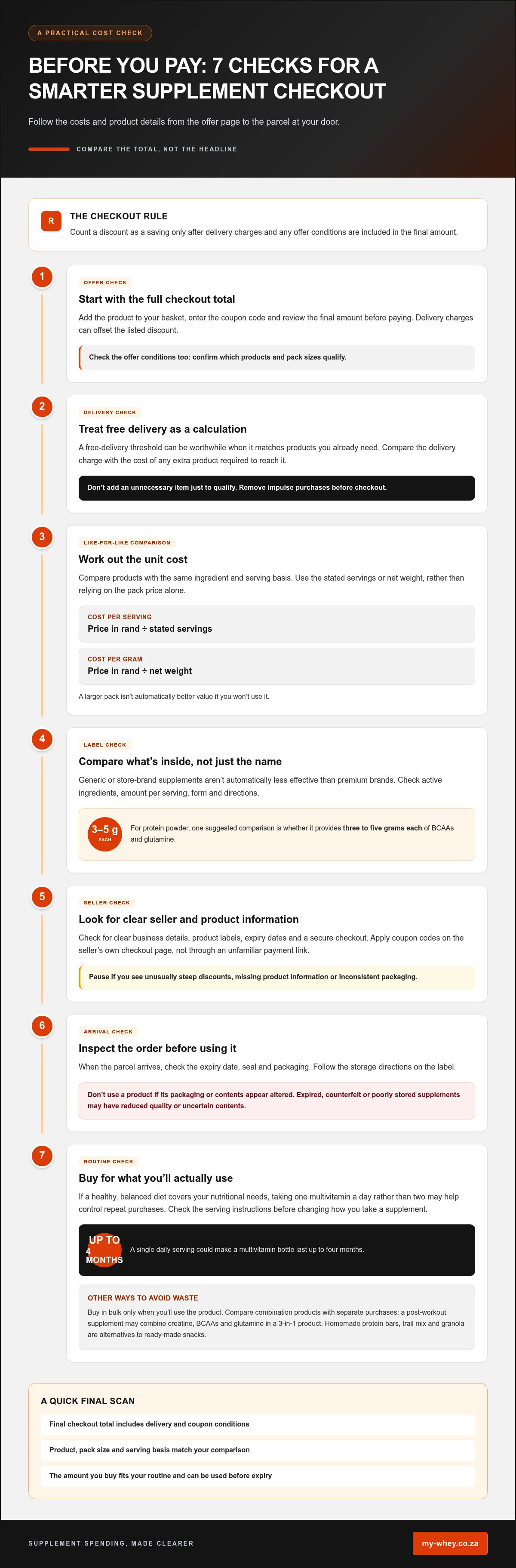
Compare the checkout total, not the advertised discount. A coupon may reduce the listed price, but delivery charges can offset the saving. Add the product to your basket, enter the code and review the final amount before paying. Check the offer’s conditions, including which products and sizes qualify.
Free delivery can be worthwhile when the order threshold matches products you already need. Don’t add an unnecessary item just to reach it. Compare the delivery charge with the cost of the extra product, and remove impulse purchases before checkout.
To compare cost per serving or gram, divide the product’s price in rand by its stated servings or net weight. Compare products with the same ingredient and serving basis; a larger pack isn’t automatically better value if you won’t use it.
Generic or store-brand supplements aren’t automatically less effective than premium brands, but the label matters more than the name. Compare the active ingredients, amount per serving, form and directions. For protein powder, one suggested comparison is whether it provides three to five grams each of BCAAs and glutamine.
To assess an online seller, look for clear business details, product labels, expiry dates and a secure checkout. Apply coupon codes on the seller’s own checkout page, not through an unfamiliar payment link. Treat unusually steep discounts, missing product information or inconsistent packaging as reasons to pause.
Expired, counterfeit or poorly stored supplements may have reduced quality or uncertain contents. Check the expiry date, seal and packaging when an order arrives. Follow the storage directions on the label, and don’t use a product if its packaging or contents appear altered.
If a balanced diet covers your nutritional needs, taking one multivitamin a day rather than two may help control repeat purchases. A single daily serving could make a bottle last up to four months. Check the serving instructions before changing how you take any supplement.
Also compare combination products with separate purchases. A post-workout supplement combining creatine, BCAAs and glutamine in a 3-in-1 product may consolidate ingredients. Homemade protein bars, trail mix and granola are other ways to avoid paying for ready-made snacks.
How do supplement prices compare across South African pharmacies, supermarkets and online stores?
There isn’t one cheapest shop for every supplement. Compare the same product, pack size and serving directions across pharmacies, supermarkets and online stores. Weigh the shelf price against delivery or travel costs and the quantity you’ll use. A lower price per tub may still cost more overall if the pack is larger or includes ingredients you don’t need.
At a pharmacy, check the label and pack size in person before deciding. This makes it easier to compare the stated serving amount and ingredients directly. Include the cost of travelling to the shop if you’re making a special trip. A convenient location can matter if it avoids an extra journey or delivery charge.
Supermarkets can be practical for products stocked with regular groceries. Compare price per serving, not just the shelf price. For example, divide each tub’s price by its stated number of servings, keeping the ingredient and serving size consistent.
Online stores make it easier to compare product details, pack sizes and delivery terms. But shipping and any free-delivery threshold affect the total. Add the product to your basket and compare the checkout amount with the in-store option. Count a discount as a saving only after reviewing the final total.
Use a simple comparison note on your phone. Record the product name, active ingredients, pack weight, servings, shelf or checkout total, and delivery or travel cost. For powders, compare cost per gram; for capsules or tablets, compare cost per serving. This helps keep differences in pack size from disguising the better-value option.
Choose the store that offers the best fit for your routine, not simply the lowest headline figure. If you’re comparing products online, use the same checklist to review supplement information alongside pack details and checkout costs.
Which South African supplement brands offer good value for money?
No single South African brand offers the best value across every supplement category. Your choice depends on the product, its labelled serving, ingredient information and how consistently you’ll use it. Compare products within the same category, such as protein powder with protein powder, rather than treating different products as equivalent.
Start with the label, then assess the brand. Check that it clearly states the ingredients, serving directions, net quantity and expiry date. For herbal supplements, look for the named plant ingredients and the amount per serving. Vague product descriptions make it harder to compare what you’re paying for.
Use this checklist when comparing two South African brands:
- Match the product type. Compare like with like, such as creatine with creatine or herbal supplements with herbal supplements.
- Review the ingredient details. Check the ingredient names and amounts shown on each label.
- Calculate usable quantity. Divide the pack quantity by the stated serving amount to understand how many servings it provides.
- Include the purchase conditions. Compare the final checkout total, delivery charge and any coupon terms.
- Consider your routine. A large pack is poor value if you won’t finish it before its expiry date.
Two protein powders may look similar but differ in serving size, ingredients or servings per pack. Compare those details before deciding one is a bargain. Likewise, compare herbal products only when their ingredients and serving information match.
Brand reputation alone doesn’t show whether a product suits your needs or offers good value. Compare product details with your intended use. Avoid products with unclear labels, missing expiry information or claims that don’t explain what they contain. This helps you compare options without paying extra for packaging or promotional language.
Bulk supplements in South Africa: cost and waste tips
A larger pack is better value only if its usable contents cost less and you finish them before expiry. Compare the total quantity with the amount you use each time, then consider whether your routine will use the full pack. A bulk discount has little value if you discard some unused.
Before choosing a larger size, review your recent buying pattern. If you regularly finish the same supplement and its ingredients suit your needs, buying more at once may reduce repeat delivery charges or shopping trips. If you’re trying a product for the first time, a smaller pack can limit waste if you don’t continue using it.
Use these steps to assess a bulk purchase:
- Check the expiry date. Make sure your expected use fits comfortably within the product’s stated date.
- Calculate servings. Divide the pack quantity by the labelled serving amount, then compare with your usual routine.
- Review storage directions. Keep the container as directed on its label, and close it properly after use.
- Include delivery. A bulk pack’s lower unit cost may be offset by shipping or an unnecessary extra item.
Store supplements according to their label directions. If the label calls for cool, dry storage, avoid leaving the product in direct sunlight, a hot vehicle or a damp place. Keep it in its original container so the product information and expiry date remain available, and don’t transfer it into an unlabelled jar.
Keep a simple stock note on your phone with the product name, opening date and expiry date. Check it before reordering to avoid duplicate purchases. If someone else in your household uses the same product, agree on one container and note when it was opened. Use the oldest suitable pack first.
Bulk buying works best for products already established in your routine, not impulse additions. Explore supplement options and choose a pack size that fits your regular use and storage space.
My Whey: Creatine Monohydrate
If you’ve decided to include creatine in your routine, compare My Whey’s Creatine Monohydrate with your needs and budget. Review the product information and pack quantity, then consider how much you’ll use before choosing a size. My Whey is a bulk supplier of premium quality supplements and vitamins, with bulk pricing.
My Whey also offers Whey Protein Concentrate 80%, Omega 3 Softgels and Amino Acids. Focus on the category that matches your requirements, rather than adding products simply because they appear in the same catalogue. A clear shopping list can keep your order centred on supplements you actually plan to use.
Explore My Whey’s Creatine Monohydrate and compare the product details with your routine and budget.
Make your next supplement choice count
A practical approach to how to save money on supplements in South Africa starts with deciding what you genuinely intend to use. Before ordering, note the product category you need and the label details that matter to you. This helps you choose based on your needs, rather than adding products because a promotion makes them seem appealing.
If creatine is on your list, My Whey offers Creatine Monohydrate. Its range also includes Whey Protein Concentrate 80% and Omega 3 Softgels. Focus on the product that fits your requirements, then assess its information and purchase terms against your budget.
For help considering your supplement options, contact My Whey for supplement advice. A considered choice is a stronger starting point for a routine you can manage with confidence.
Frequently Asked Questions
Which South African supplement retailers offer the best prices and discounts?
No South African retailer is always the cheapest across every supplement category. Compare the product and quantity you need, then consider order terms and delivery costs. My Whey is a bulk supplement supplier, which may suit shoppers comparing bulk options. Choose based on the product details and total purchase conditions, not simply the largest advertised discount.
How can shoppers use loyalty programmes, coupons and sales to save on supplements in South Africa?
Use loyalty rewards, coupons and sales only for products you already planned to buy. To save money on supplements in South Africa, note the usual product and pack you buy, then compare the promotion’s final checkout total with that baseline. Read coupon conditions, including exclusions and expiry dates, and check whether rewards combine with sale pricing before ordering.
Which supplements are worth buying, and which can be replaced by food or are unnecessary?
Choose supplements that fit your routine and compare their ingredients, servings and expiry date. If a balanced diet covers your nutritional needs, one multivitamin a day rather than two may be enough; homemade protein bars, trail mix and granola can replace ready-made snacks.