

Supplements for Getting Lean and Defined: Which to Choose
The best supplements for getting lean and defined aren’t a shortcut around training: protein supports muscle growth, while strength training provides the stimulus. For most people aiming to build muscle, a useful daily protein target is about 1.2 to 1.6 grams per kilogram of body weight alongside strength training. A protein shake can help you reach that target when food alone falls short.
It makes sense to look for a supplement that can speed up fat loss, but the best supplements for getting lean and defined depend on your goals and routine. This article explains how protein can help you meet your daily intake, what caffeine may contribute to exercise performance, and why strength training matters. You’ll also learn how creatine fits in, so you can focus on practical choices rather than hype.
Key Takeaways
- Use a whey shake as a convenient way to support muscle recovery and help meet your daily protein needs.
- Set your protein target around your body weight and strength-training routine, then use supplements to fill practical gaps.
- Consider caffeine for exercise performance, but don’t treat it as a substitute for a sound nutrition and training plan.
- Pair consistent strength training with suitable supplements such as creatine to support progress towards a leaner, more defined physique.
1. What is the best protein shake for lean muscle gains?
For many people, whey protein is a practical shake choice because it supplies protein that supports muscle repair and growth. In a 10-week trial involving recreational bodybuilders, the whey group gained approximately 9 pounds more lean muscle mass and lost nearly 3 pounds more body fat than the comparison group. Those results came alongside training, not from a shake alone.
Whey protein supplies protein that supports muscle protein synthesis, the process involved in muscle repair and building after exercise. Have a shake after training if a meal isn’t convenient, or use it to help meet your daily protein needs. Your overall nutrition and consistent strength training remain central to progress.
Evidence also links 20–40 g/day or more of whey protein over 8–12 weeks with increases in lean body mass and strength, alongside decreases in fat mass. The best serving for you depends on how much protein your meals already provide. For example, a shake can fill a gap after a low-protein meal.
Combining supplements doesn’t automatically improve results. In one study, adding 5 g of glutamine and 3 g of branched-chain amino acids (BCAAs) to 40 g of whey protein did not increase strength or muscle mass after a 10-week strength-training programme. Prioritise sufficient protein and training before adding multiple products.
For athletes in South Africa, whether an ingredient is banned or restricted depends on the ingredient and the rules for their competition. Check the full ingredient list against the relevant current prohibited list. A product category or claim on the front label doesn’t establish its status.
Protein powder, creatine and fat burners don’t have one standard price in South Africa. Pack size, serving count and formulation all affect comparisons. Check the amount per serving on the label rather than judging by tub size alone.
Risks depend on ingredients, dose and combinations; some products can cause unwanted effects, especially when stimulant ingredients are combined. Read the full ingredient and dosage panels, and look for clear third-party testing information. Buy from an established South African seller, and check that packaging is sealed and batch and expiry details are present to help identify questionable products.
2. Protein supplements and daily protein intake
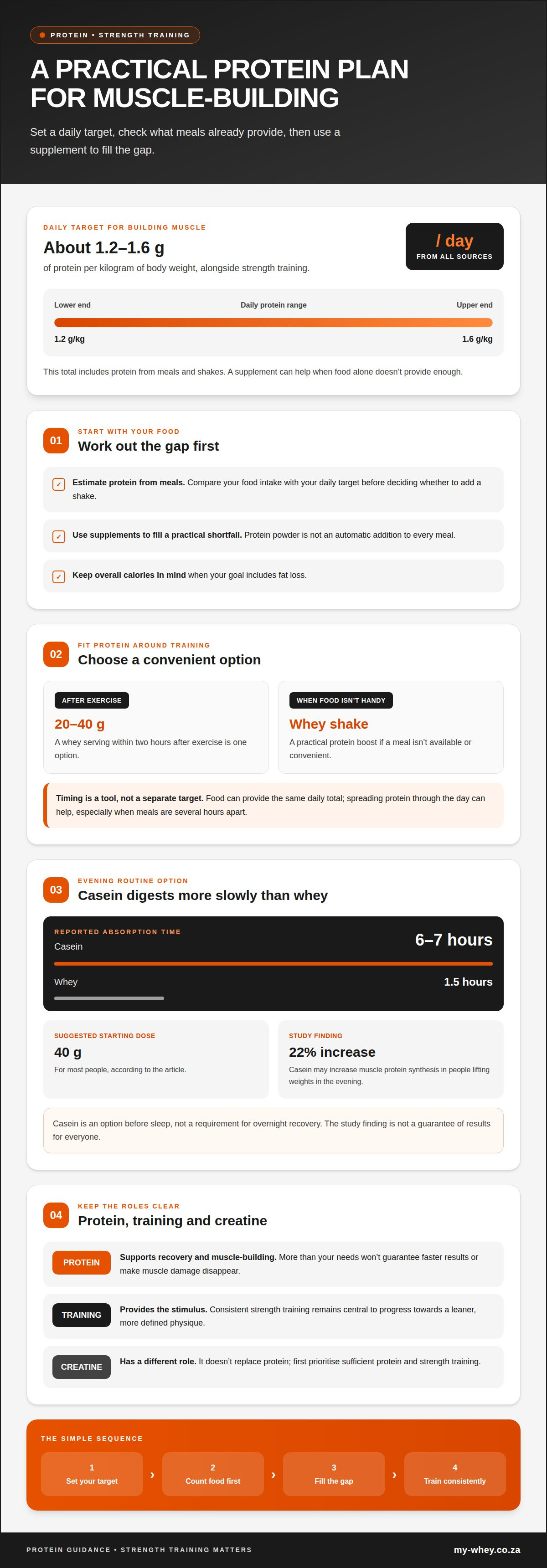
For building muscle, most people are advised to consume about 1.2 to 1.6 g of protein per kilogram of body weight daily, alongside strength training. This target includes protein from meals and shakes. A supplement is useful when food doesn’t provide enough, rather than an automatic addition to every meal. Consider your overall calorie intake too, particularly during fat loss.
Does protein powder help preserve muscle while losing fat, and how much protein is recommended? Protein powder can help you reach the daily target and support muscle retention alongside strength training. Aim for about 1.2 to 1.6 g per kilogram of body weight per day for muscle growth.
Timing can make protein easier to fit around training. A serving of 20–40 g of whey protein within two hours after exercise is one option. If a meal isn’t available, use a shake as a practical protein boost; otherwise, food can supply the same daily total. Spread protein through the day, especially when meals are several hours apart.
Casein offers a slower-digesting alternative for evening routines. It can take 6–7 hours to absorb, compared with 1.5 hours for whey. One study found casein may increase muscle protein synthesis by 22% in people who lift weights in the evening. A 40 g serving is suggested as a starting dose for most people. This makes casein an option before sleep, not a requirement for overnight recovery.
For a straightforward plan, estimate your daily protein from meals first, then use whey or casein to fill the remaining gap. Creatine serves a different purpose and doesn’t replace protein. Protein supports recovery and building muscle, but adding more than your needs won’t make muscle damage disappear or guarantee faster results. A whey protein option can provide a convenient way to supplement your nutrition.
3. Caffeine for exercise performance and weight loss
Caffeine is better understood as an exercise-performance aid than a stand-alone fat burner. The reported dose range for supporting strength and other exercise performance is 1.4–4 milligrams per pound of body weight. Your body weight therefore matters when interpreting a dose; a fixed amount won’t represent the same dose for everyone.
Does caffeine, green tea extract or another fat burner meaningfully increase fat loss? Caffeine may support training performance, while human trials suggest EGCG paired with caffeine may increase energy expenditure by an additional 4%. That finding concerns energy expenditure, not a 4% reduction in body weight, and doesn’t establish that a fat burner causes meaningful fat loss on its own.
Start by identifying your goal. If you want support for demanding workouts, caffeine’s role in exercise performance is more relevant than a product’s “fat-burning” label. If your priority is changing body weight, focus on how your overall nutrition supports that goal rather than expecting a stimulant to replace it. The amount of caffeine you consume and how you respond to it also matter.
Don’t confuse caffeine with protein or leucine: they have different roles. Caffeine is associated with exercise performance, while protein supplies amino acids used in muscle protein synthesis. Caffeine alone doesn’t provide the building blocks needed to increase muscle mass. Evidence about energy expenditure also doesn’t establish a specific hormone change or prove that caffeine prevents muscle loss during weight reduction.
Keep the evidence in proportion. A 4% additional energy-expenditure finding for EGCG paired with caffeine is a specific result, not a promise of a particular weight change. Treat caffeine as a possible training aid, not the foundation of a leaner physique. A consistent workout and appropriate nutrition remain central; adding several fat burners together doesn’t follow from the evidence described here.
4. Combining supplements with strength training
Strength training gives supplements a useful context: muscles need a training stimulus and recovery to adapt. Studies cited on creatine report 2–4 pounds of extra lean muscle mass after 4–12 weeks of training with supplementation. Creatine can complement a structured programme, but it doesn’t replace progressive resistance work, appropriate nutrition or recovery between sessions. The best supplements for getting lean and defined support a plan you can follow consistently.
Choose supplements for a defined purpose. A 2025 systematic review found better strength and power outcomes with beta-alanine doses of 4 to 6.4 g per day, split into small doses and combined with high-fatigue training. However, a review of 20 studies concluded beta-alanine is unlikely to improve body composition, whether used alone or with resistance training. Strength and physique outcomes aren’t interchangeable, so match a supplement to the result you’re targeting.
Amino acids aren’t a guaranteed route to muscle growth. One small study found BCAA supplements didn’t produce significant gains in postmenopausal women after 8 weeks of resistance training. Essential amino acids are a different option: the suggested amount is 5–9 g before and/or following resistance exercise. Avoid stacking products without a clear reason.
Beyond supplements, follow a consistent strength-training programme, progressively challenge your muscles and plan meals to support training and recovery. To get lean, manage calorie intake alongside protein-rich nutrition. For definition, aim to preserve muscle while reducing body fat. The best supplements for getting lean and defined support these fundamentals, they don’t replace them.
Keep your plan simple: choose a training schedule you can sustain, track performance, and adjust nutrition to match your goal. Use supplements only when they serve a clear role in that plan. Explore support for your training routine as you decide which options fit your approach.
My Whey: Herbal Supplements
My Whey offers supplement options to complement a nutrition and strength-training plan. If you’re working towards lean muscle, Whey Protein Concentrate 80% can help you add protein to your routine, while Creatine Monohydrate is another option to consider alongside resistance training. Amino Acids, Omega 3 Softgels and herbal supplements are also available for people exploring different supplement categories.
Choose a supplement to address a specific need, rather than adding products without a clear purpose. Protein may help if you find it difficult to meet daily needs through meals; creatine may suit someone looking for a training supplement. Both belong alongside consistent training and appropriate nutrition, not in place of them.
For a straightforward next step, contact My Whey to discuss its supplement options and find the category that fits your goals.
Make your next step count
Choosing the best supplements for getting lean and defined starts with a clear priority, not a longer product list. Decide whether you need help meeting protein intake, support for your strength-training routine or a more focused nutrition plan. Then choose one relevant step and build it consistently into your routine, rather than changing several things at once.
My Whey offers Whey Protein Concentrate 80%, Creatine Monohydrate and Omega 3 Softgels. These are options to consider in the context of your own goals and existing habits. A supplement can complement a considered plan, but it doesn’t replace training or balanced nutrition.
If you’d like help considering which supplement category fits your goals, contact My Whey for supplement advice. Take the next step with a clear purpose, and build your routine steadily.
Frequently Asked Questions
What is the best protein shake for lean muscle gains?
Whey protein is a convenient option for adding protein around training. Choose one that fits your dietary needs and helps you meet your overall protein target, rather than judging it by flavour or marketing claims alone. If your post-workout meal is delayed, for example, a shake can be a straightforward option until you can eat.
How does creatine help muscle growth?
Creatine increases the creatine available in muscle and supports repeated high-intensity efforts such as weightlifting. This can help you maintain training quality across sets, giving your programme more opportunity to build strength and muscle over time. Consistent use matters more than treating creatine as an immediate pre-workout boost. It complements resistance training, but doesn’t replace a structured programme.
Which supplements have the strongest evidence for fat loss and muscle definition?
Protein and creatine play different roles: protein helps you meet intake needs, while creatine supports strength-training performance. Caffeine may aid exercise performance, but findings about energy expenditure don’t establish a substantial fat-loss effect. For a defined physique, prioritise sustainable training and nutrition, then use supplements to address specific needs.
Does creatine improve muscle definition, and can it cause water-weight gain?
Creatine can support strength and lean muscle gains during resistance training, which may contribute to a more defined appearance over time. It doesn’t directly reduce body fat, and changes in muscle water can affect scale weight. Track progress using more than one measure, such as training performance and how your clothes fit, instead of treating every scale change as fat gain.
What are the risks and side effects of common weight-loss and bodybuilding supplements?
Risks depend on ingredients, doses and combinations. Some supplements can cause unwanted effects, particularly when stimulant ingredients are combined. Read the full ingredient and dosage panels, and look for clear third-party testing information.