

Supplements to Support Adrenal Health: Evidence and Safety
What if a supplement promising to “reset” your adrenals offers more certainty than the science can support? The symptoms often labelled “adrenal fatigue”, including tiredness and poor sleep, are real, but “adrenal fatigue” isn’t a recognised medical diagnosis. That can make choosing supplements to support adrenal health confusing, especially when claims blur the line between general wellbeing and treating a disorder.
This guide separates adrenal fatigue claims from recognised conditions such as adrenal insufficiency, then looks at supplement ingredients, the outcomes studied and their safety limits. You’ll also learn why evidence about ashwagandha and stress doesn’t mean it treats an adrenal disorder, and when to speak with a health professional before taking a supplement.
These statements have not been evaluated by the Food and Drug Administration. This product is not intended to diagnose, treat, cure or prevent any disease. Always consult your health care provider before taking any supplements. Pregnant or lactating women, people with existing medical conditions, or people taking medications should consult their health care provider/s before taking any dietary supplement. Keep out of reach of children.
Key Takeaways
- Persistent fatigue or stress alone doesn’t show that your adrenal glands are not working properly.
- Compare supplements to support adrenal health by the outcomes studied, the limits of the evidence and the safety considerations.
- Research on ashwagandha and stress doesn’t establish it as a treatment for adrenal fatigue or adrenal insufficiency.
- Consider your symptoms, health conditions and medicines, then discuss supplement options with a healthcare provider.
- My Whey Ashwagandha Powder is organic, vegan and gluten-free, with purity tested by a third party. These statements have not been evaluated by the Food and Drug Administration. This product is not intended to diagnose, treat, cure or prevent any disease. Always consult your health care provider before taking any supplements. Pregnant or lactating women, people with existing medical conditions, or people taking medications should consult their health care provider/s before taking any dietary supplement. Keep out of reach of children.
Supplements to support adrenal health: what does the term really mean?
Persistent fatigue can affect work, relationships and daily routines. Ongoing stress can take a toll, too. Those experiences deserve attention, but neither symptom alone proves that your adrenal glands are damaged, depleted or functioning abnormally. “Adrenal health” is often used broadly in wellness marketing, so it helps to distinguish everyday wellbeing claims from a medical condition that needs diagnosis.
Your adrenal glands sit above your kidneys and produce hormones, including cortisol, which plays a role in the body’s response to stress. The overview of adrenal gland function provides useful background, but a general description of cortisol’s role cannot diagnose a health problem. Adrenal insufficiency is a recognised condition in which the glands don’t produce enough hormones. It requires clinical assessment. Symptoms or an online checklist aren’t enough to confirm it.
In brief: adrenal insufficiency is a medically diagnosed hormone deficiency; “adrenal fatigue” is a popular wellness label, not an established medical diagnosis.
Adrenal fatigue and adrenal insufficiency are not interchangeable
The Endocrine Society does not recognise “adrenal fatigue” as a medical diagnosis. The idea that chronic stress makes the adrenal glands “wear out” is not supported by consistent scientific evidence. That doesn’t mean a person’s tiredness or stress is imaginary. It means those experiences shouldn’t be explained as adrenal dysfunction without evidence. Adrenal insufficiency, by contrast, is a real disorder that requires assessment and appropriate medical care, not self-diagnosis or a supplement plan.
Why fatigue alone cannot identify the cause
Fatigue, changes in sleep and difficulty concentrating can have many possible causes. The same is true of digestive complaints: symptoms need context rather than an automatic assumption about one organ or system. For example, the gut health supplements guide discusses digestive supplements, but a supplement should not replace investigating persistent symptoms.
If symptoms are severe, persistent or getting worse, seek advice from a qualified healthcare professional. They can consider your health history and decide whether further assessment is appropriate. Don’t use “adrenal support” wording as evidence that you have adrenal insufficiency or as a reason to delay care. Supplements may be considered for general wellbeing, but they cannot diagnose or treat the cause of ongoing symptoms or replace medical assessment.
These statements have not been evaluated by the Food and Drug Administration. This product is not intended to diagnose, treat, cure or prevent any disease. Always consult your health care provider before taking any supplements. Pregnant or lactating women, people with existing medical conditions, or people taking medications should consult their health care provider/s before taking any dietary supplement. Keep out of reach of children.
Which supplements are discussed for adrenal health, and what does evidence say?
Supplement labels may group herbs, vitamins and minerals under “adrenal support”, but a shared label doesn’t mean the ingredients work in the same way. Ask a more specific question: has an ingredient been studied for a particular outcome, such as perceived stress, and does that evidence apply to adrenal function or a diagnosed disorder? Those are separate claims when weighing supplements to support adrenal health.
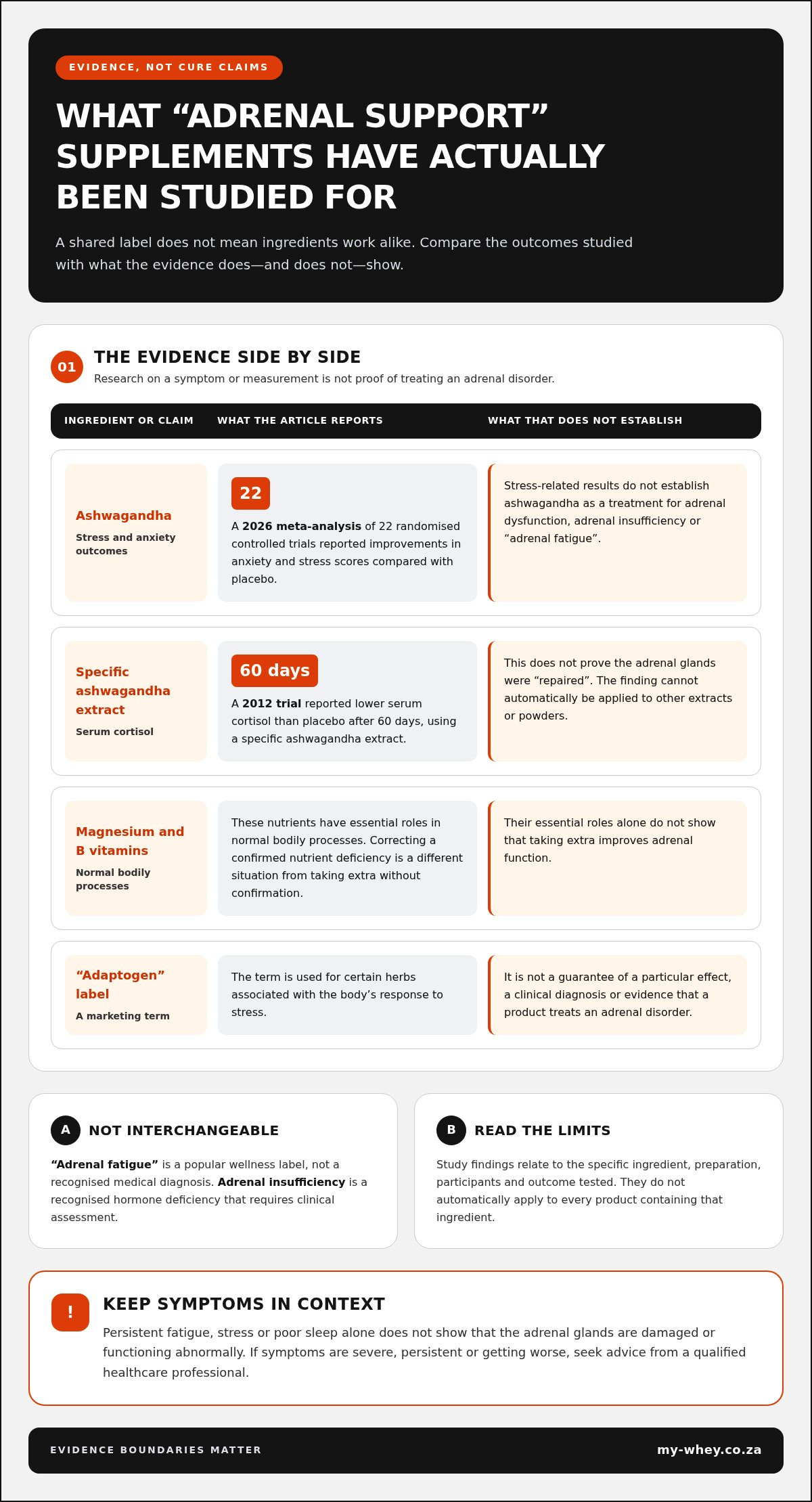
Research on symptoms can inform choices, but it cannot establish that a supplement treats adrenal insufficiency. Study results also relate to the specific ingredient, preparation, participants and outcome tested. They don’t automatically show that every product containing that ingredient has the same effect.
Ashwagandha and adaptogens: separate research from marketing
“Adaptogen” is a term used in supplement marketing for certain herbs associated with the body’s response to stress. It isn’t a guarantee of a particular effect or a clinical diagnosis. Human research on ashwagandha has examined stress and anxiety outcomes. A 2026 meta-analysis of 22 randomised controlled trials reported improvements in anxiety and stress scores compared with placebo. However, results from studies using different preparations and participants don’t establish a treatment for adrenal dysfunction.
A 2012 trial of a specific ashwagandha extract reported lower serum cortisol than placebo after 60 days. That finding is not proof that the adrenal glands were “repaired”, nor can it be assumed to apply to other extracts or powders. Evidence that an ingredient may affect a symptom does not establish that it treats an adrenal disorder. Research about stress-related outcomes is not evidence of curing “adrenal fatigue”.
Vitamins and minerals: context matters
Magnesium and B vitamins have essential roles in normal bodily processes, but that alone doesn’t show that taking extra will improve adrenal function. Correcting a confirmed nutrient deficiency is different from supplementing without a known need. Whether testing or supplementation makes sense depends on individual circumstances, diet, health and medicines. Don’t treat fatigue as proof of a deficiency or assume that a broad “adrenal” formula is right for everyone.
Don’t treat ingredient lists as a proven stack. Evidence that one ingredient affects stress can’t be combined with separate nutrient research to prove that a blend supports the adrenal glands. For broader supplement-literacy context, the omega-3 evidence guide illustrates why research on a nutrient’s general role shouldn’t be mistaken for evidence of adrenal treatment.
Compare each ingredient by the outcome studied, how closely the study preparation matches the product, and the safety questions that apply to you. My Whey’s supplement range includes Ashwagandha Powder. Consider it as an ingredient option for general wellbeing, not as a treatment for an adrenal condition. Ask a healthcare professional for guidance before using supplements if you have a medical condition, take medicines, are pregnant or are breastfeeding.
How to compare adrenal-support supplements without buying into a cure claim
Compare each ingredient with the specific outcome studied, not the broad promise on the front of a bottle. Evidence about stress, nutrient status or general wellbeing doesn’t establish that a supplement treats adrenal insufficiency. A study of one preparation also doesn’t prove that a different product, dose or blend will have the same effect.
A practical evidence-and-safety comparison
Use this table to guide questions, not as a prescription. Safety can depend on your health and medicines, so discuss personal risks with a healthcare professional.
| Ingredient | Research outcome | Evidence limitation | Safety consideration |
|---|---|---|---|
| Ashwagandha | Human studies have examined stress and anxiety symptoms; some have measured cortisol. | Results for specific extracts and study groups don’t prove an effect on adrenal function or apply automatically to every powder or product. | The US National Center for Complementary and Integrative Health notes possible side effects and interactions; it may not be suitable during pregnancy or for some health conditions or medicines. |
| Magnesium | Research may examine magnesium status or other health outcomes. | That is not evidence that supplementation treats an adrenal condition. A confirmed deficiency differs from taking it without a known need. | Supplemental magnesium can cause diarrhoea and may interact with some medicines. Check suitability with a healthcare professional. |
| B vitamins | Studies may examine individual vitamins and specific outcomes. | Evidence for a nutrient’s role in the body doesn’t establish that a B-vitamin product supports adrenal function. | High or prolonged intake of some B vitamins can carry risks. Review the amount and your circumstances with a healthcare professional. |
These ingredients aren’t interchangeable and don’t form a proven “adrenal stack”. A study measuring perceived stress asks a different question from one measuring cortisol, and neither alone demonstrates treatment of a diagnosed disorder. The NIH Office of Dietary Supplements’ fact sheets can help readers check nutrient roles and safety, while the National Center for Complementary and Integrative Health summarises what is known about ashwagandha.
Claims that deserve a closer look
Terms such as “adrenal reset”, “cortisol balancing” or “hormone repair” sound precise, but a marketing phrase isn’t proof of a clinical outcome. Be cautious of promises to cure a condition, deliver a quick fix or guarantee a hormone result. Ask what ingredient and preparation were studied, what outcome was measured, and whether that evidence applies to the product in front of you.
Clear labelling helps you identify ingredients and amounts, while relevant testing information can tell you about product purity. My Whey states that its products are third-party laboratory tested for purity. That quality information is not evidence that a product prevents, treats or cures a health condition. Assess the product and the health claim separately.
These statements have not been evaluated by the Food and Drug Administration. Keep out of reach of children.
How to choose supplements for adrenal health more safely
A safer choice starts with why you’re considering a supplement, not the strongest promise on its label. Use this sequence to assess supplements to support adrenal health without letting a product replace appropriate care.
- Review your symptoms. Note what you’re experiencing, when it began and whether it’s changing or disrupting daily life. This record can help you explain the issue clearly and recognise when it needs professional assessment.
- Check your health conditions and medicines. Consider prescribed and over-the-counter medicines, other supplements, pregnancy or breastfeeding, and any existing health conditions. These factors can affect whether an ingredient is suitable or could interact with treatment.
- Assess the evidence and product information. Look for research on the specific ingredient and outcome, not just a broad “adrenal support” claim. Check the full ingredient list, serving information and warnings. Distinguish evidence about an ingredient from evidence about the product itself.
- Discuss your options with a healthcare provider. Before starting a supplement, ask for advice that takes your personal circumstances into account, especially if you’re pregnant or breastfeeding, have a medical condition or take medicines.
When to seek professional assessment
Arrange healthcare advice if symptoms persist, worsen or interfere with daily activities. Severe or concerning symptoms deserve attention too. A clinician can consider possible causes and decide whether examination or testing is appropriate. Don’t try to diagnose adrenal insufficiency from symptoms or a supplement questionnaire, and don’t use a supplement instead of assessment. If you’re already taking prescribed medicine, don’t stop or change it without guidance from the clinician who prescribed it.
Check interactions and product information before use
Bring the product label, or a clear photograph of it, to a discussion with your healthcare provider. Check the complete ingredient list, serving information, cautions and any other supplements you use. A product’s natural origin doesn’t establish that it’s suitable for everyone. Purity testing can provide information about product quality, but it doesn’t prove a health outcome. If the label or evidence is unclear, pause and seek advice rather than adding more products to a growing stack.
If you’re considering an ingredient for general wellbeing, review its composition and quality information without treating it as an adrenal treatment. Explore My Whey’s Ashwagandha Powder as one option to assess, with no promise that it treats adrenal fatigue or adrenal insufficiency.
These statements have not been evaluated by the Food and Drug Administration.
Keep out of reach of children.
My Whey Ashwagandha Powder: a transparent option, not an adrenal cure
Ashwagandha is one ingredient people may consider for general wellbeing, including in the context of stress-related research. That doesn’t make it a treatment for adrenal fatigue or adrenal insufficiency. My Whey’s Ashwagandha Powder is a clearly described ingredient option, but choosing it should be a considered decision, not a substitute for medical assessment or a promise of a particular health outcome.
What My Whey confirms about its Ashwagandha Powder
The powder is listed as organic, vegan and gluten-free. My Whey also states that its products are third-party laboratory tested for purity. These details describe the product and its quality checks; they answer different questions from clinical research. A purity test does not show that a product changes cortisol, improves a symptom or treats a health condition.
Keep that distinction in mind when comparing supplements to support adrenal health. Research on a particular ashwagandha preparation or on stress-related outcomes cannot automatically be applied to every powder or product. Nor does an ingredient’s presence establish that a finished product has been proven to deliver a specific result. Look at the product information for what it confirms, and keep claims about adrenal treatment separate.
Don’t assume a serving size, dose or outcome from the ingredient name alone. Read the product information carefully and consider how it fits your personal circumstances. If you’re weighing up an ingredient because of persistent symptoms, prioritise appropriate healthcare advice rather than relying on a supplement to explain or resolve them.
A responsible next step for readers considering ashwagandha
Before using any supplement, discuss it with a healthcare provider if you’re pregnant or breastfeeding, have an existing medical condition or take medicines. This is especially relevant when you’re managing a diagnosed health concern or considering more than one supplement. A healthcare professional can help you assess whether use is suitable for you; the product itself cannot diagnose or treat adrenal insufficiency.
Review the My Whey Ashwagandha Powder as an ingredient option, considering its stated attributes and purity testing. There’s no need to rush a decision. If your symptoms need attention, seek professional advice first. If you’re considering the product for general wellbeing, make an informed choice based on the label and guidance suited to you.
These statements have not been evaluated by the Food and Drug Administration.
Keep out of reach of children.
Choose your next step with care
Make a choice based on your needs, not pressure to find a quick fix. If symptoms persist or concern you, prioritise appropriate healthcare advice before considering supplements to support adrenal health. A supplement should be an informed personal choice, never a substitute for assessment or prescribed care.
If ashwagandha is an ingredient you’re considering for general wellbeing, explore My Whey Ashwagandha Powder. It’s listed as organic, vegan and gluten-free, and My Whey states that its products undergo third-party laboratory purity testing. These product details describe the ingredient and quality checks, not a promised health outcome.
These statements have not been evaluated by the Food and Drug Administration.
Keep out of reach of children.
Take the time you need, ask questions and choose what feels right for your circumstances.
Frequently Asked Questions
Is adrenal fatigue a medically recognised diagnosis?
No. “Adrenal fatigue” isn’t recognised as a medical diagnosis by the Endocrine Society. The symptoms often linked to it, such as tiredness or poor sleep, can have different causes and don’t confirm an adrenal problem. Adrenal insufficiency is a distinct medical condition. If you’re concerned, avoid relying on online symptom checklists or home hormone tests to label what’s happening; discuss your symptoms with a healthcare professional.
Can supplements support adrenal health or cure adrenal fatigue?
No supplement has been established as a cure for “adrenal fatigue”, and that term isn’t a recognised diagnosis. Research on an ingredient may relate to a specific outcome, such as stress, without showing that it treats adrenal insufficiency. Supplements to support adrenal health should not replace medical assessment or prescribed care. Treat claims that a product can fix an adrenal disorder or guarantee a hormone result with caution.
Can ashwagandha interact with medicines or medical conditions?
Yes. The US National Center for Complementary and Integrative Health notes that ashwagandha may interact with medicines for thyroid conditions, blood pressure, diabetes, seizures and immune suppression, as well as sedatives. It may also be unsuitable for people with some health conditions, including thyroid or autoimmune disorders. Share the product label and your medicines with a healthcare provider or pharmacist before use, rather than assuming a herbal ingredient is suitable for you.
How long does ashwagandha take to work?
There’s no reliable timeframe that applies to everyone or every ashwagandha product. Research has studied particular preparations over set periods, but results don’t establish when an individual will notice an effect, or whether they will. Don’t increase the amount or combine products to try to speed things up. If you’re considering a trial, ask a healthcare professional whether it’s appropriate and how to review your experience safely.
Can I take adrenal-support supplements while pregnant or breastfeeding?
Don’t start an adrenal-support supplement during pregnancy or breastfeeding without advice from your healthcare provider. For ashwagandha specifically, the National Center for Complementary and Integrative Health advises avoiding use during pregnancy and breastfeeding. Products can contain different ingredients, so check the full label and discuss it with your provider before taking anything. If you’re already using a supplement, tell them what it is and how often you take it.
What should I do if fatigue continues despite taking supplements?
Arrange a healthcare assessment rather than adding more supplements or increasing what you take. Note when the fatigue began, how it affects daily activities, and any changes in sleep, medicines or supplement use. This can help guide a discussion about possible causes and whether further assessment is needed. If symptoms are severe or worsening, seek advice promptly. Don’t stop prescribed medicine without guidance from the clinician responsible for your care.
Can supplements affect cortisol test results?
Some supplements may affect hormone levels, while certain ingredients can also affect how specific laboratory tests work. Ashwagandha has been studied for stress-related outcomes, including cortisol, but that doesn’t mean it will necessarily distort your test. Before testing, tell the clinician and laboratory staff about every supplement and medicine you use. Ask whether anything needs to be paused and follow their instructions; don’t stop prescribed treatment on your own.
These statements have not been evaluated by the Food and Drug Administration.
Keep out of reach of children.